Wi-Fi
802.11r Fast Roaming
Overview
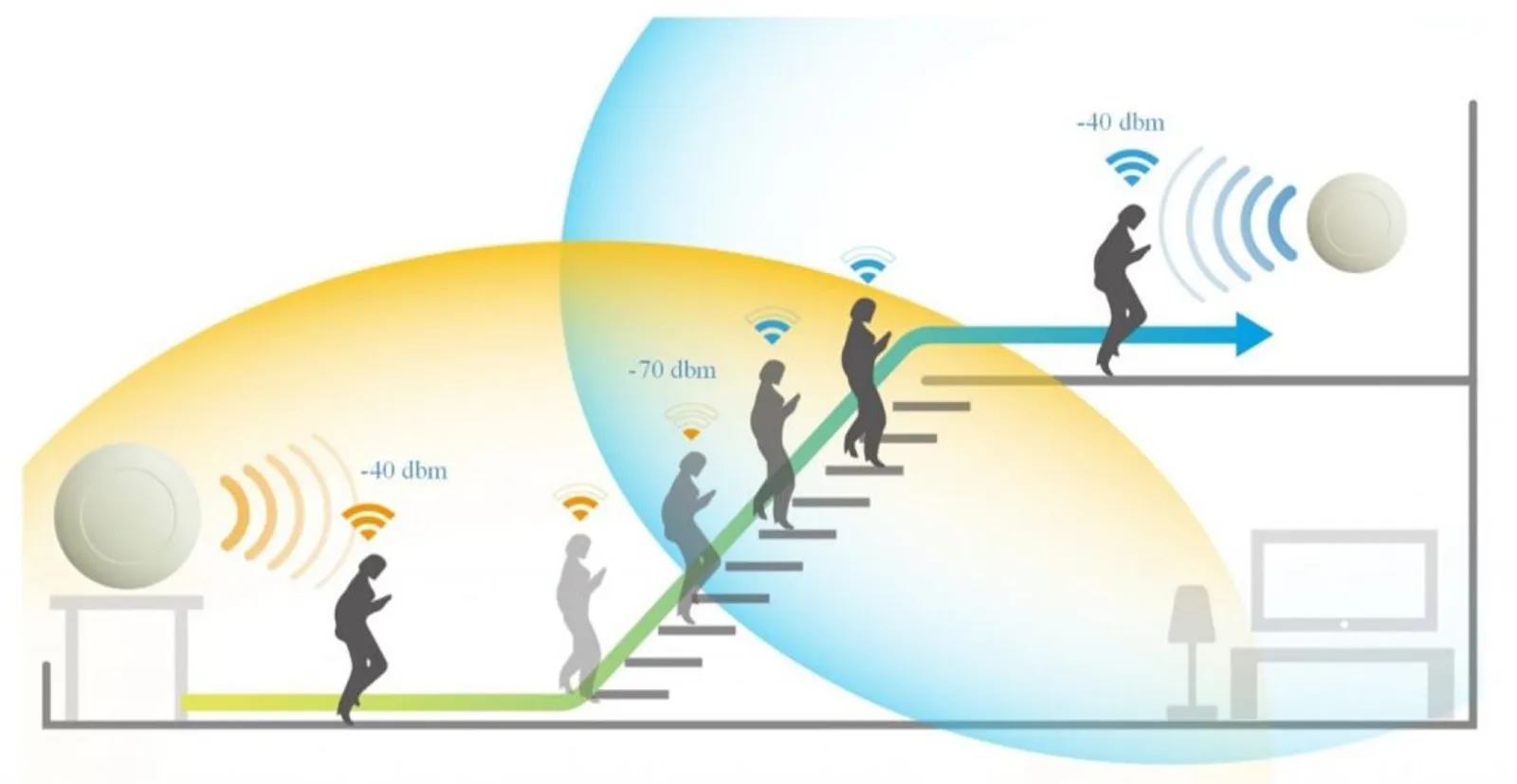
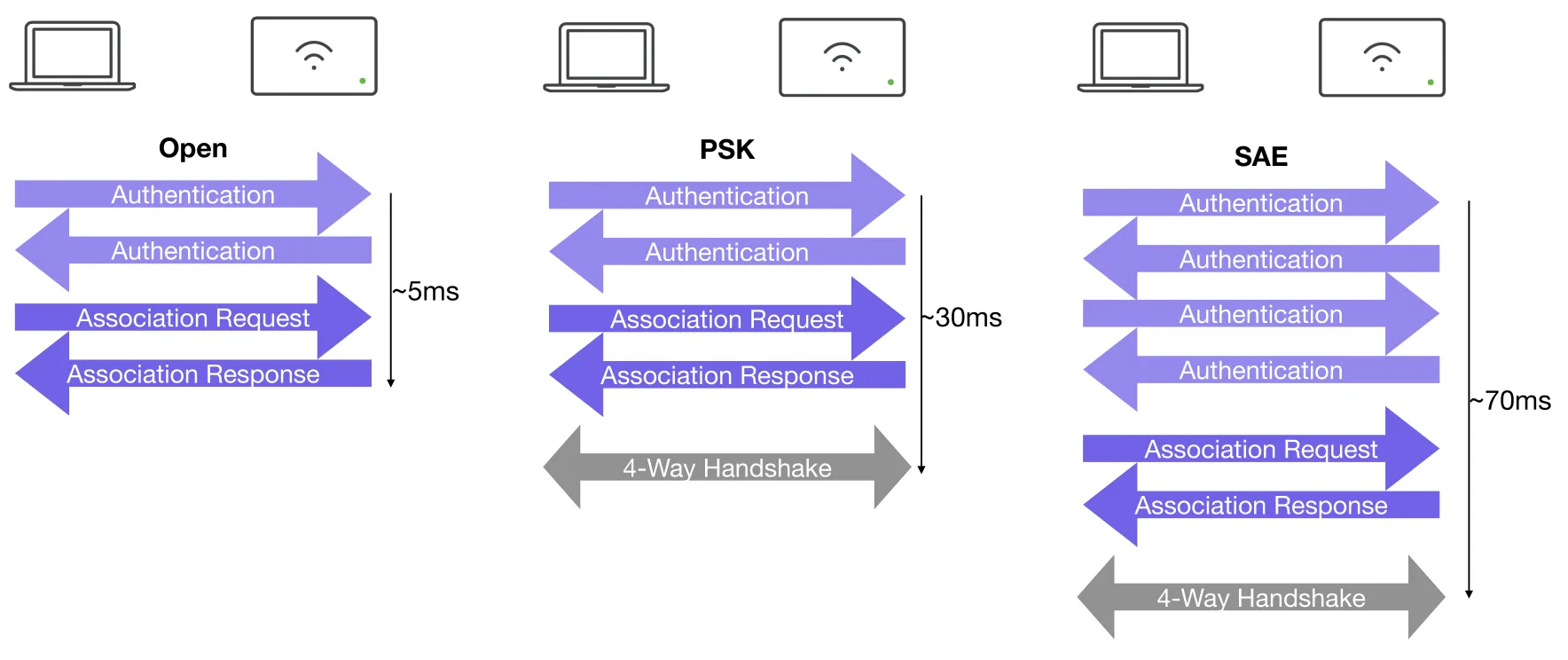
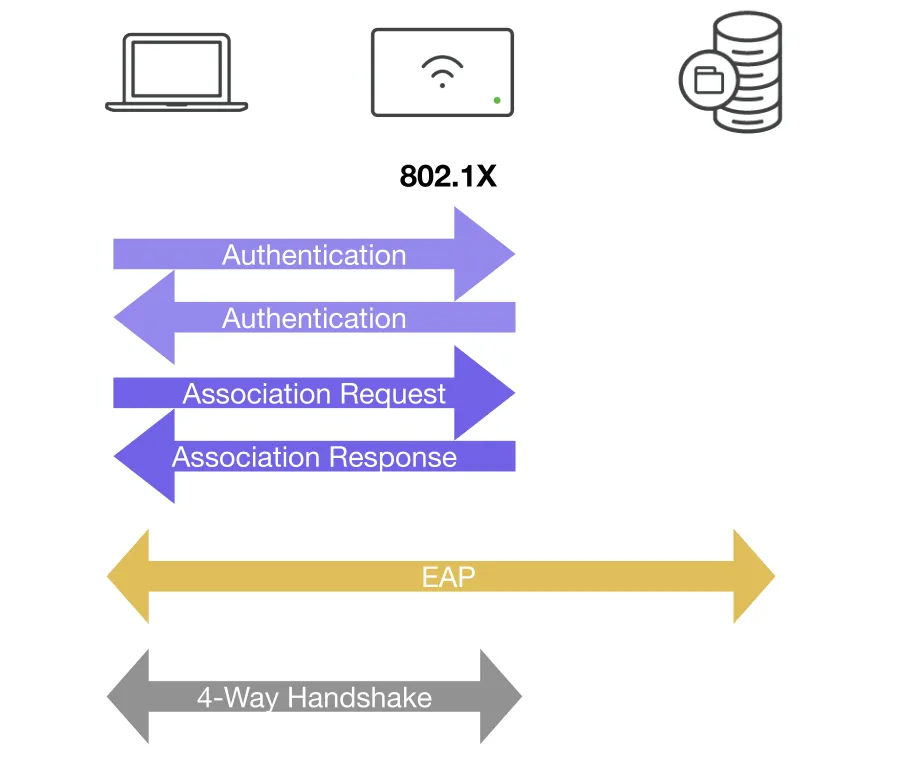
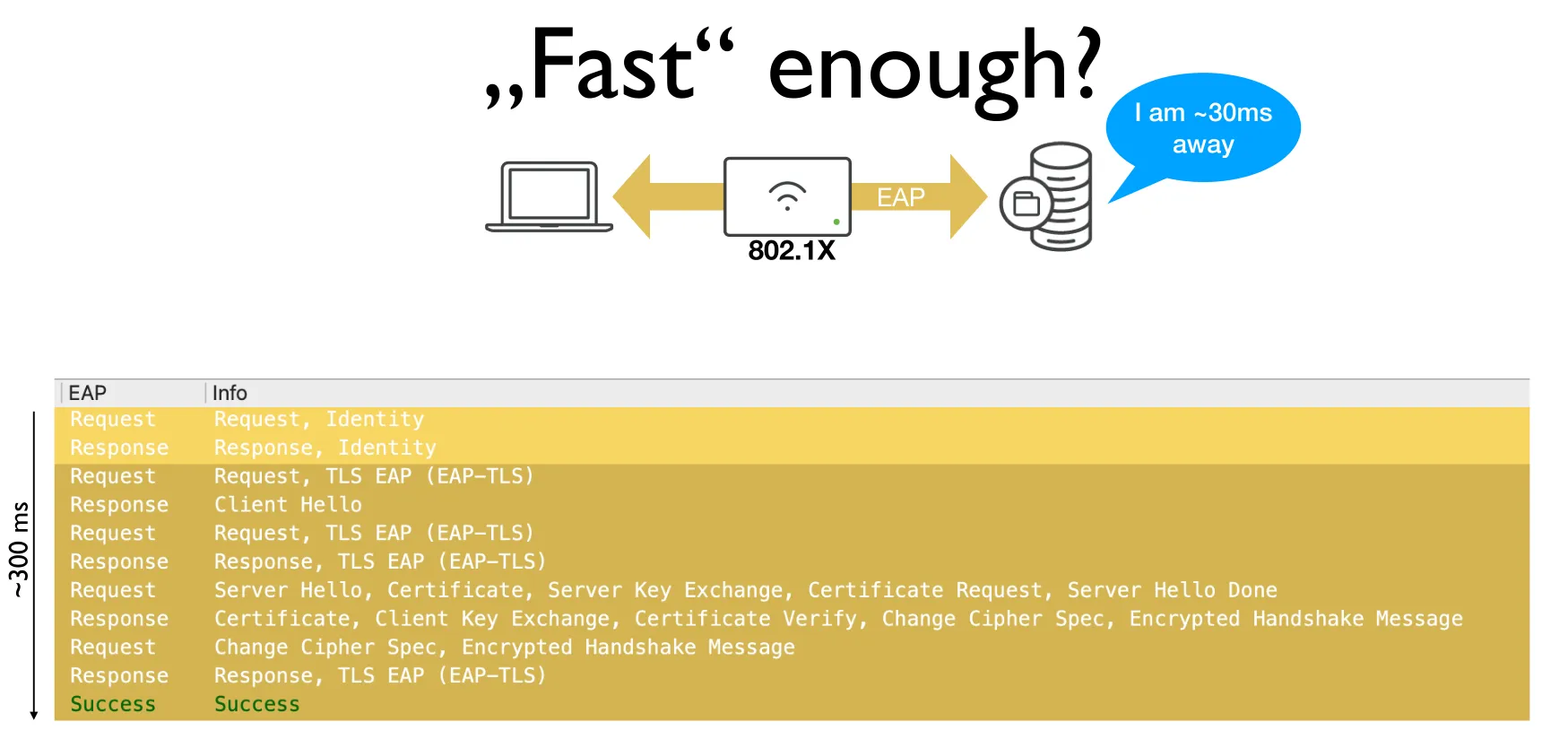
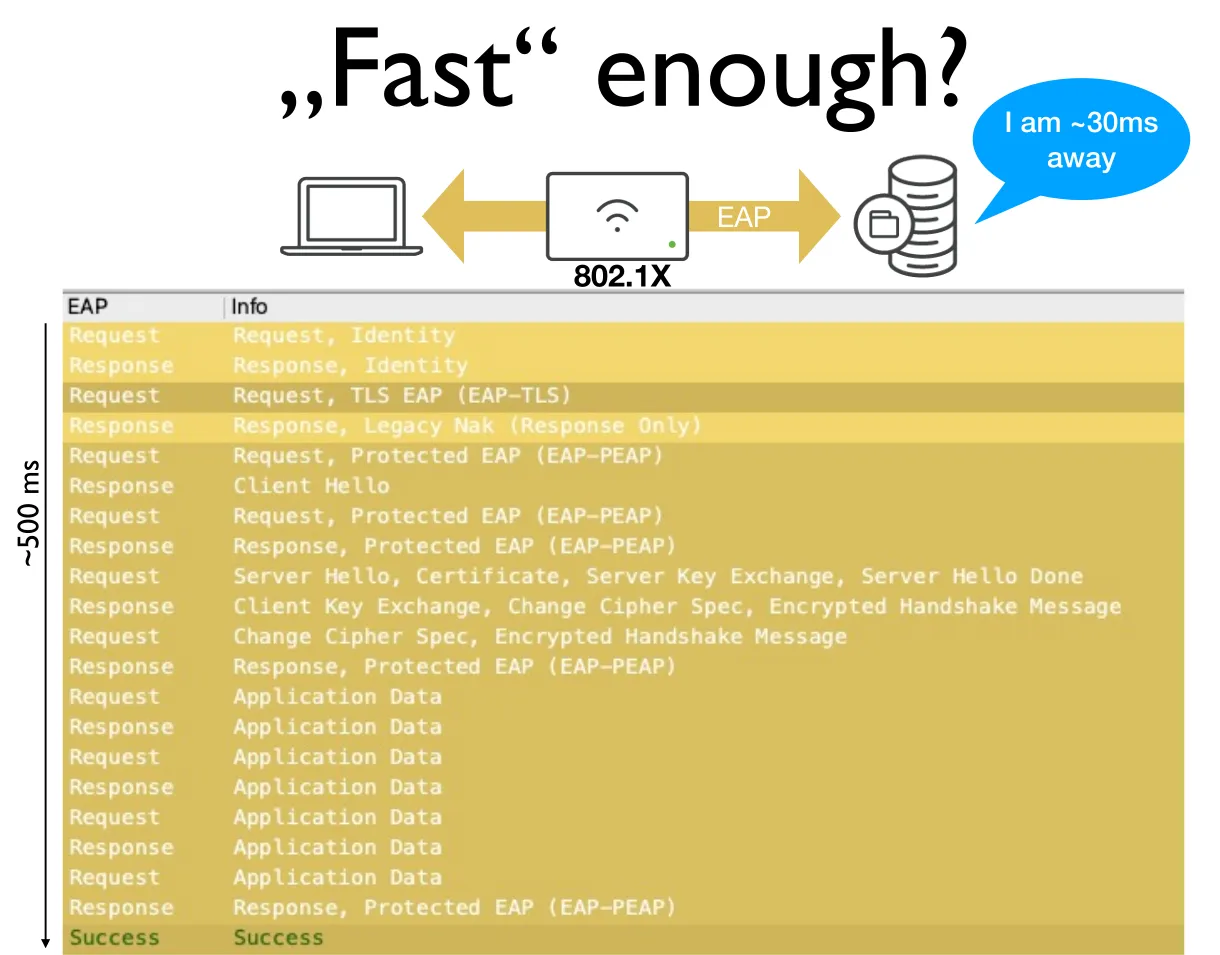
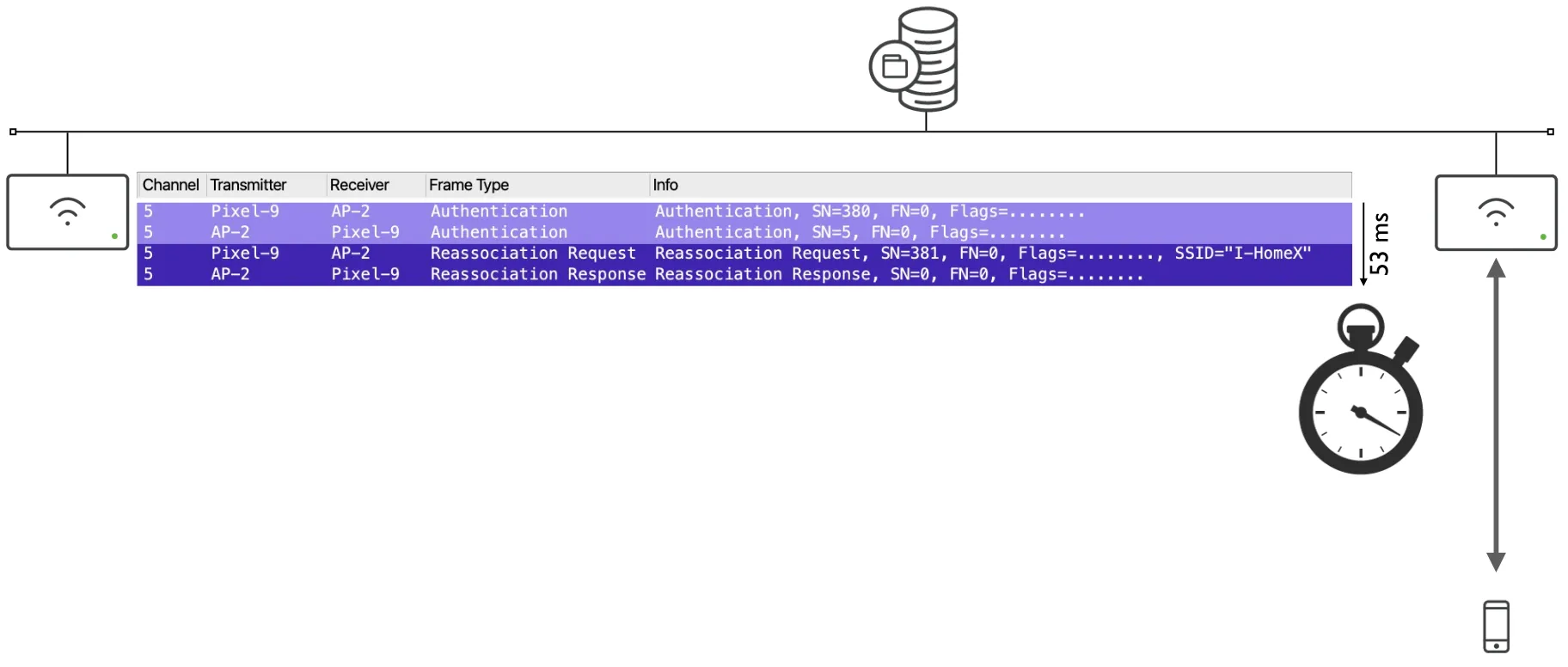
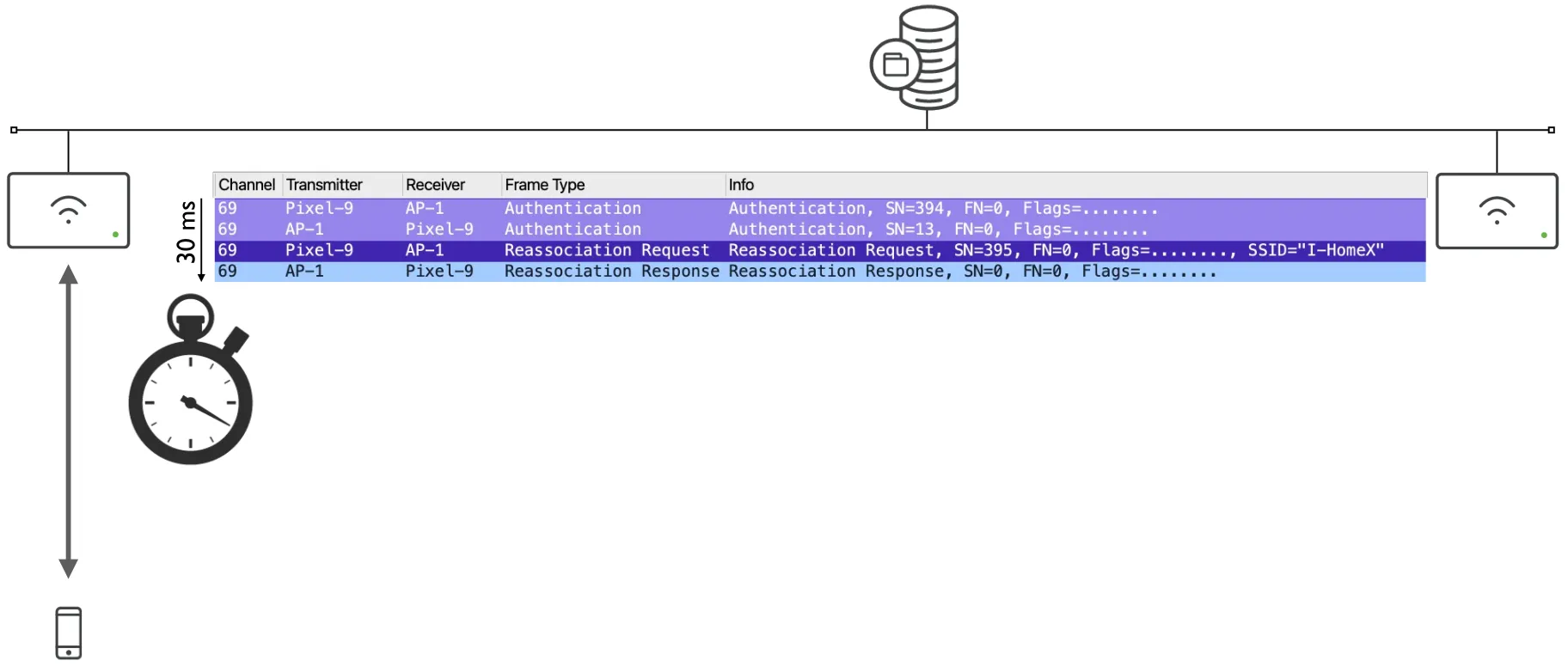
On a WLAN, when a STA moves between different APs, the service continuity and data transmission stability must be ensured. In traditional roaming technologies, when a STA roams from one AP to another, the STA needs to re-perform identity authentication and key negotiation. As a result, services are interrupted for a long time during roaming, degrading user experience. To solve this problem, the 802.11r standard is introduced. 802.11r, or Fast Basic Service Set Transition (FT), allows a STA to complete authentication and key negotiation with the target AP in advance. This process skips 802.1X authentication and key negotiation during roaming, reducing the number of information exchanges and achieving low latency and service data flow continuity during roaming.

802.1x Implementation
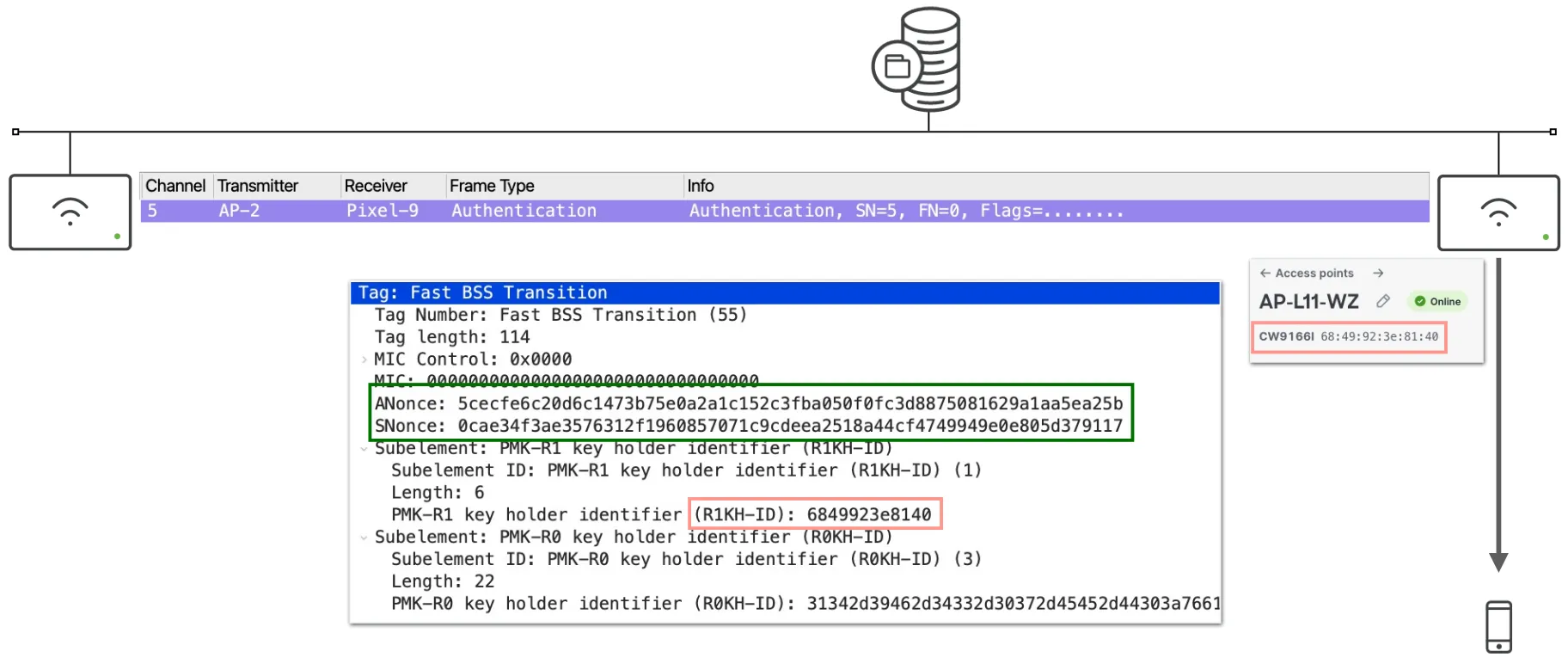
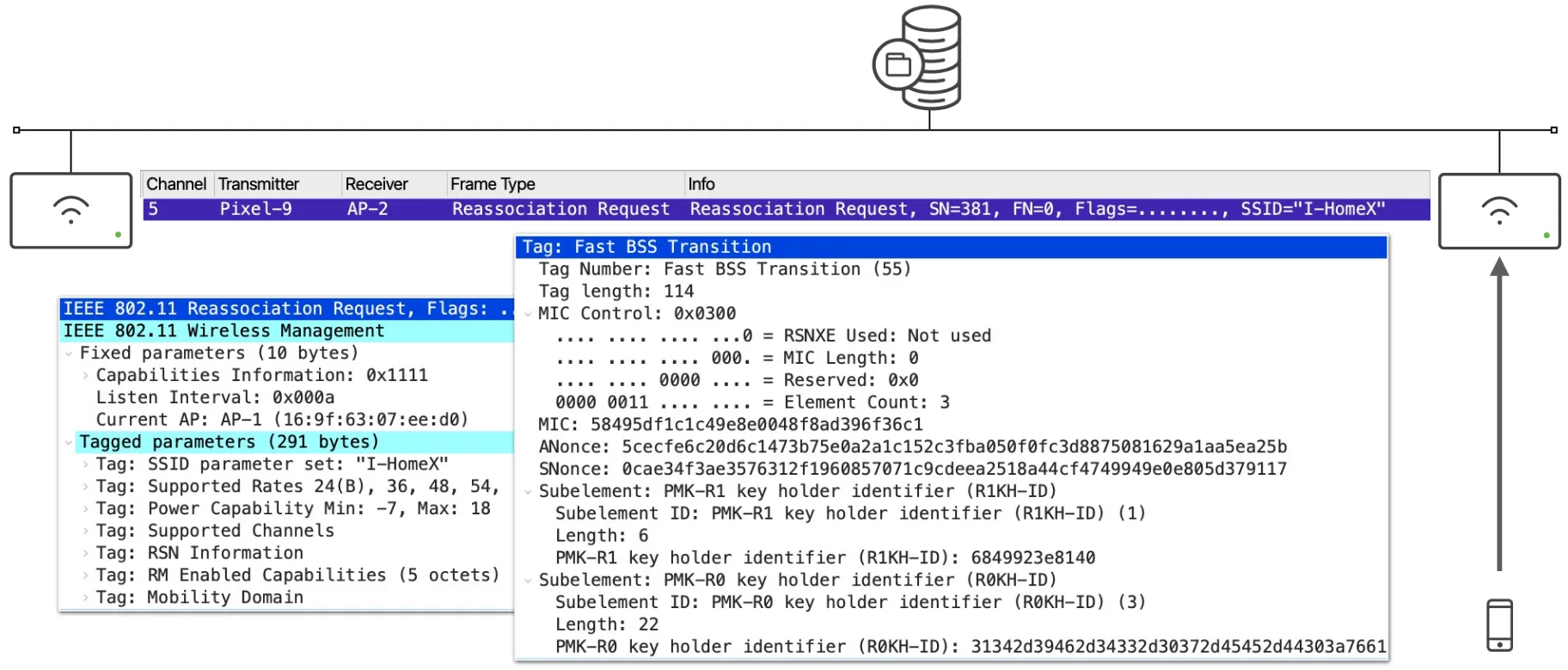
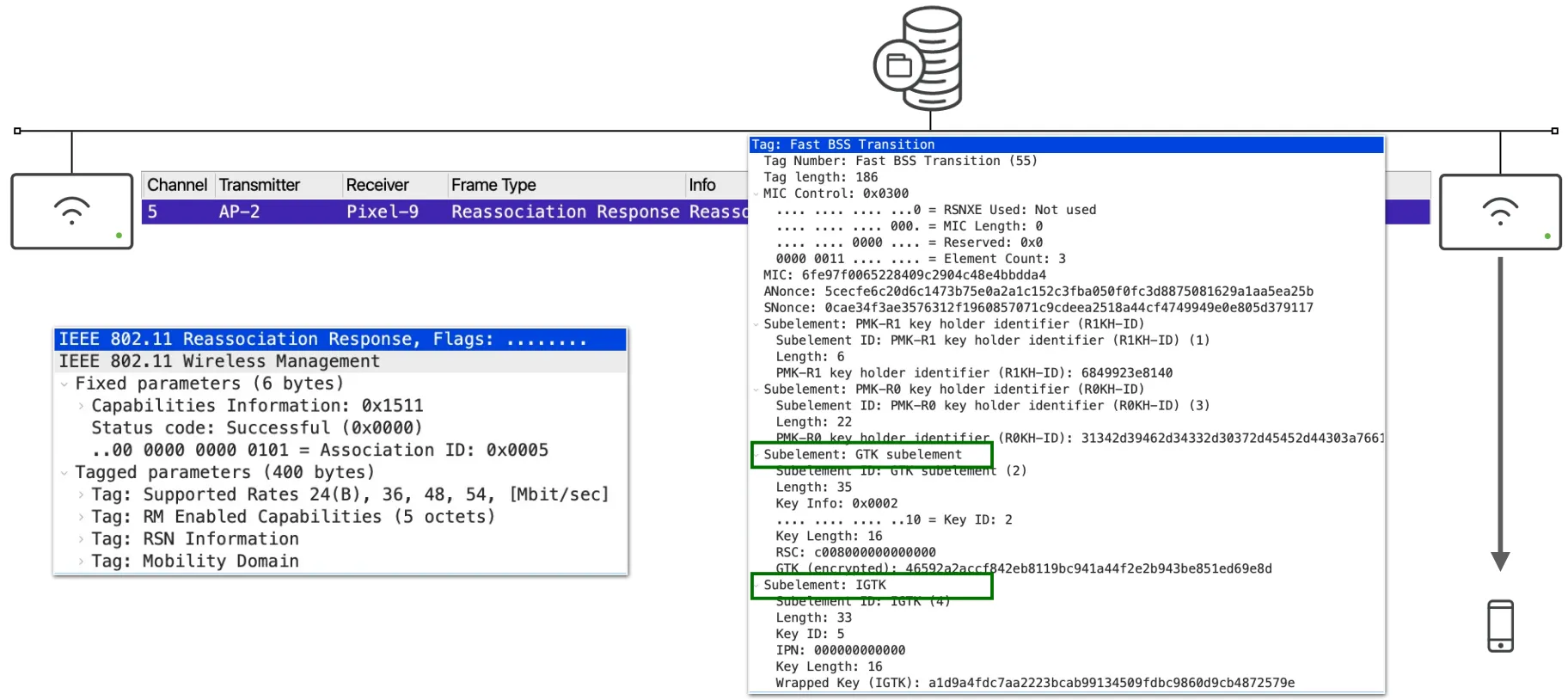
Fast BSS Transition
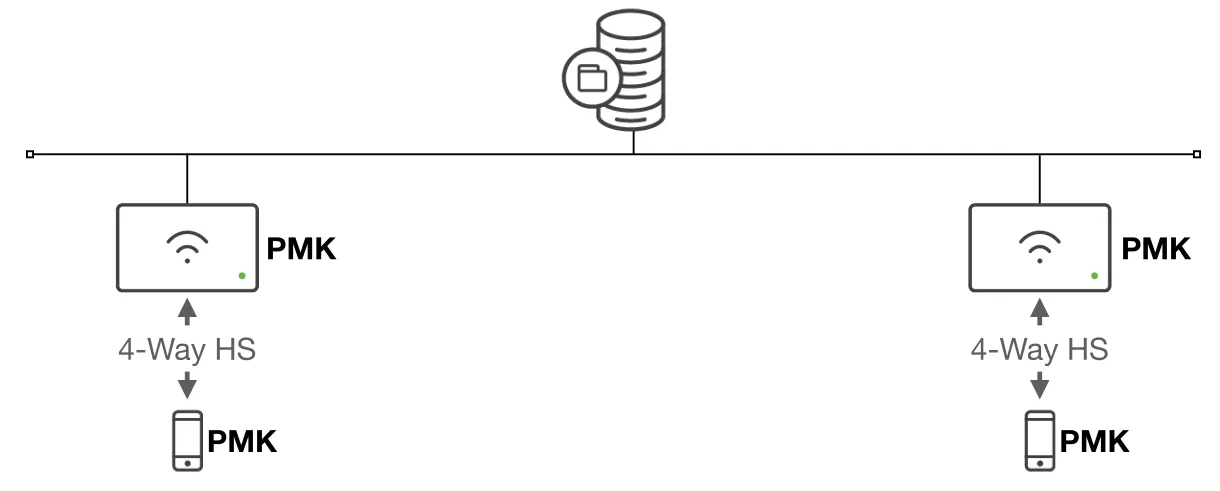
- Each STA-AP combination needs a 4-Way-Handshake generate the PTK from the PMK.
- Each STA-AP combination needs a PMK.
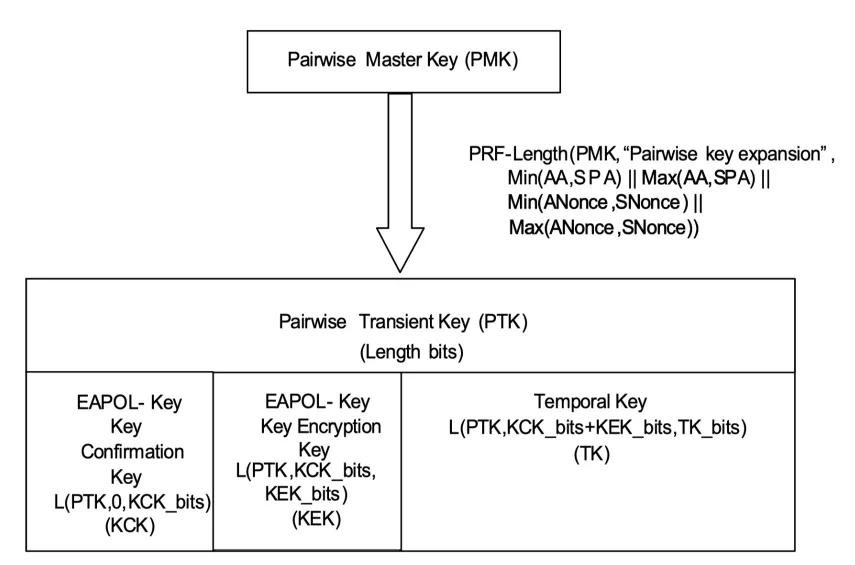
Key Hierarchy
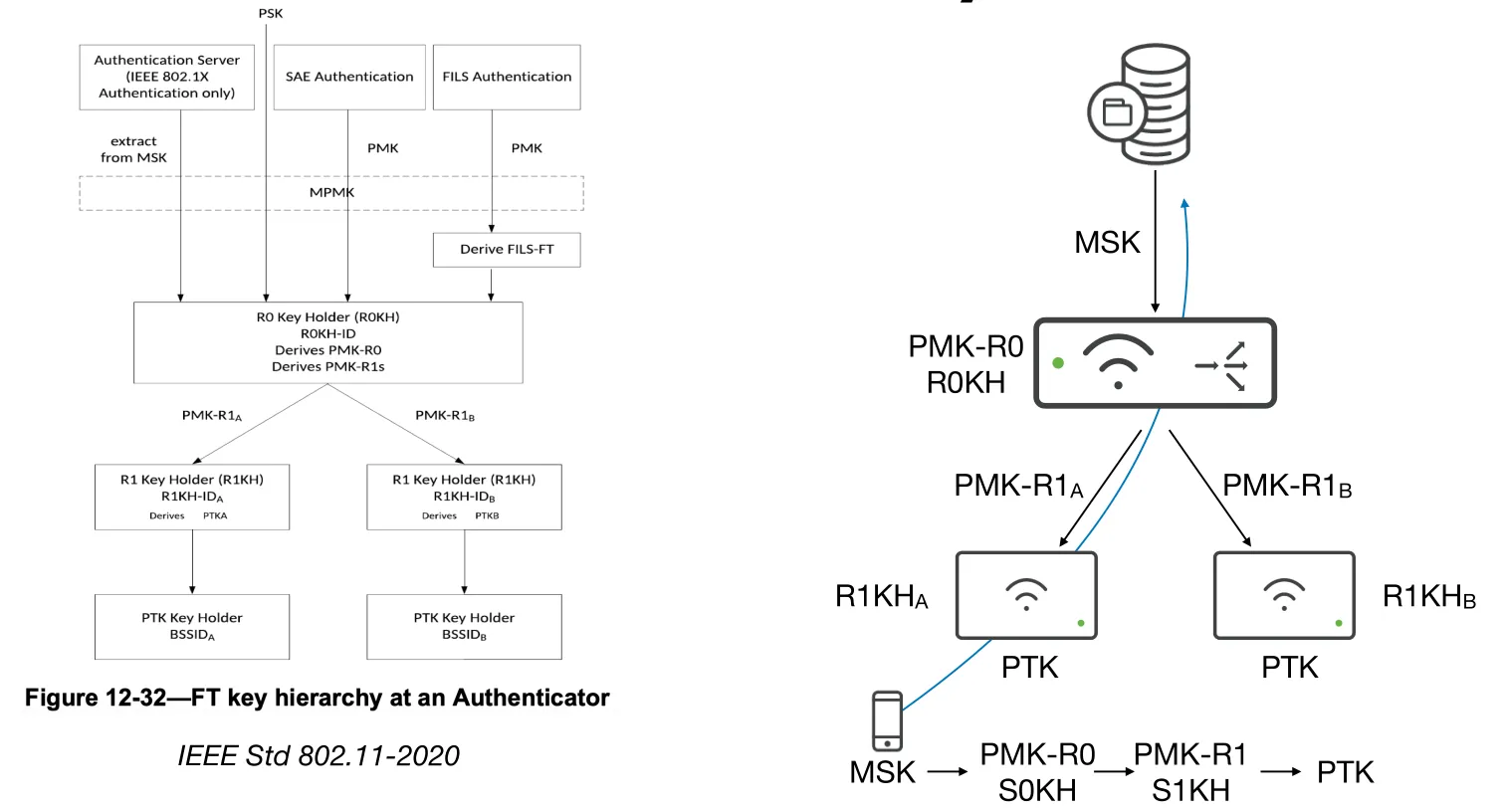
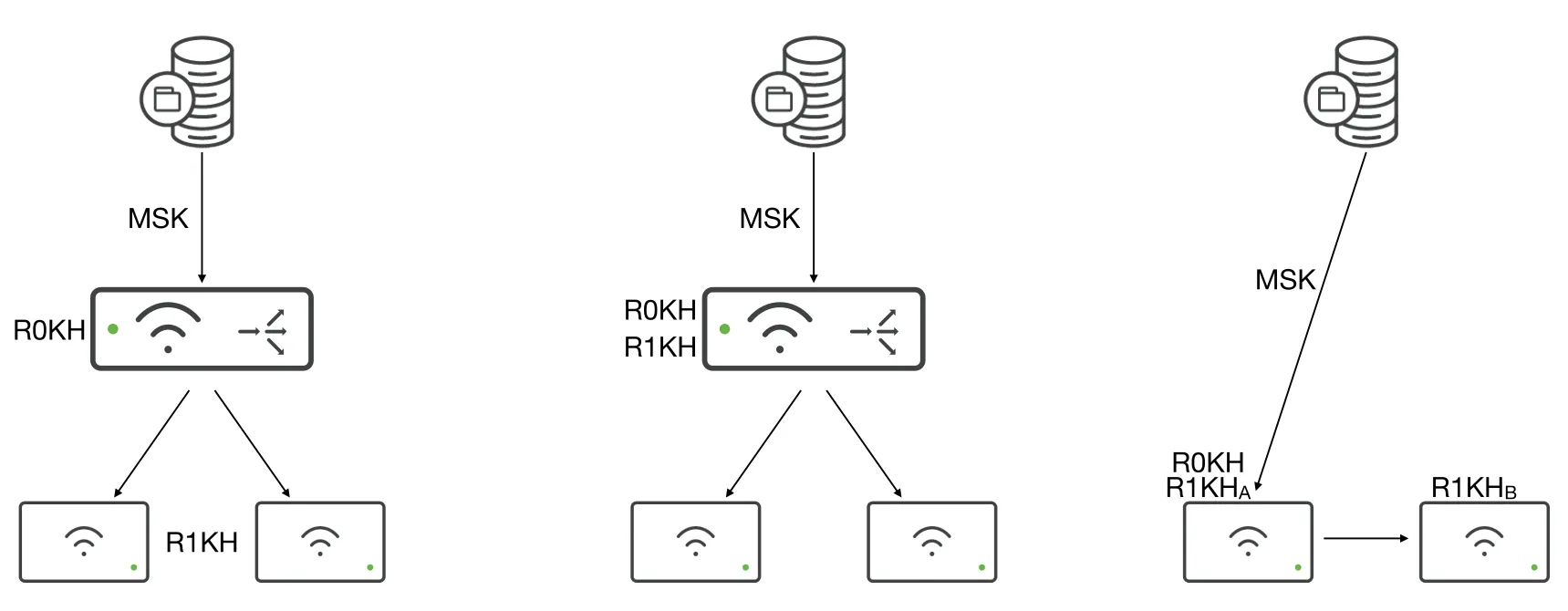
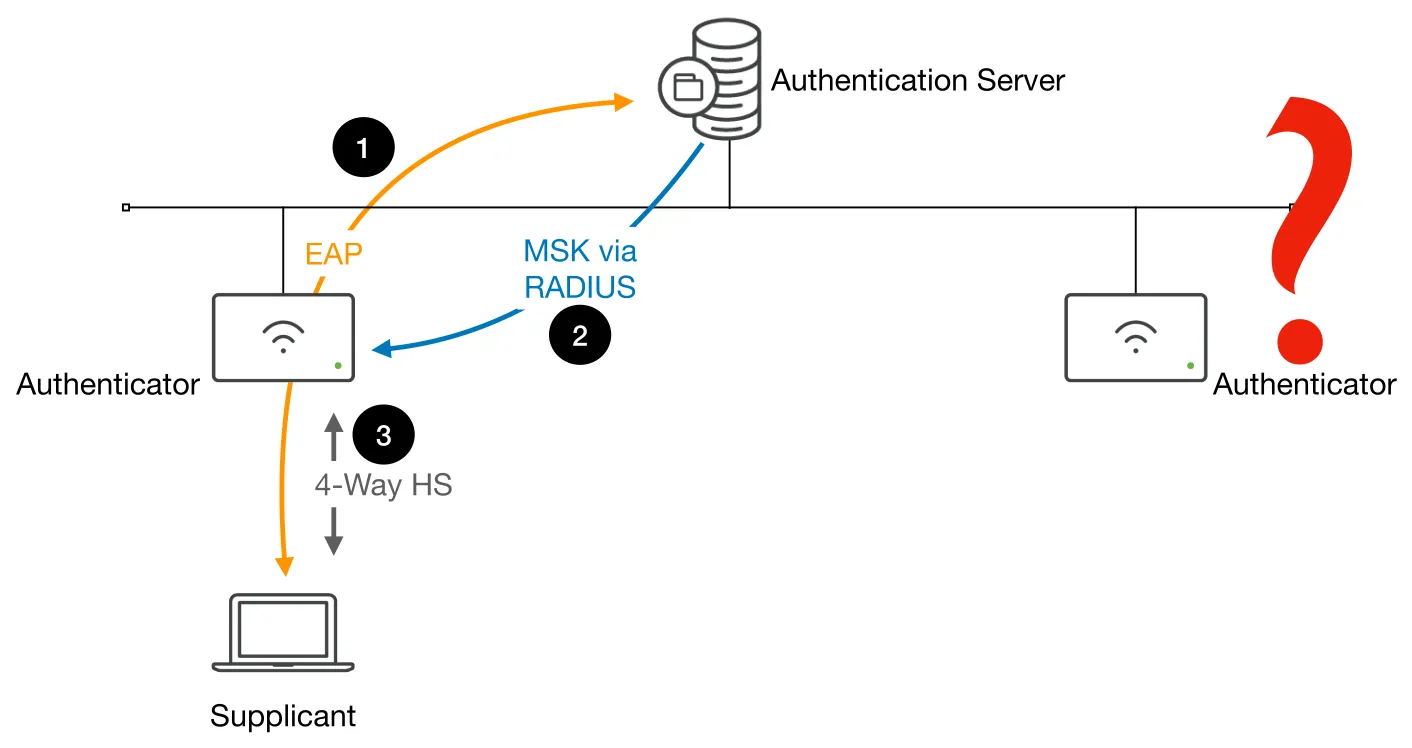
- The R0KH interacts with the IEEE 802.1X Authenticator to receive the MSK resulting from an EAP authentication.
- The R1KH interacts with the IEEE 802.1X Authenticator to open the Controlled Port.
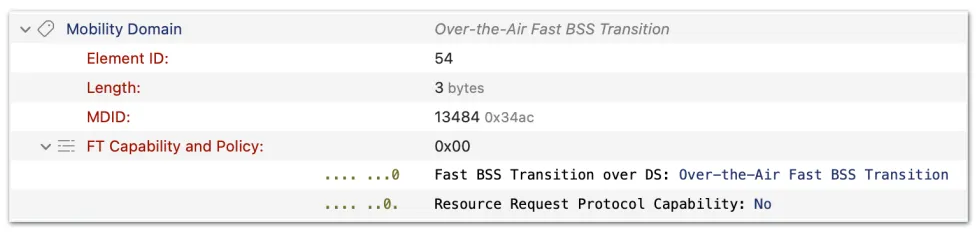
Is Fast BSS Transition available?
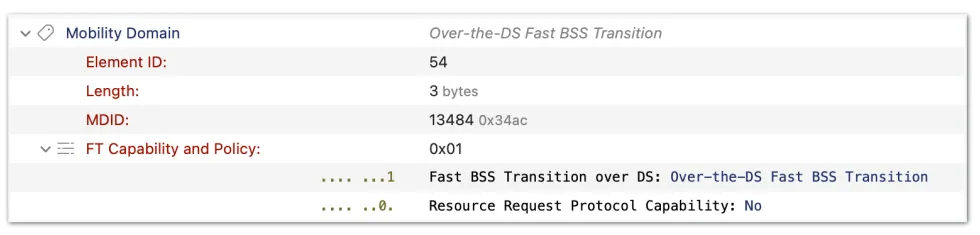
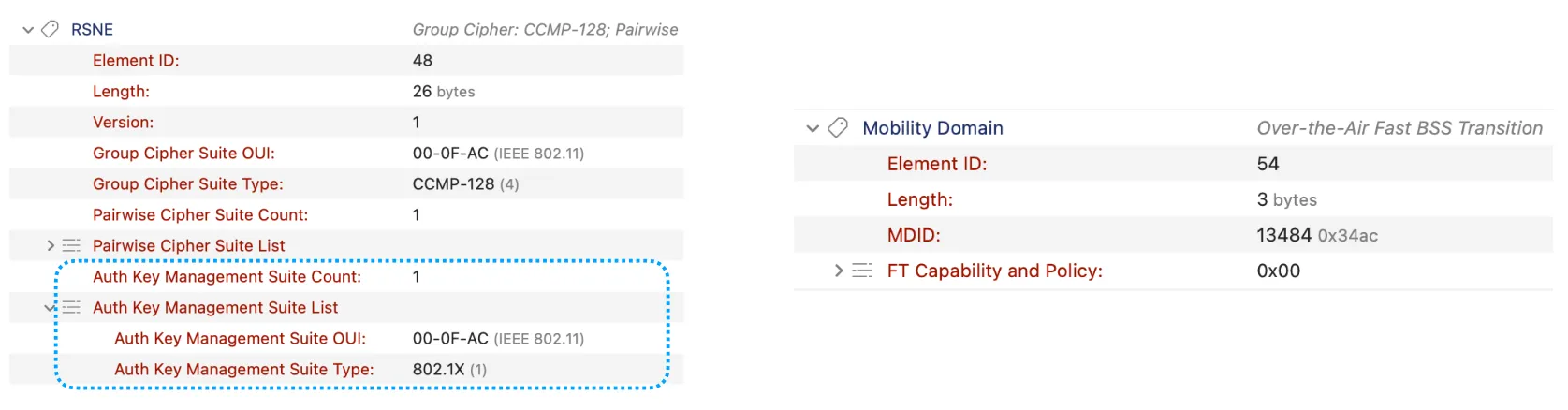
- mobility domain: A set of basic service sets (BSSs), within the same extended service set (ESS), that support fast BSS transitions between themselves and that are identi ed by the set’s mobility domain identi er (MDID).
- mobility domain identi er (MDID): An identi er that names a mobility domain.
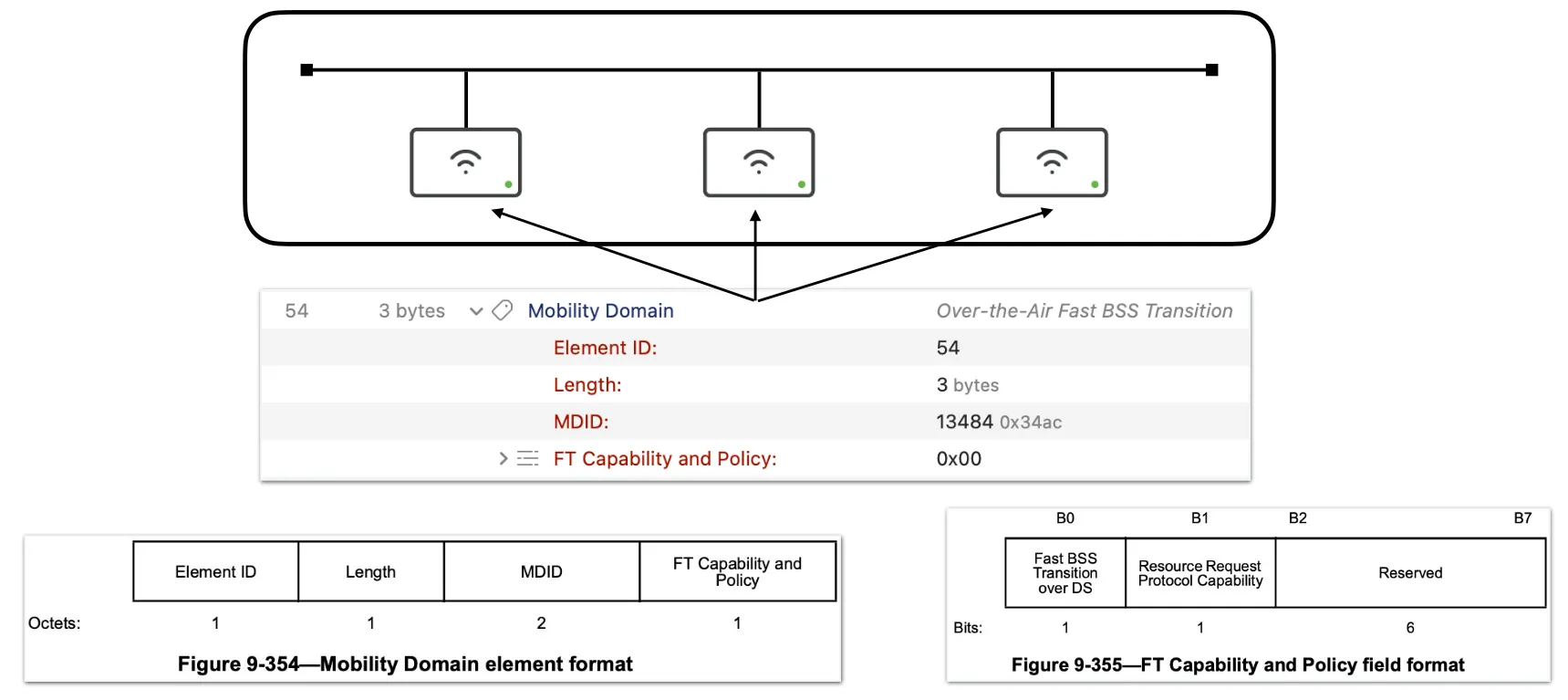
Over-the-Air
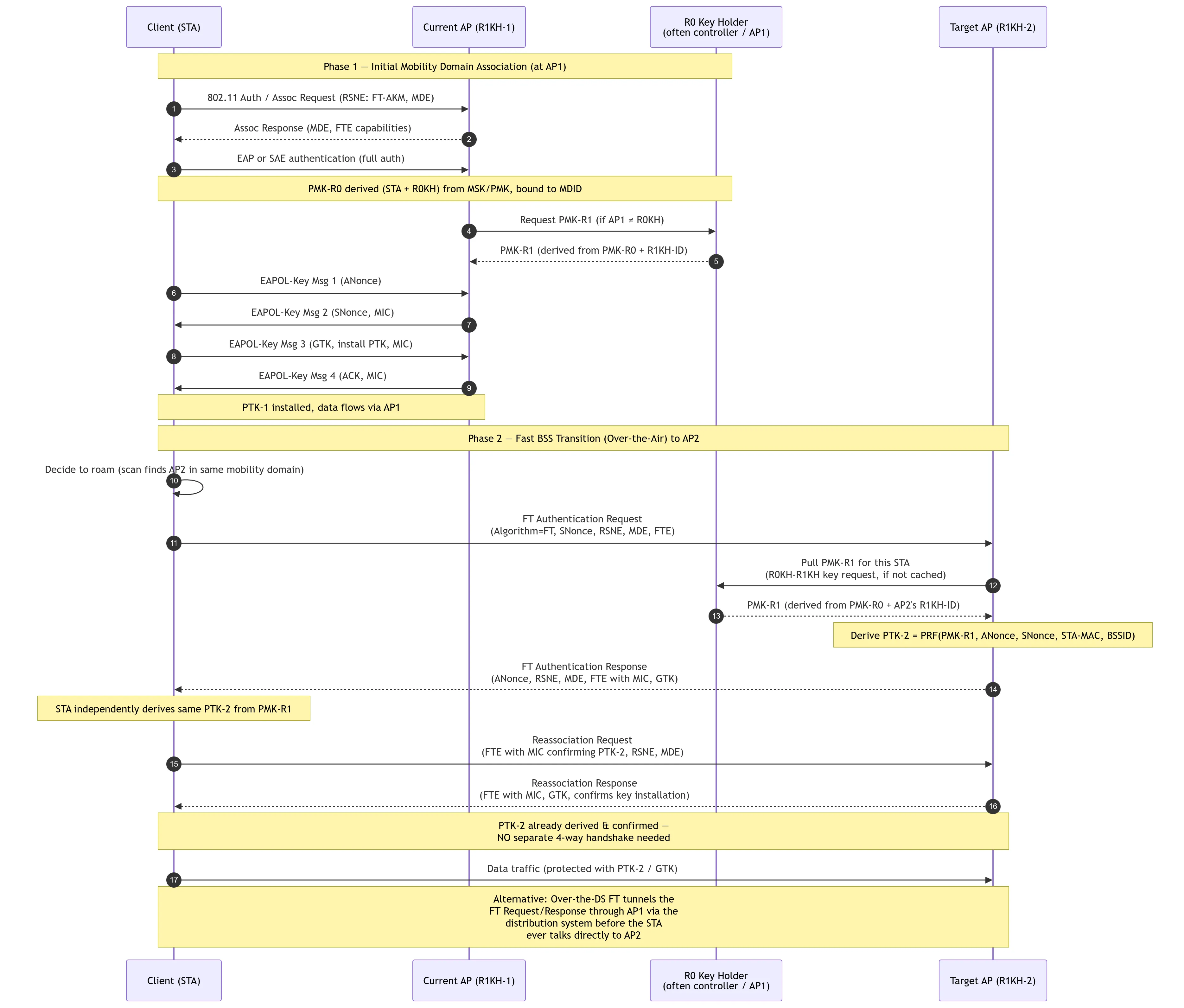
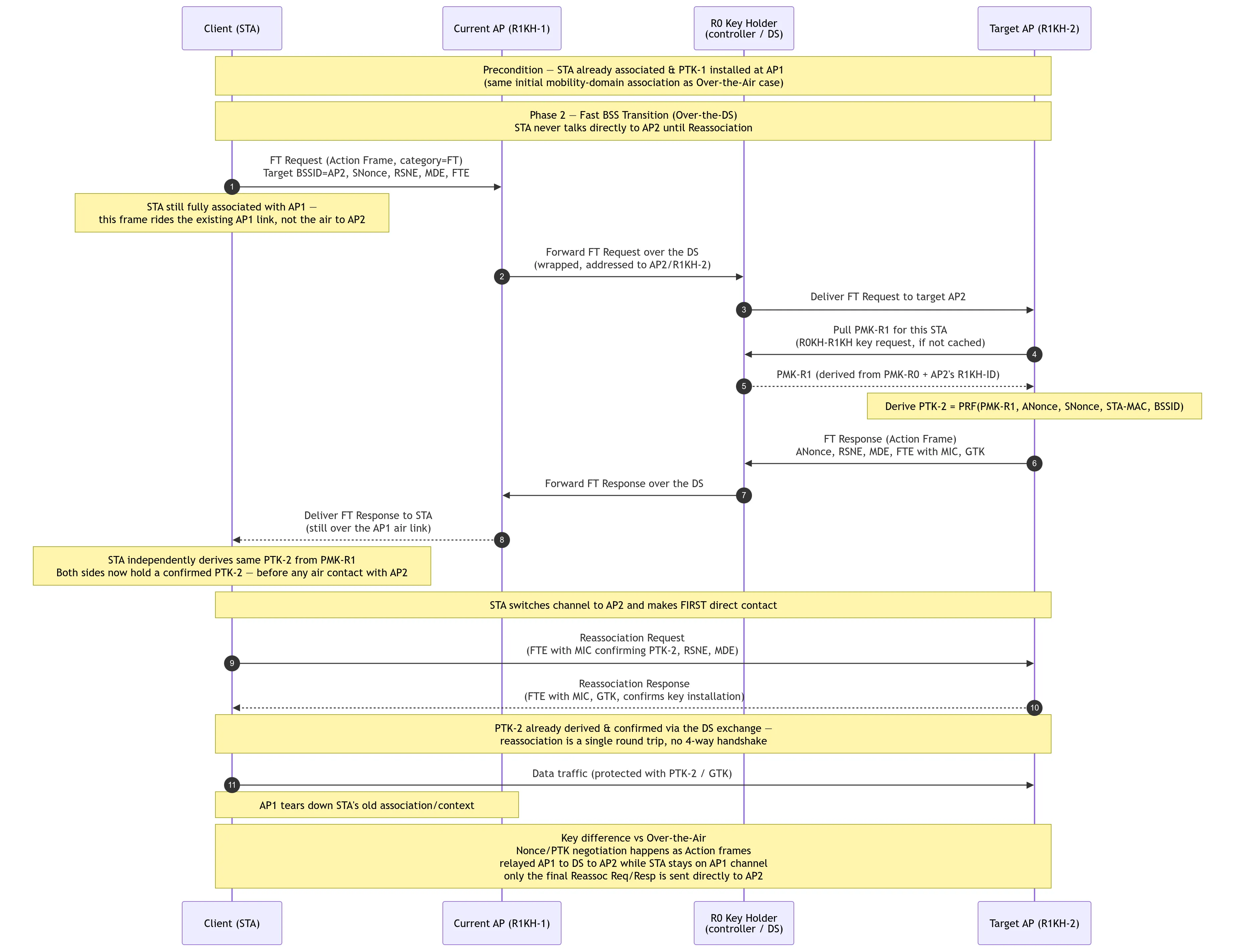
Over-the-DS
FT Protocols
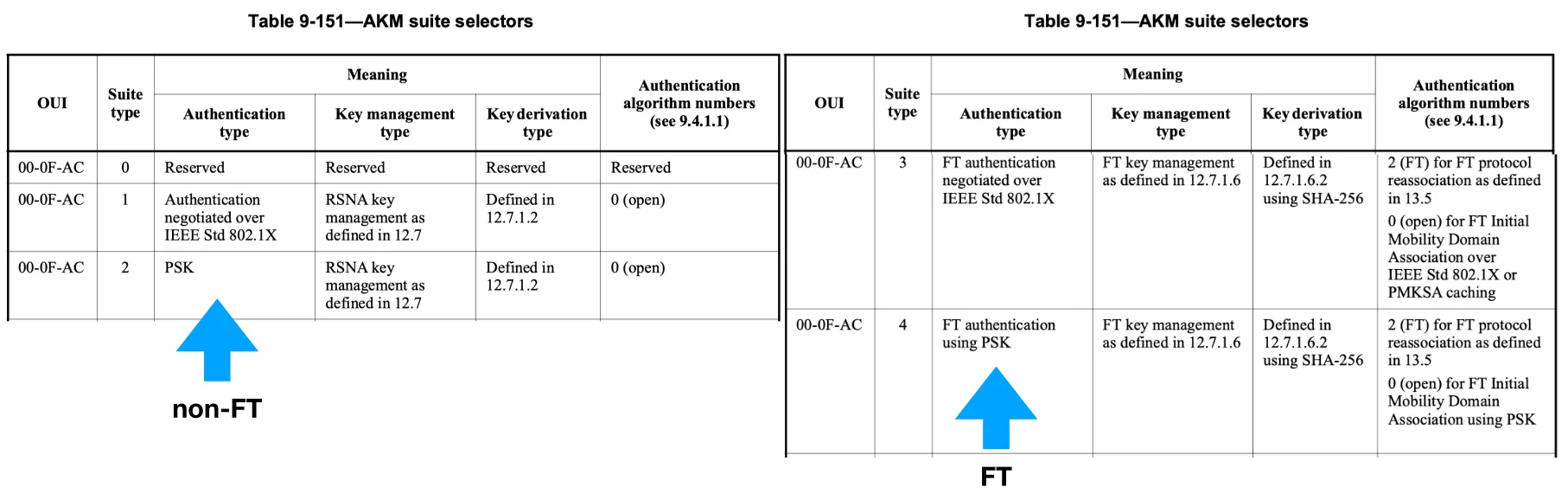
- FT protocol
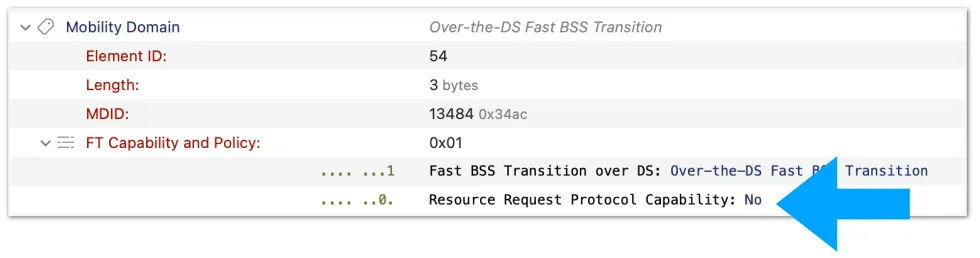
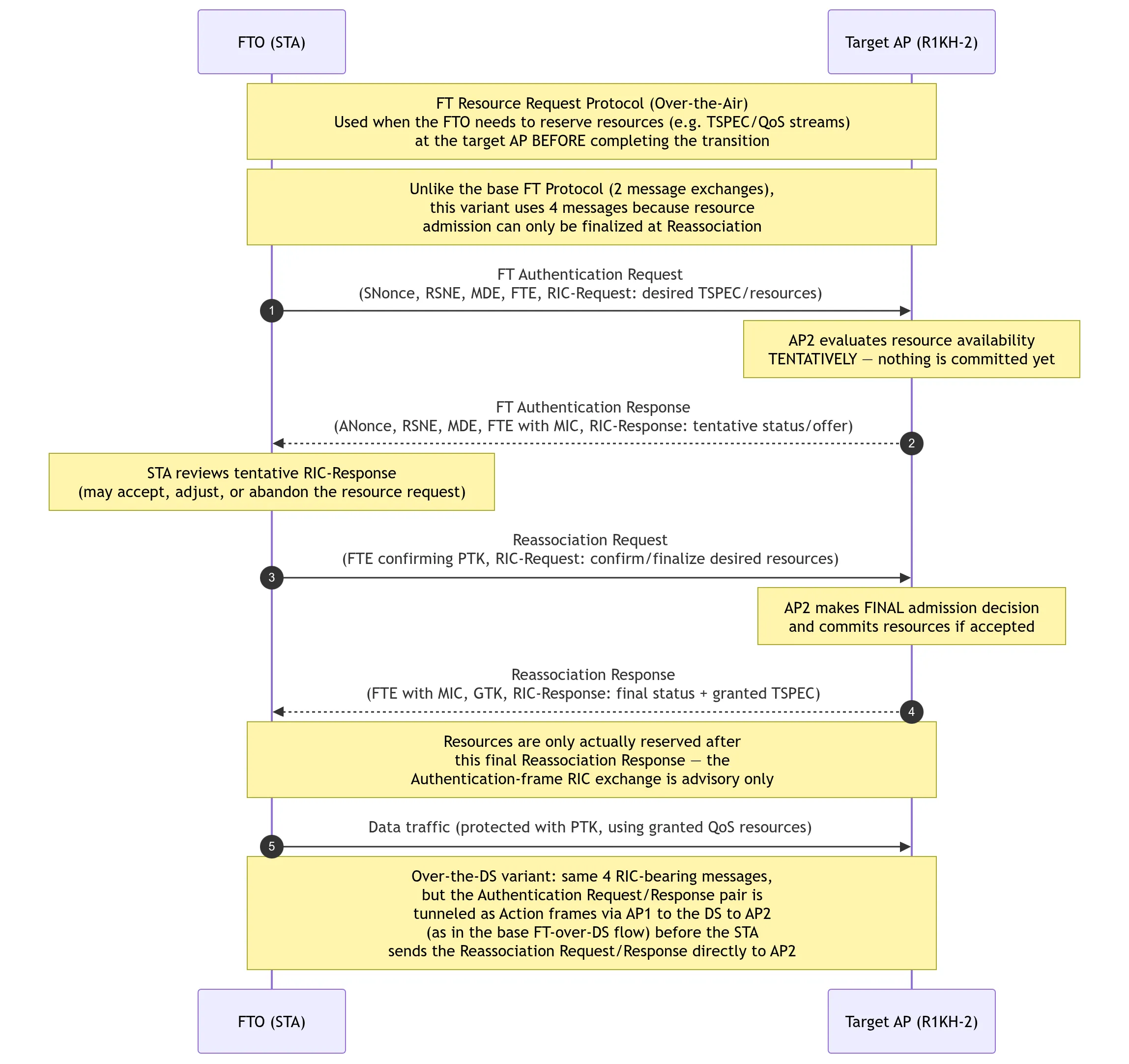
- FT resource request protocol
This protocol is executed when an FTO requires a resource request prior to its transition.
802.11r in Hostapd
Overview and Purpose
In IEEE 802.11r (Fast BSS Transition / FT), roaming between Access Points (APs) within a Mobility Domain (MD) is designed to occur with minimal latency (< 50 ms) to support real-time applications such as Voice over IP (VoIP) and video streaming without requiring full 802.1X/EAP re-authentication against a RADIUS server.
The RRB (Remote Request Broker) mechanism is the inter-AP backbone protocol that enables APs to communicate over the Distribution System (DS / wired backbone LAN) to:
- Relay FT Action frames between the Current AP and Target AP during FT-over-the-DS roaming.
- Distribute security keys (
PMK-R1) securely between Key Holders (R0KH R1KH) across the network backbone using cryptographic protection.
802.11r Key Hierarchy and Architectural Roles
To understand RRB, it is essential to understand the 802.11r key hierarchy:
                  [ Master Session Key (MSK) / PMK ]
                    (from 802.1X/EAP or FT-PSK)
                                |
                                v
                   [ First-Tier Key: PMK-R0 ]
                      Held by R0KH (R0 Key Holder)
                                |
             +------------------+------------------+
             |                                     |
             v                                     v
   [ Second-Tier: PMK-R1 ]               [ Second-Tier: PMK-R1 ]
   Held by AP1 (R1KH-1)                  Held by AP2 (R1KH-2)
             |                                     |
             v                                     v
    [ Pairwise Transient Key ]            [ Pairwise Transient Key ]
            (PTK)                                 (PTK)
Key Entities:
- R0KH (R0 Key Holder): The initial AP or central controller that holds the first-tier key
PMK-R0derived after the initial mobility domain association. - R1KH (R1 Key Holder): The AP serving a specific BSSID that holds
PMK-R1(derived fromPMK-R0specific to the Target AP’s identifier/BSSID) and derives the final encryption key (PTK) with the station. - S1KH (Supplicant 1 Key Holder): The roaming Station (STA / Client).
- Current AP vs. Target AP: The AP to which the STA is currently connected vs. the AP to which the STA intends to roam.
The Two Primary Functions of RRB
Function A: FT-over-the-DS Frame Encapsulation (Standard IEEE 802.11r)
IEEE 802.11r defines two modes for roaming:
- FT-over-the-Air: The client switches channels and sends standard 802.11 Authentication frames directly to the Target AP.
- FT-over-the-DS: The client stays on its current channel and sends 802.11 FT Action frames to the Current AP, which encapsulates them in RRB frames and forwards them across the Ethernet backbone to the Target AP.
Over-the-Air
kernel mac80211/cfg80211
   │  NL80211_CMD_FRAME netlink
   ▼
driver_nl80211_event.c:1428  mlme_event_mgmt
   │  builds union wpa_event_data { .rx_mgmt = { frame, frame_len, freq, … } }
   ▼
wpa_supplicant_event(drv->ctx, EVENT_RX_MGMT, &event)
   │
   ▼
drv_callbacks.c:2711  hostapd_mgmt_rx
   │  selects hapd by BSSID, runs through HAPD_BROADCAST fan-out
   ▼
ieee802_11.c:8156  ieee802_11_mgmt
   │  switch (stype) { AUTH → handle_auth; ACTION → handle_action; … }
   ▼
For FT Auth:        ieee802_11.c:4670  case WLAN_AUTH_FT:
                       wpa_ft_process_auth(sm, transaction, ies, …, handle_auth_ft_finish, hapd)
For FT Action:      ieee802_11.c:7985  case WLAN_ACTION_FT:
                       wpa_ft_action_rx(sta->wpa_sm, body, len)
   │
   ▼
wpa_auth_ft.c — wpa_ft_process_auth_req / wpa_ft_rx_action
   │  build FTIE / MDIE / RSNE response
   │  if R0KH-PMK-R1 needed: ft_send_pull_request (over the DS to R0KH)
   ▼
wpa_auth_ft.c:4815  wpa_ft_action_send   (or 4670 → handle_auth_ft_finish)
   │
   ▼
wpa_auth_glue.c:1231  hostapd_wpa_auth_send_ft_action
   │  builds ieee80211_mgmt header (DA/SA/BSSID + ACTION body)
   │  hostapd_drv_send_mlme(hapd, …, 0, NULL, 0, 0)
   ▼
ap_drv_ops.c:872  hostapd_drv_send_mlme
   ▼
driver_nl80211.c:4923  wpa_driver_nl80211_send_mlme
   ▼
driver_nl80211.c:9957  nl80211_send_frame_cmd
   │  builds NL80211_CMD_FRAME netlink (NL80211_ATTR_WIPHY_FREQ, NL80211_ATTR_FRAME, …)
   │  send_and_recv_resp (libnl nl_send_auto_complete + nl_recvmsgs)
   ▼
kernel cfg80211 / mac80211 → over the air
Over-the-DS Flow:
       [ Client (STA) ]
          |          ^
(1) FT Action      (4) FT Action
    Request            Response
          v          |
     [ Current AP ]  ====== (2) RRB Request (EtherType 0x890D) =====>  [ Target AP ]
<===== (3) RRB Response (EtherType 0x890D) =====- EtherType:
0x890D(ETH_P_RRB). - Frame Header (
struct ft_rrb_frame):frame_type:RSN_REMOTE_FRAME_TYPE_FT_RRB(0x01).packet_type:FT_PACKET_REQUEST(0) orFT_PACKET_RESPONSE(1).action_length: 16-bit length of the enclosed FT Action frame.ap_address: 6-byte MAC address of the transmitting AP.payload: 802.11 Action frame body (CategoryWLAN_ACTION_FT, Action code, Station MAC, Target AP MAC, status code, and IEs like MDIE, FTIE, RSNIE).
Function B: R0KH R1KH Key Management Protocol
When a station roams to a Target AP (operating as an R1KH), that Target AP needs the corresponding PMK-R1 to derive the PTK. The RRB mechanism provides a secure protocol for inter-AP key retrieval.
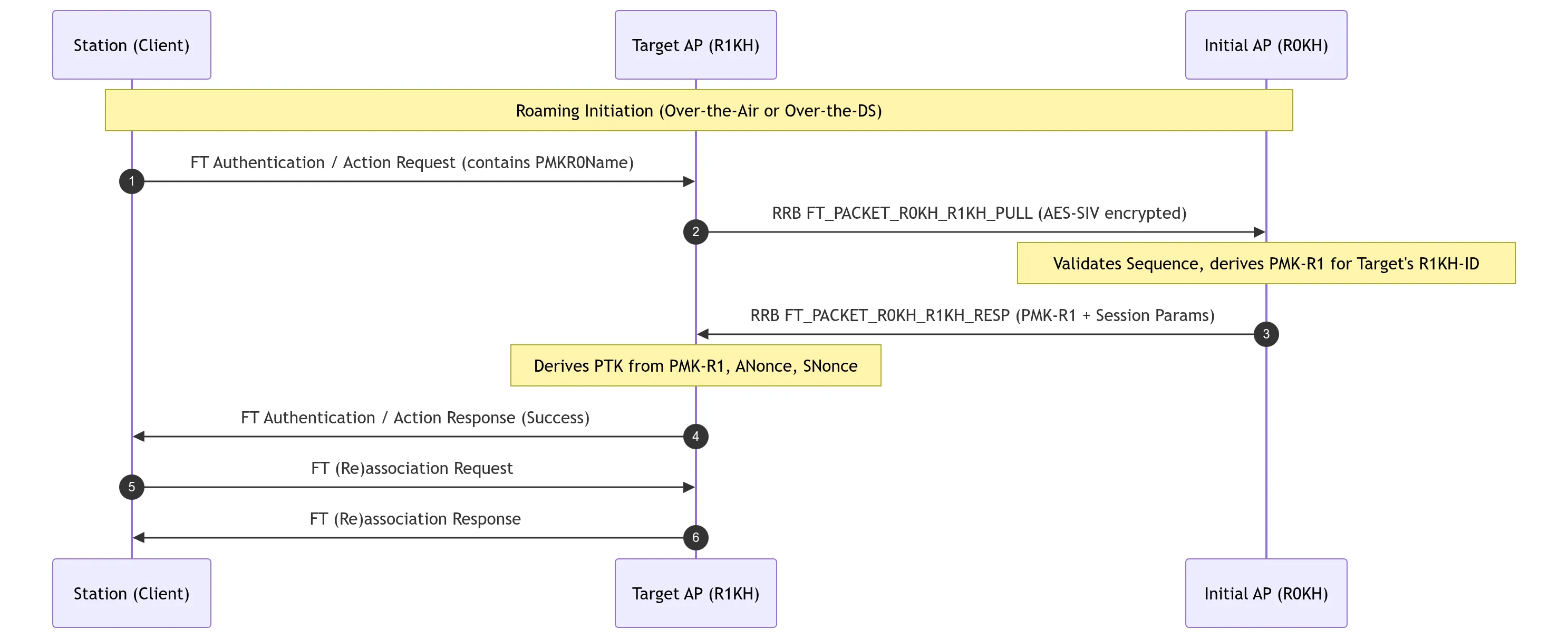
Key Distribution Packet Types:
| Subtype Code | Packet Subtype Constant | Description |
|---|---|---|
0x01 | FT_PACKET_R0KH_R1KH_PULL | Sent by Target AP () to requesting PMK-R1 for a roaming STA. |
0x02 | FT_PACKET_R0KH_R1KH_RESP | Sent by back to containing the derived PMK-R1 and session parameters. |
0x03 | FT_PACKET_R0KH_R1KH_PUSH | Proactive distribution: derives and sends PMK-R1 to all configured neighbor APs immediately upon initial STA association. |
0x04 | FT_PACKET_R0KH_R1KH_SEQ_REQ | Sequence request used to synchronize anti-replay sequence state. |
0x05 | FT_PACKET_R0KH_R1KH_SEQ_RESP | Response containing sequence parameters for anti-replay verification. |
RX / TX — over the DS (AP ↔ AP, RRB)
Two transports, both opened in wpa_auth_glue.c:1916–1937 when CONFIG_IEEE80211R_AP is set and wpa_key_mgmt_ft is configured:
| Transport | Socket | Where used |
|---|---|---|
l2_packet_init(ft_iface, …, ETH_P_RRB, hostapd_rrb_receive, …) — raw AF_PACKET on EtherType 0x890D | l2_packet_linux.c | Relaying FT Action frames between APs |
eth_p_oui_register(ft_iface, FT_PACKET_R0KH_R1KH_*, hostapd_rrb_oui_receive, …) — OUI Extended EtherType 88-B7 with vendor-specific subtype per FT packet type (PULL=1, RESP=2, PUSH=3, SEQ_REQ=4, SEQ_RESP=5) | eth_p_oui.c | R0KH ↔ R1KH key distribution |
RX path on the Target AP / R0KH
AF_PACKET socket (ETH_P_RRB  or  ETH_P_OUI 88-B7)
   │
   ▼
l2_packet_linux.c:148  l2_packet_receive  (via eloop)
   │
   ├── For ETH_P_RRB:    hostapd_rrb_receive        (wpa_auth_glue.c:1584)
   │                       wpa_ft_rrb_rx            (wpa_auth_ft.c)
   │                         REQUEST  → wpa_ft_rrb_rx_request
   │                                    → wpa_ft_process_auth_req
   │                                    → R0KH pull
   │                                    → wpa_ft_send_rrb_auth_resp
   │                         RESPONSE → wpa_ft_action_send → back to STA over the air
   │
   └── For OUI 88-B7:    hostapd_rrb_oui_receive    (wpa_auth_glue.c:1602)
                          wpa_ft_rrb_oui_rx         (wpa_auth_ft.c:4827)
                            switch (oui_suffix):
                              PULL     → wpa_ft_rrb_rx_pull  → wpa_ft_rrb_rx_r0 (R0KH) → build PMK-R1 → resp
                              RESP     → wpa_ft_rrb_rx_resp  → wpa_ft_rrb_rx_r1 (R1KH) → ft_finish_pull → 4-way handshake
                              PUSH     → wpa_ft_rrb_rx_push  → wpa_ft_rrb_rx_r1 (R1KH) → cache PMK-R1
                              SEQ_REQ  → wpa_ft_rrb_rx_seq_req  → anti-replay sync
                              SEQ_RESP → wpa_ft_rrb_rx_seq_resp
TX path on the Current AP / R0KH / R1KH
For RRB (action relay):   wpa_ft_rrb_send (wpa_auth_ft.c:631)
                            builds RRB frame header:
                              frame_type     = RSN_REMOTE_FRAME_TYPE_FT_RRB
                              packet_type    = FT_PACKET_REQUEST / FT_PACKET_RESPONSE
                              action_length  = host_to_le16(len)
                              ap_address     = <AP MAC>
                              payload        = <FT Action body>
                          → hostapd_wpa_auth_send_rrb  (callback in wpa_auth_glue.c)
                          → for_each_interface() local-delivery check
                          → l2_packet_send  (l2_packet_linux.c:115)
                              sendto() on AF_PACKET with proto=ETH_P_RRB

For OUI 88-B7:            wpa_ft_rrb_oui_send (wpa_auth_ft.c:642)
                          → hostapd_wpa_auth_send_oui  (wpa_auth_glue.c:1092)
                          → eth_p_oui_send  (eth_p_oui.c)
                              AF_PACKET sendto() with global_oui 00:13:74 00:01 prefix
For OUI 88-B7 frames, encryption is AES-SIV (wpa_ft_rrb_build at wpa_auth_ft.c:523 → wpa_ft_rrb_encrypt / wpa_ft_rrb_decrypt at wpa_auth_ft.c:58/478) with the per-R0KH/R1KH shared key. Authenticated TLVs (SEQ, NONCE, R0KH-ID, R1KH-ID) are AAD; encrypted TLVs (S1KH-ID, PMK-R0 name, PMK-R1, pairwise, expires-in, VLAN, identity, RADIUS CUI, session-timeout) are the ciphertext.
State / database
| State | Lives in |
|---|---|
struct wpa_state_machine (per-STA; FT-specific fields: ft_pending_*, wpa_ft_seq, ft_current_ap_addr, RRB nonce, RRB seq, R0/R1 key holders, ft_pending_req_ies) | wpa_auth_ft.c, allocated by wpa_ft_add_sta (called from wpa_auth->cb->add_sta → hostapd_wpa_auth_add_sta in wpa_auth_glue.c:1261) |
struct wpa_authenticator::conf (FT settings: ft_over_ds, rkh_pull_retries, rkh_pull_timeout, r0_key_lifetime, r1_key_holder, r0_key_holder, r0kh_list, r1kh_list) | Set in hostapd_wpa_auth_conf (wpa_auth_glue.c) from hostapd_bss_config |
struct sta_info::wpa_sm pointer | sta_info.c |
Upstream vs vendor — verdict
For the FT over DS path specifically:
| File | Status |
|---|---|
src/ap/wpa_auth_ft.c | Pure upstream (Jouni 2004–2018) — zero QCA / QCOM / vendor markers |
src/ap/wpa_auth.c, wpa_auth_glue.c, wpa_auth_ie.c, eth_p_oui.c | Pure upstream |
src/ap/ieee802_11.c, drv_callbacks.c | Merged upstream with Qualcomm MLO/EHT contributions; not a vendor patch in this tree |
src/drivers/driver_nl80211.c | Contains vendor QCA patches under #ifdef CONFIG_DRIVER_NL80211_QCA (vendor commands to QCA firmware: 22 ifdefs) — but none touch the FT path |
src/l2_packet/l2_packet_linux.c | Pure upstream |
RRB Packet Format and Cryptographic Protection
RRB key distribution frames are encapsulated in IEEE 802 Extended OUI EtherType frames and secured using AES-SIV (Synthetic Initialization Vector, RFC 5297) for Authenticated Encryption with Associated Data (AEAD).
+-------------------------------------------------------------------------+
| IEEE 802 Extended OUI EtherType Frame Header                            |
+-------------------------------------------------------------------------+
| Auth Length (16-bit little endian)                                      |
+-------------------------------------------------------------------------+
| Authenticated TLVs (Plaintext, protected by AES-SIV AAD):               |
|   - FT_RRB_SEQ (Domain ID, Sequence Number, Timestamp)                  |
|   - FT_RRB_NONCE (16-byte random challenge nonce)                       |
|   - FT_RRB_R0KH_ID (NAS Identifier / FQDN of R0KH)                      |
|   - FT_RRB_R1KH_ID (6-byte BSSID / Identifier of R1KH)                  |
+-------------------------------------------------------------------------+
| Encrypted TLVs (AES-SIV Ciphertext + SIV tag):                          |
|   - FT_RRB_S1KH_ID (Client STA MAC address)                             |
|   - FT_RRB_PMK_R0_NAME (16-byte PMK-R0 Name)                            |
|   - FT_RRB_PMK_R1 (256/384-bit PMK-R1 Key)                              |
|   - FT_RRB_PAIRWISE (Pairwise Cipher Suite)                             |
|   - FT_RRB_EXPIRES_IN (Key lifetime in seconds)                         |
|   - FT_RRB_VLAN_UNTAGGED / FT_RRB_VLAN_TAGGED (VLAN Configuration)     |
|   - FT_RRB_IDENTITY (User identity from 802.1X)                         |
|   - FT_RRB_RADIUS_CUI (Chargeable-User-Identity)                        |
|   - FT_RRB_SESSION_TIMEOUT (Session timeout)                            |
+-------------------------------------------------------------------------+
Security Details
- AES-SIV AEAD: Associated Authenticated Data (AAD) binds the Source MAC address, authenticated TLVs, and message subtype to prevent tampering, injection, and address spoofing.
- Anti-Replay Mechanism: Each AP pair tracks monotonically increasing sequence numbers (
ft_rrb_seq) and timestamps to prevent replay attacks. - Pairwise Inter-AP Secret Keys: APs share 256-bit symmetric encryption keys configured in their respective R0KH/R1KH lists.
Where the action lives
File (relative to hostapd-2.12/) | Role |
|---|---|
src/ap/wpa_auth_ft.c | The entire 802.11r/RRB engine — pure upstream |
src/ap/wpa_auth.c / wpa_auth_glue.c / wpa_auth_ie.c | Authenticator + glue callbacks |
src/ap/eth_p_oui.c / eth_p_oui.h | IEEE 802 OUI Extended EtherType 88-B7 dispatch (upstream) |
src/ap/ieee802_11.c | MLME dispatcher; carries merged-upstream MLO code (Qualcomm copyright) |
src/ap/drv_callbacks.c | Driver→core event router (same provenance as above) |
src/ap/ap_drv_ops.c | hostapd_drv_send_mlme → driver backend |
src/drivers/driver_nl80211.c | Linux nl80211 driver wrapper (with QCA vendor ifdefs) |
src/l2_packet/l2_packet_linux.c | AF_PACKET raw Ethernet path |
Hostapd Configuration Example
Below is a typical configuration in hostapd.conf configuring RRB and FT:
##### 802.11r Fast BSS Transition Configuration #####
wpa=2
wpa_key_mgmt=FT-PSK FT-EAP
wpa_pairwise=CCMP

# 2-octet Mobility Domain Identifier (must match across all APs in domain)
mobility_domain=a1b2

# NAS Identifier for this AP (R0KH-ID)
r0_key_holder=r0kh-ap1.network.local

# 6-octet R1KH-ID (defaults to BSSID)
r1_key_holder=02:01:02:03:04:05

# Dedicated interface for RRB distribution (e.g., wired bridge)
ft_iface=br-lan

# Enable FT-over-the-DS action frame forwarding (1 = enabled, 0 = disabled)
ft_over_ds=1

# Push PMK-R1 proactively to all neighbor APs upon client association (1 = enabled)
pmk_r1_push=1

# List of R0KHs in the mobility domain:
# Format: <MAC address> <NAS Identifier> <256-bit Hex Key>
r0kh=02:01:02:03:04:05 r0kh-ap1.network.local 000102030405060708090a0b0c0d0e0f000102030405060708090a0b0c0d0e0f
r0kh=02:01:02:03:04:06 r0kh-ap2.network.local 00112233445566778899aabbccddeeff00112233445566778899aabbccddeeff

# List of R1KHs in the mobility domain:
# Format: <MAC address> <R1KH-ID> <256-bit Hex Key>
r1kh=02:01:02:03:04:05 02:01:02:03:04:05 000102030405060708090a0b0c0d0e0f000102030405060708090a0b0c0d0e0f
r1kh=02:01:02:03:04:06 02:01:02:03:04:06 00112233445566778899aabbccddeeff00112233445566778899aabbccddeeff

# Timeouts & Retries
rkh_pull_timeout=1000
rkh_pull_retries=4
Key Benefits of the RRB Mechanism
- Sub-50ms Seamless Handoff: Enables real-time communications without dropouts by eliminating round-trips to the central RADIUS authentication server.
- Channel Optimization: Over-the-DS roaming allows the station to negotiate its handover via the wired backbone without having to switch radio channels prematurely.
- Session Continuity & Policy Preservation: Transports VLAN assignments, session timeouts, and RADIUS accounting attributes across APs seamlessly.
- Strong Backbone Security: Protects key material using AES-SIV authenticated encryption with anti-replay guarantees.
Frame by Frame
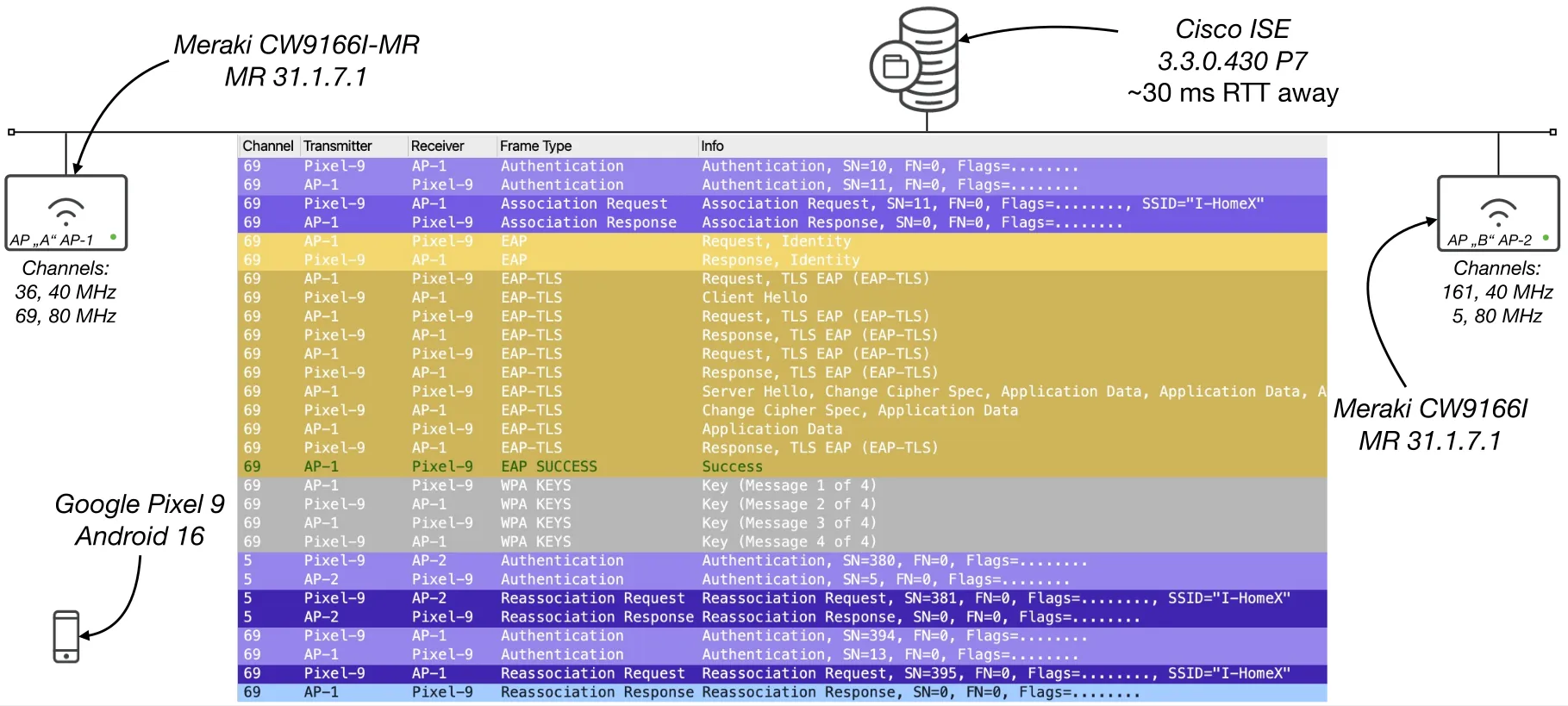
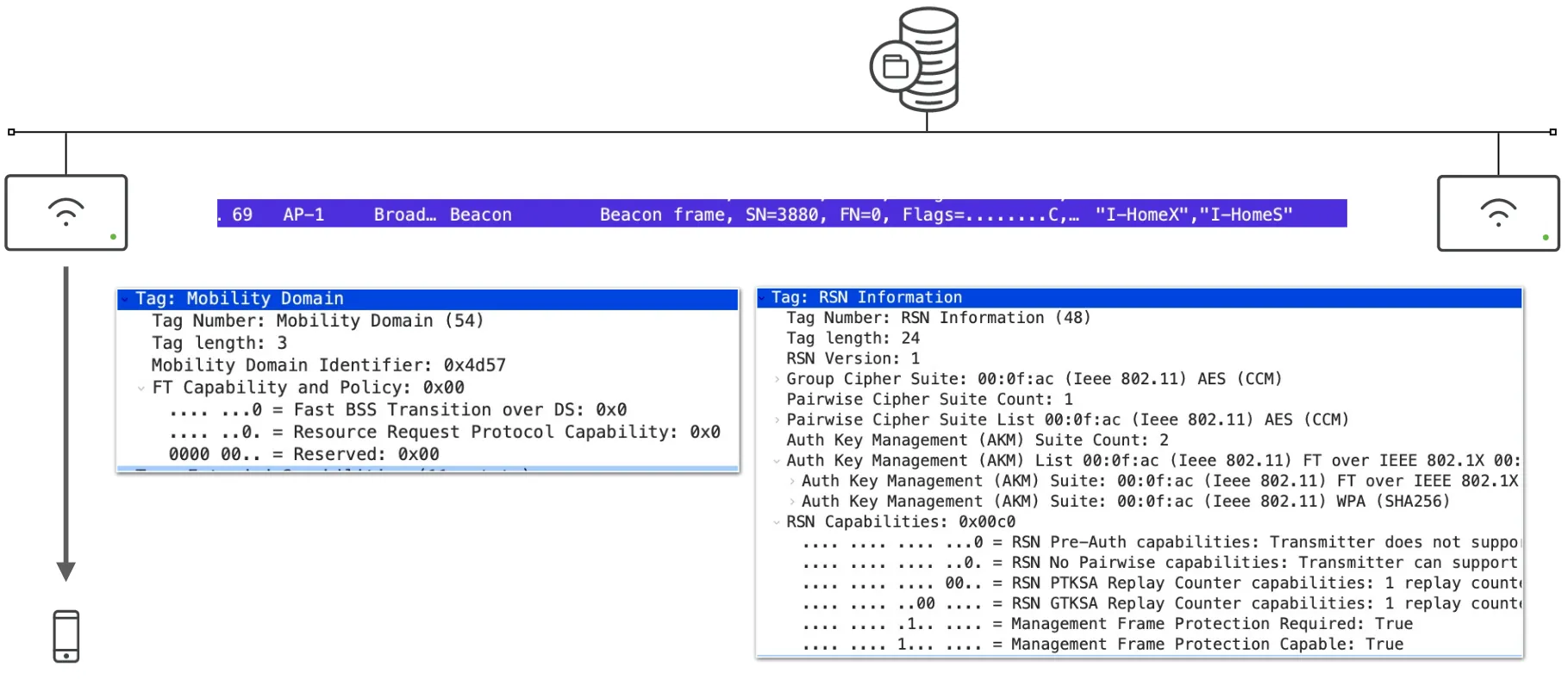
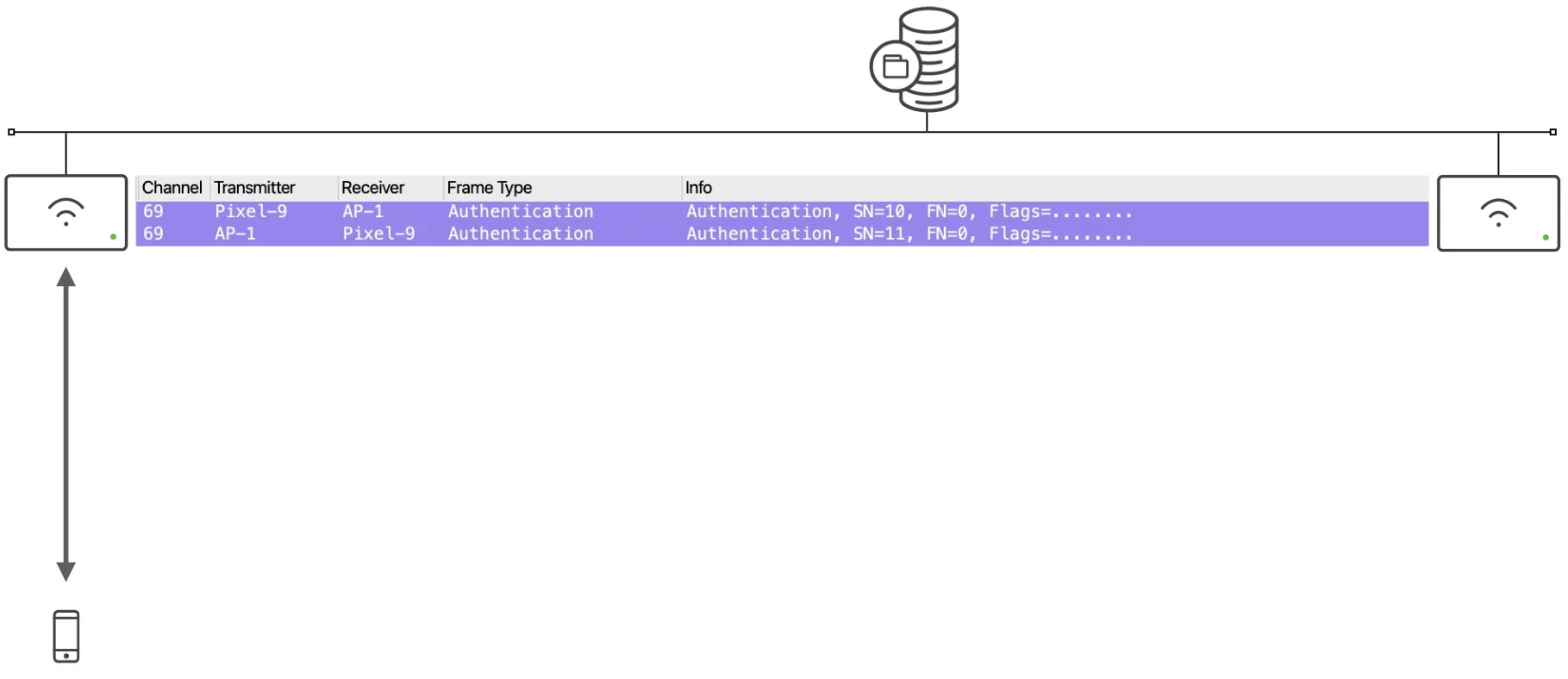
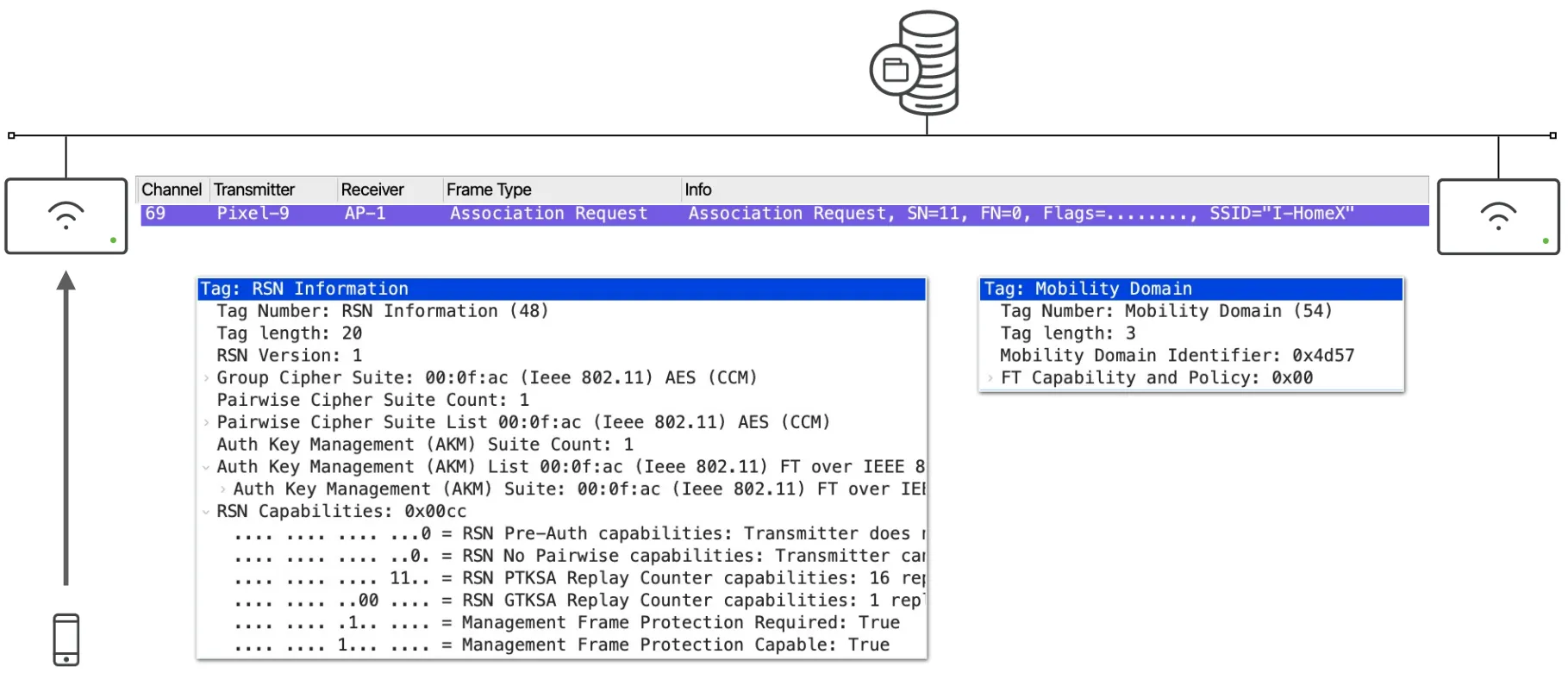
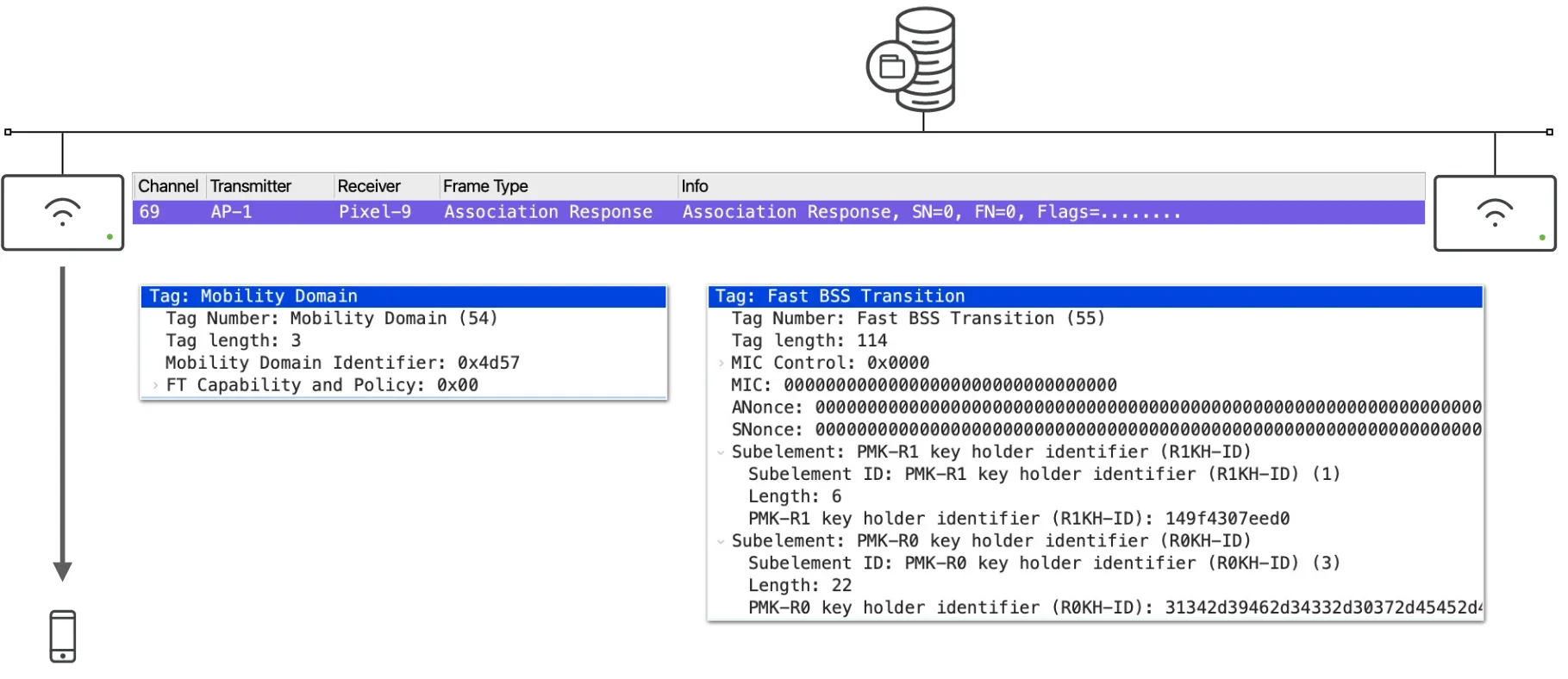
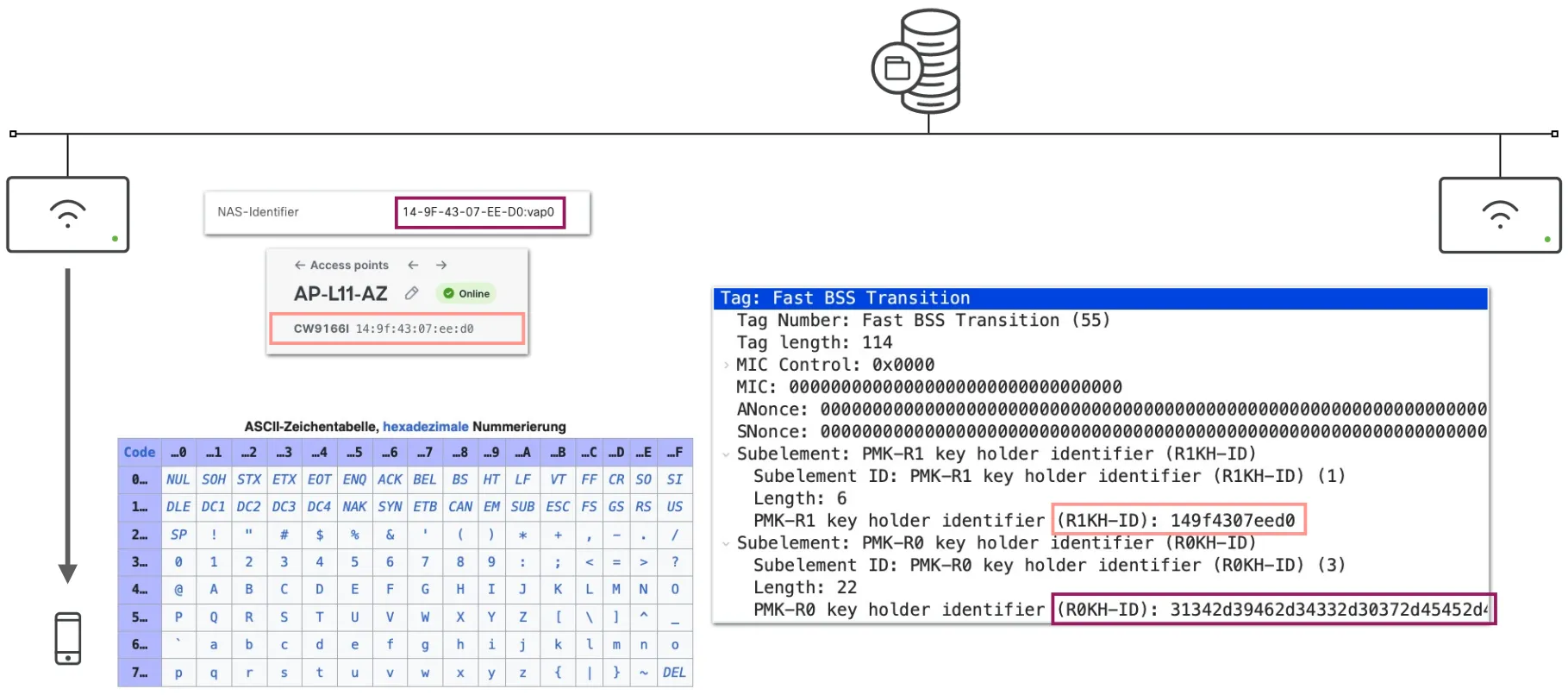
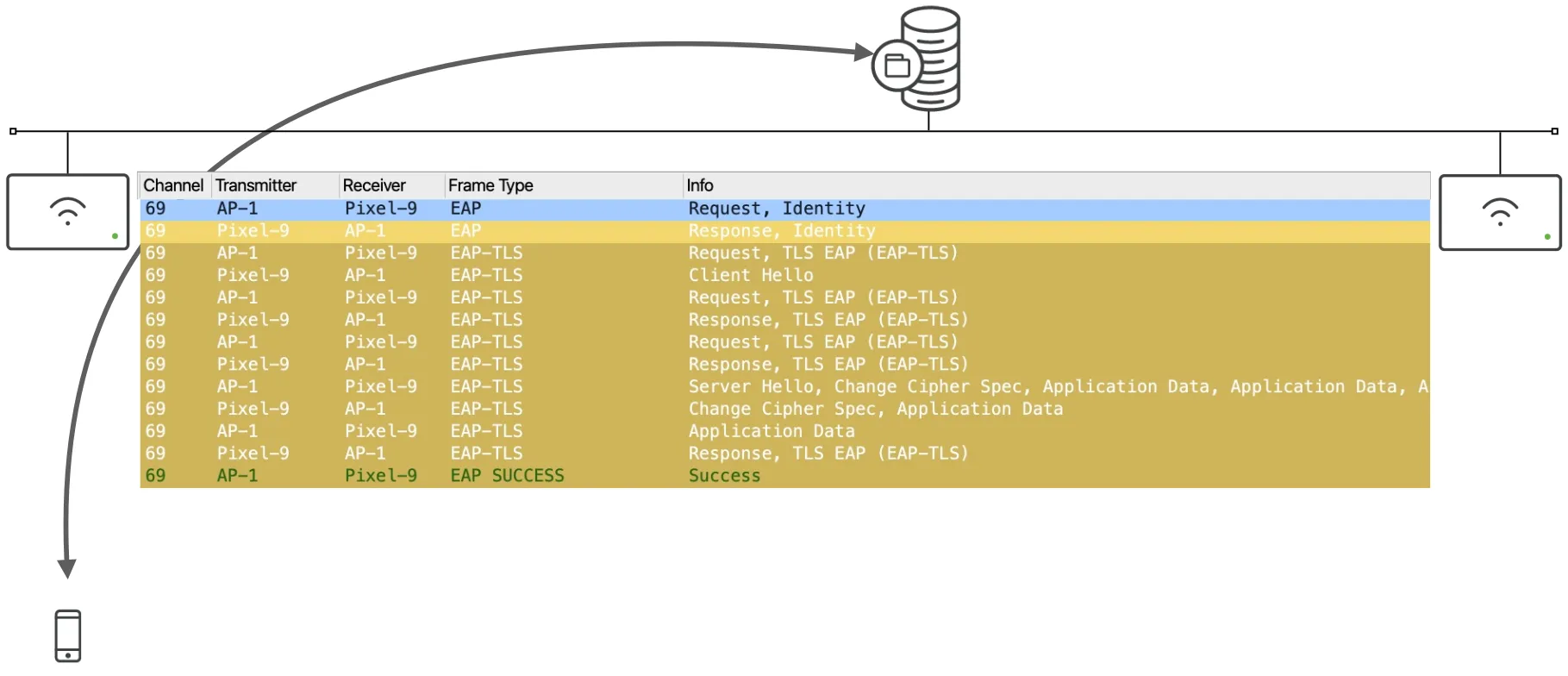

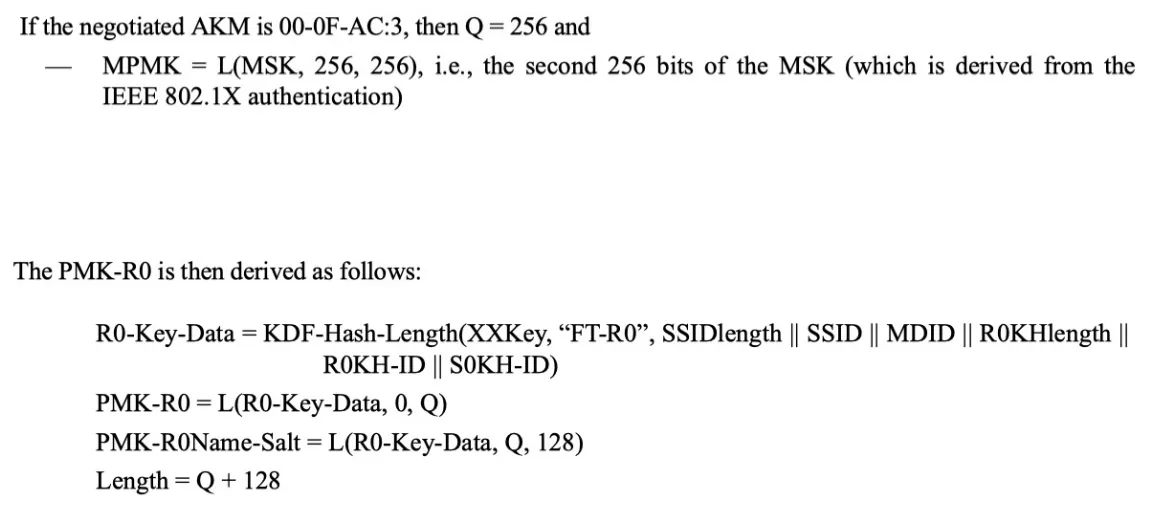
MSK -> PMK-R0
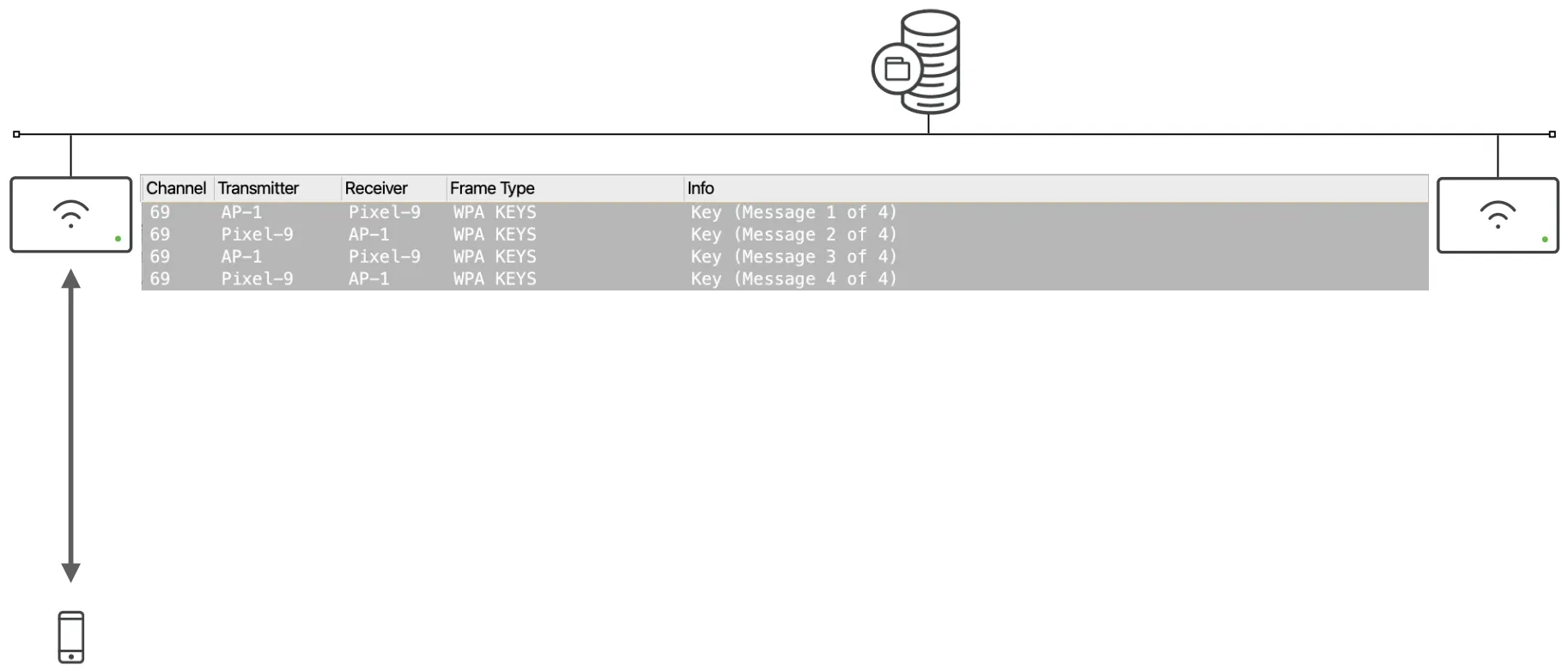
PMK-R0 -> PMK-R1

The computation of PMK-R0 and PMK-R1, and all of the intermediate results in the computations, shall be restricted to the R0KH.
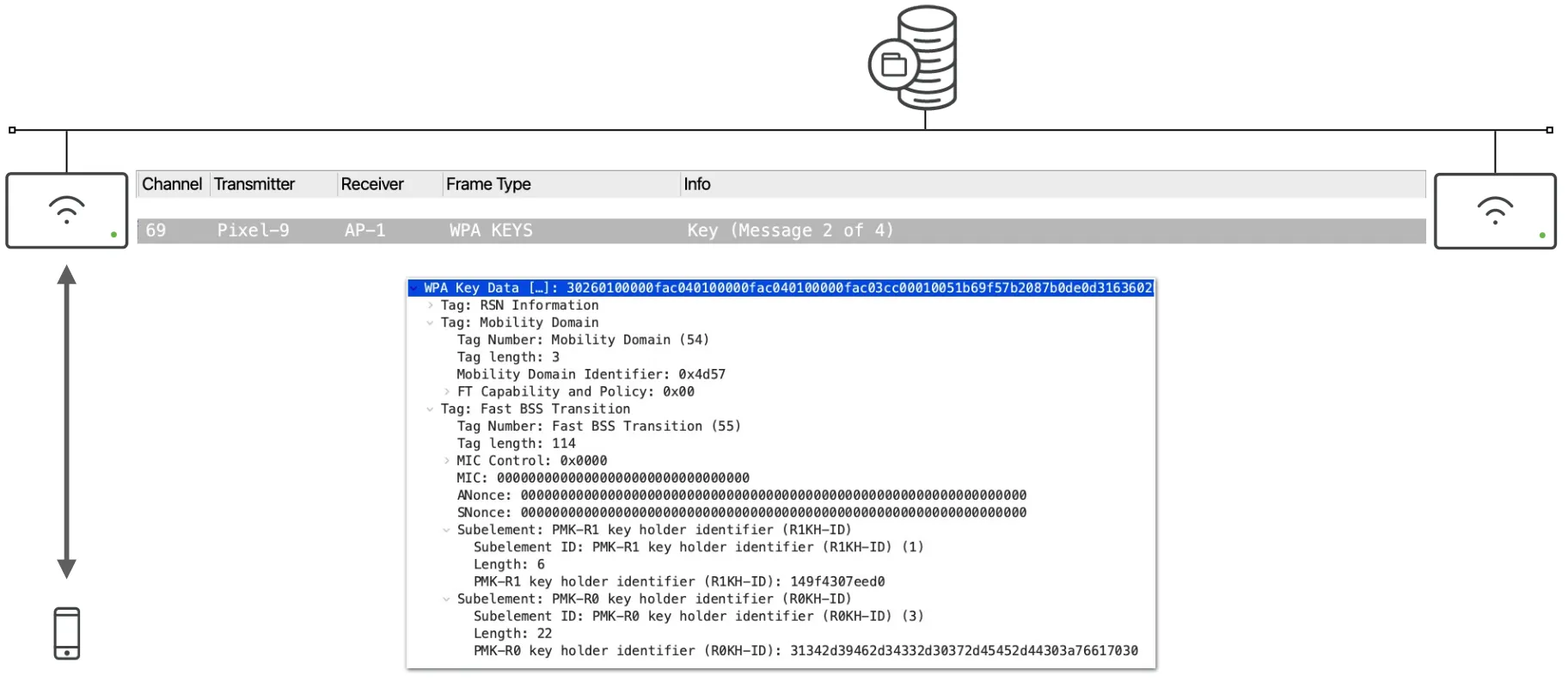
PMK-R1 -> PTK

The computation of PTK, and all intermediate results in its computation, shall be restricted to the R1KH.
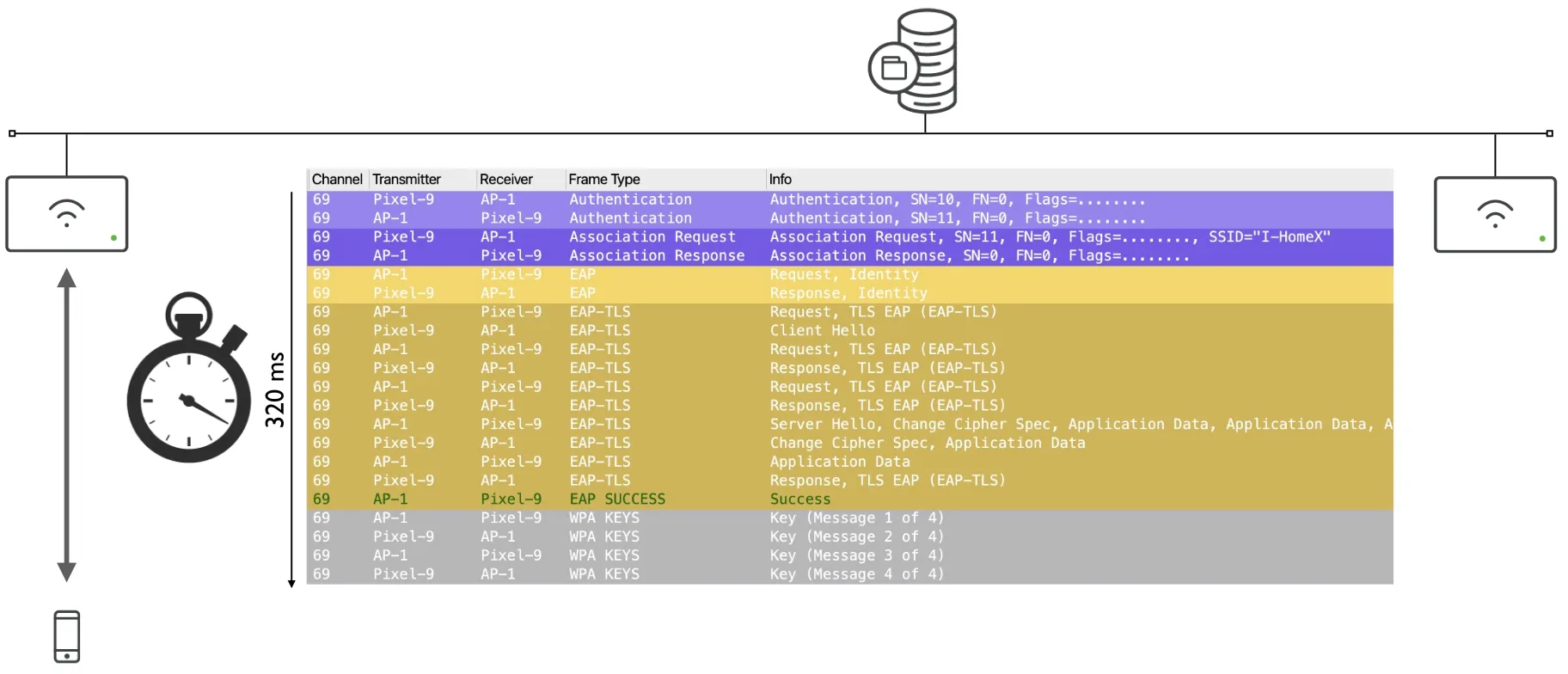
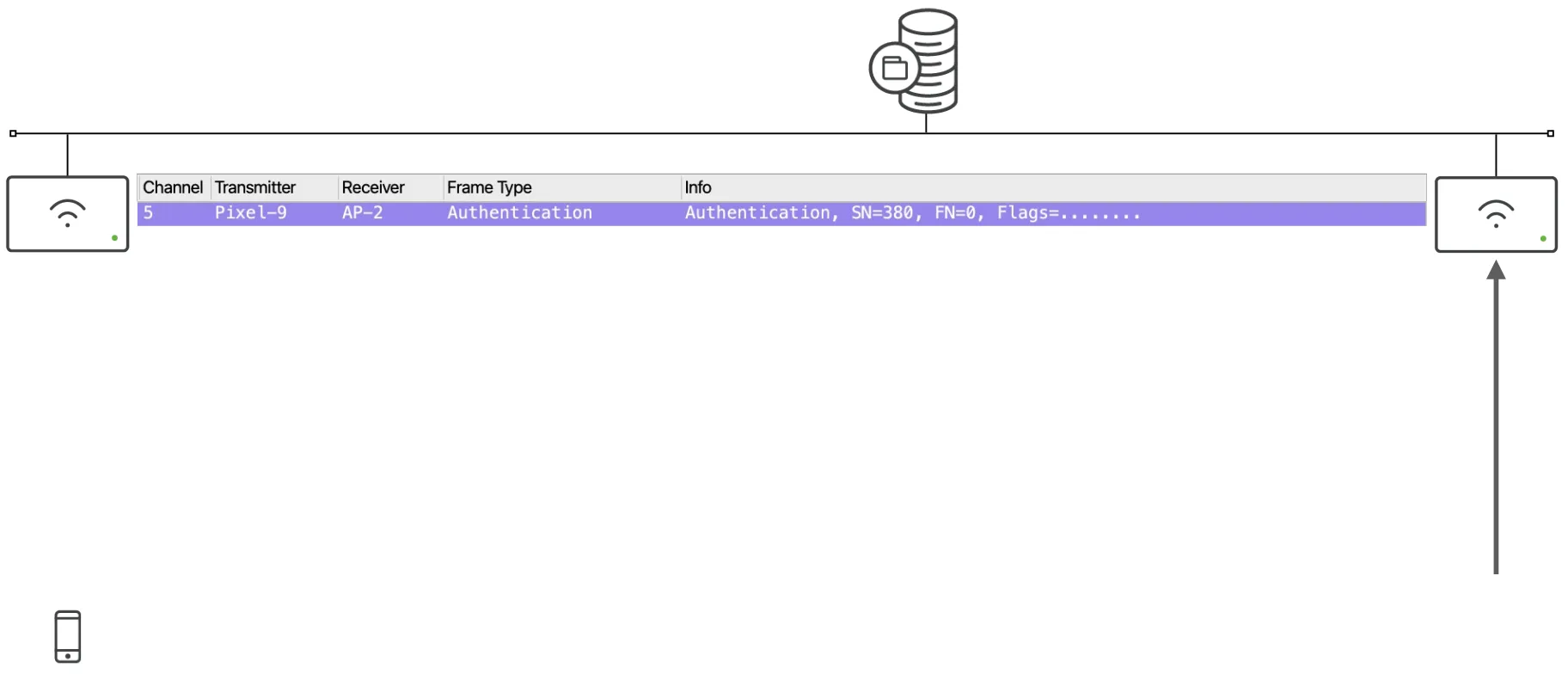
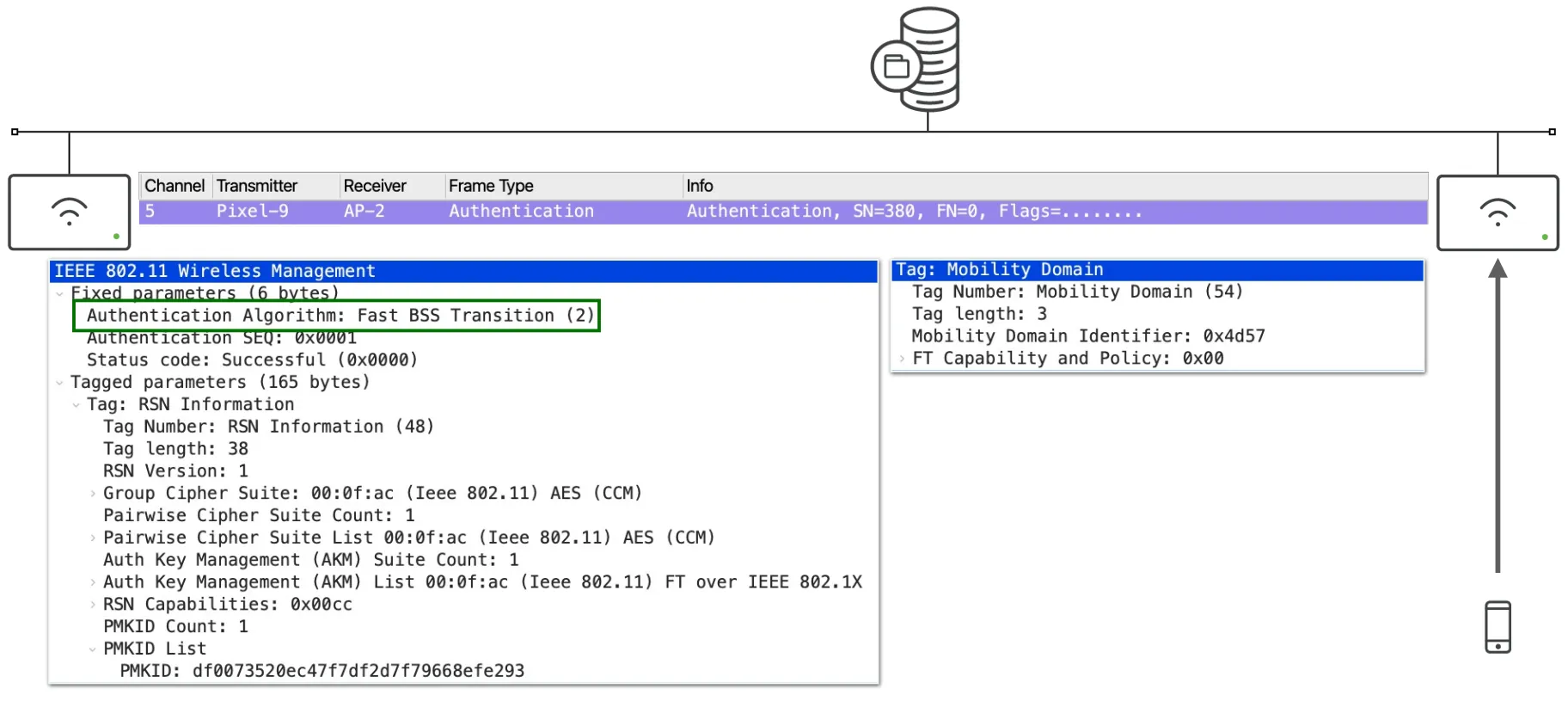
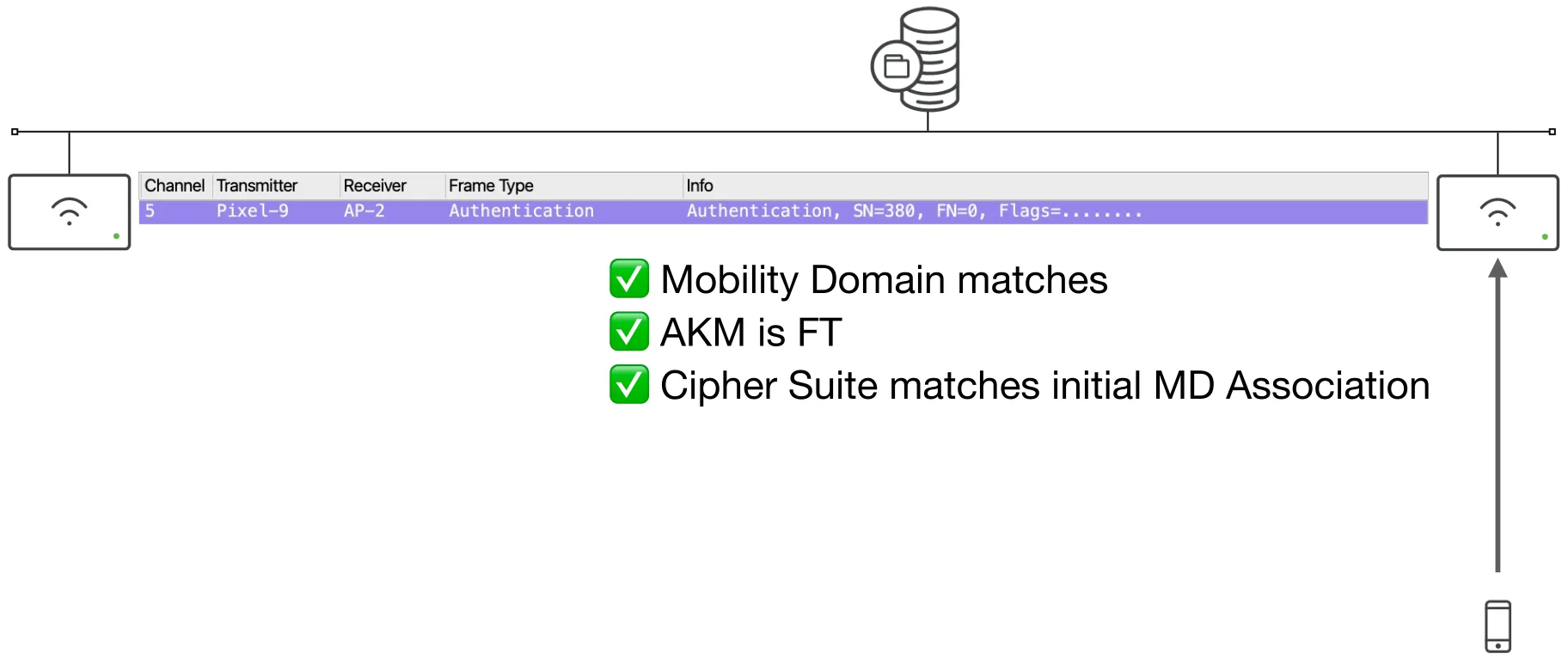
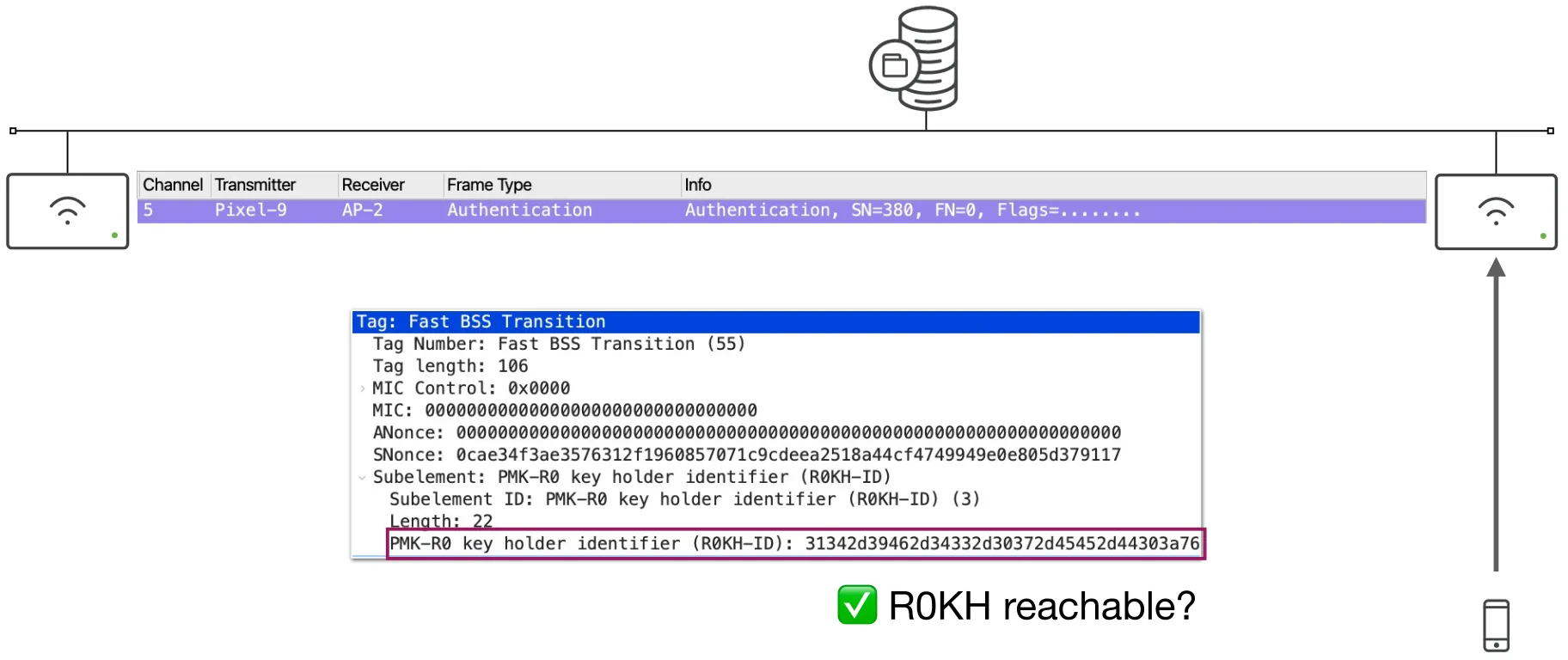
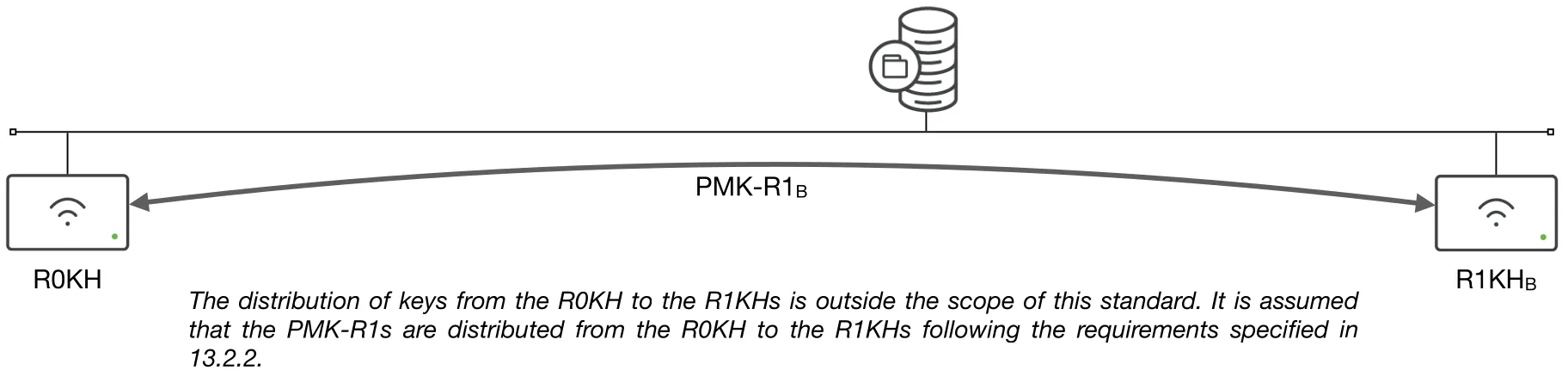
The R0KH and the R1KH are assumed to have a secure channel between them that can be used to exchange cryptographic keys without exposure to any intermediate parties. The cryptographic strength of the secure channel between the R0KH and R1KH is assumed to be greater than or equal to the cryptographic strength of the channels for which the keys are used.
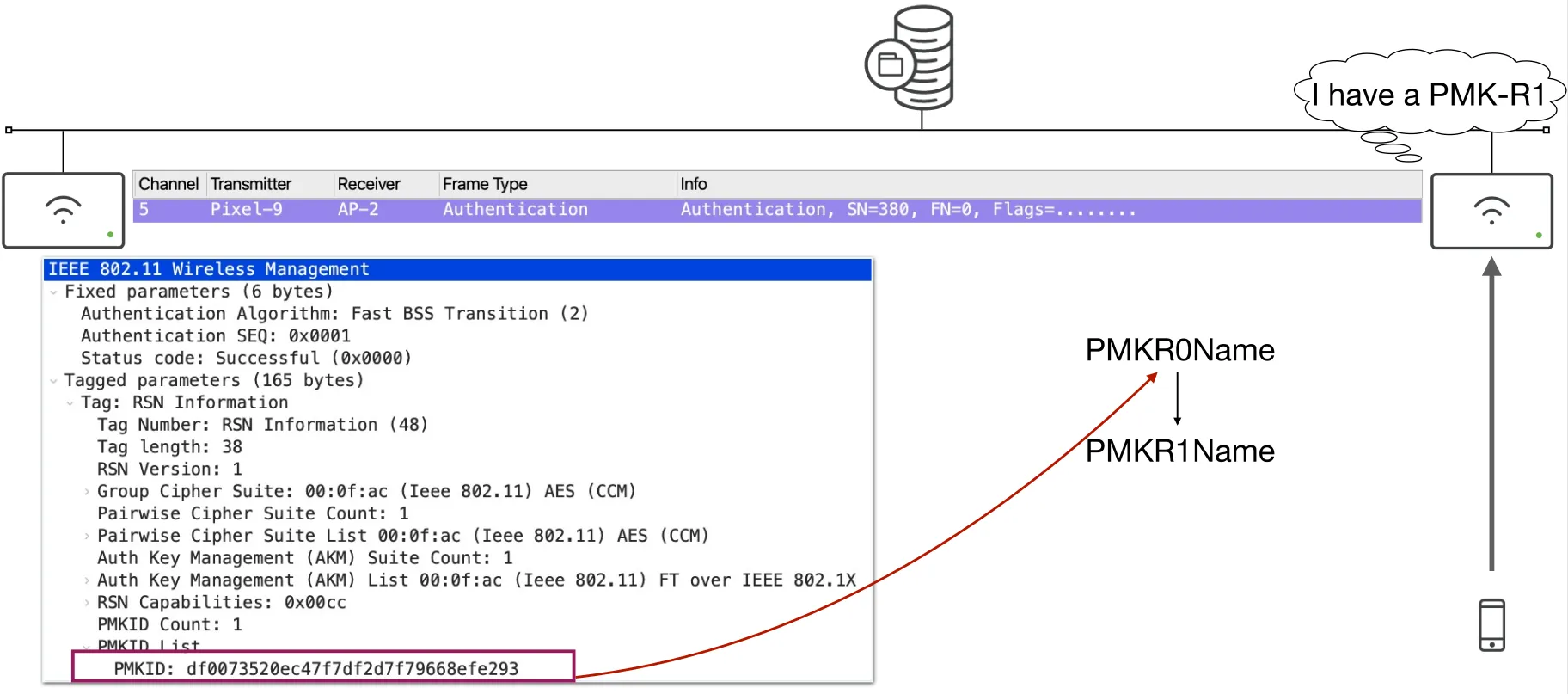
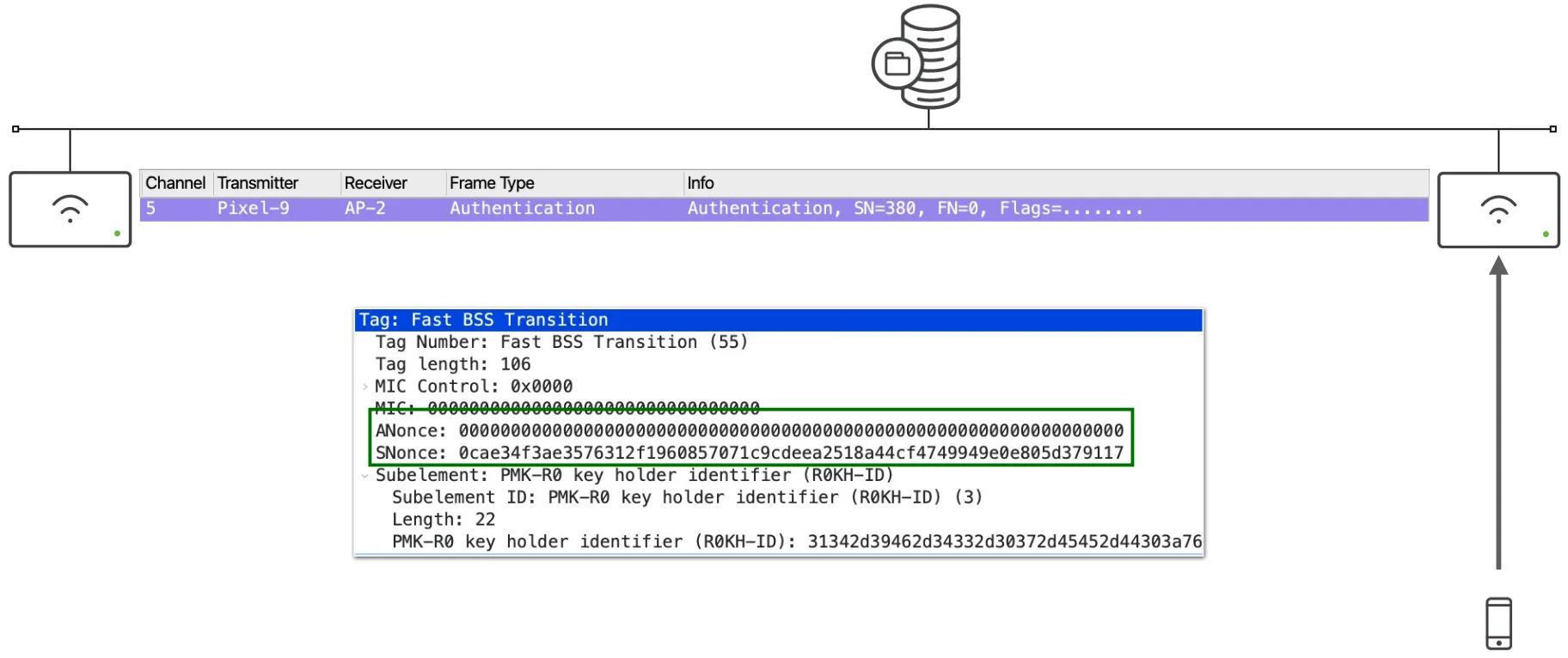
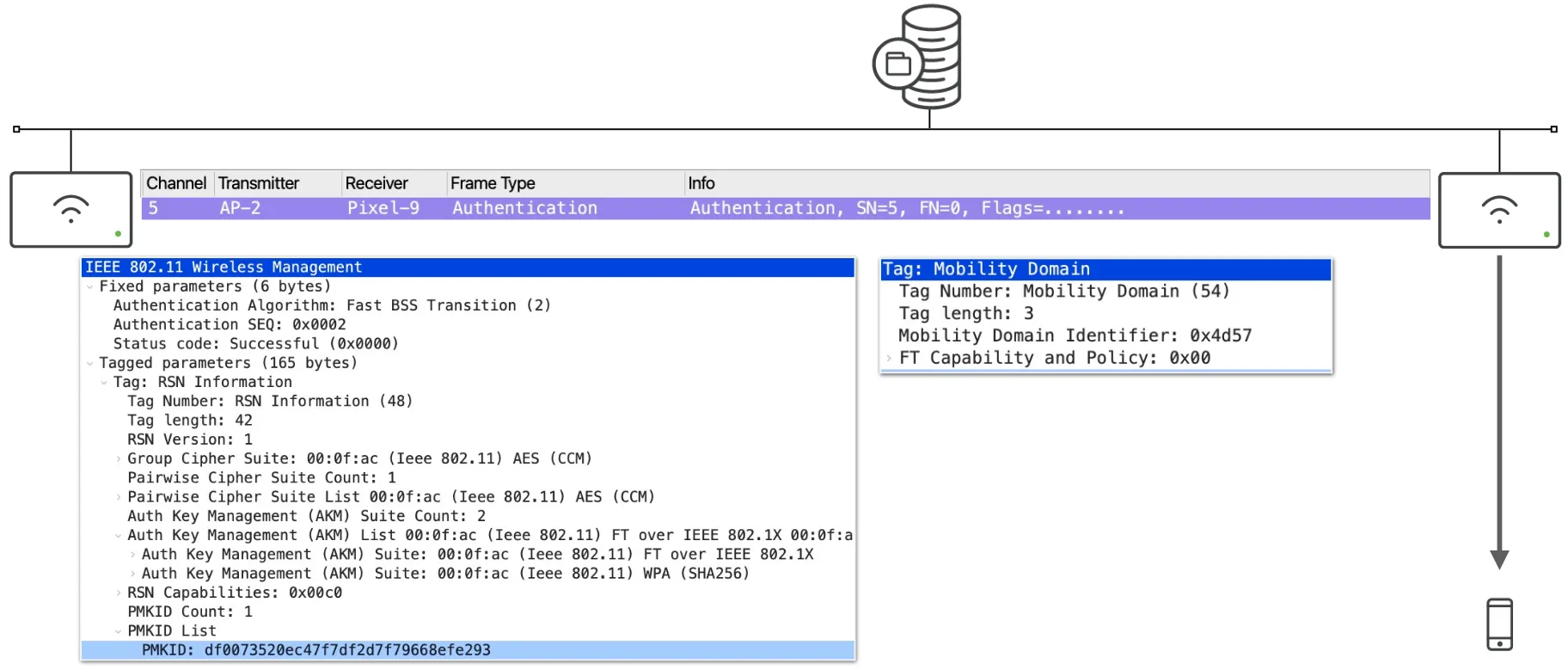
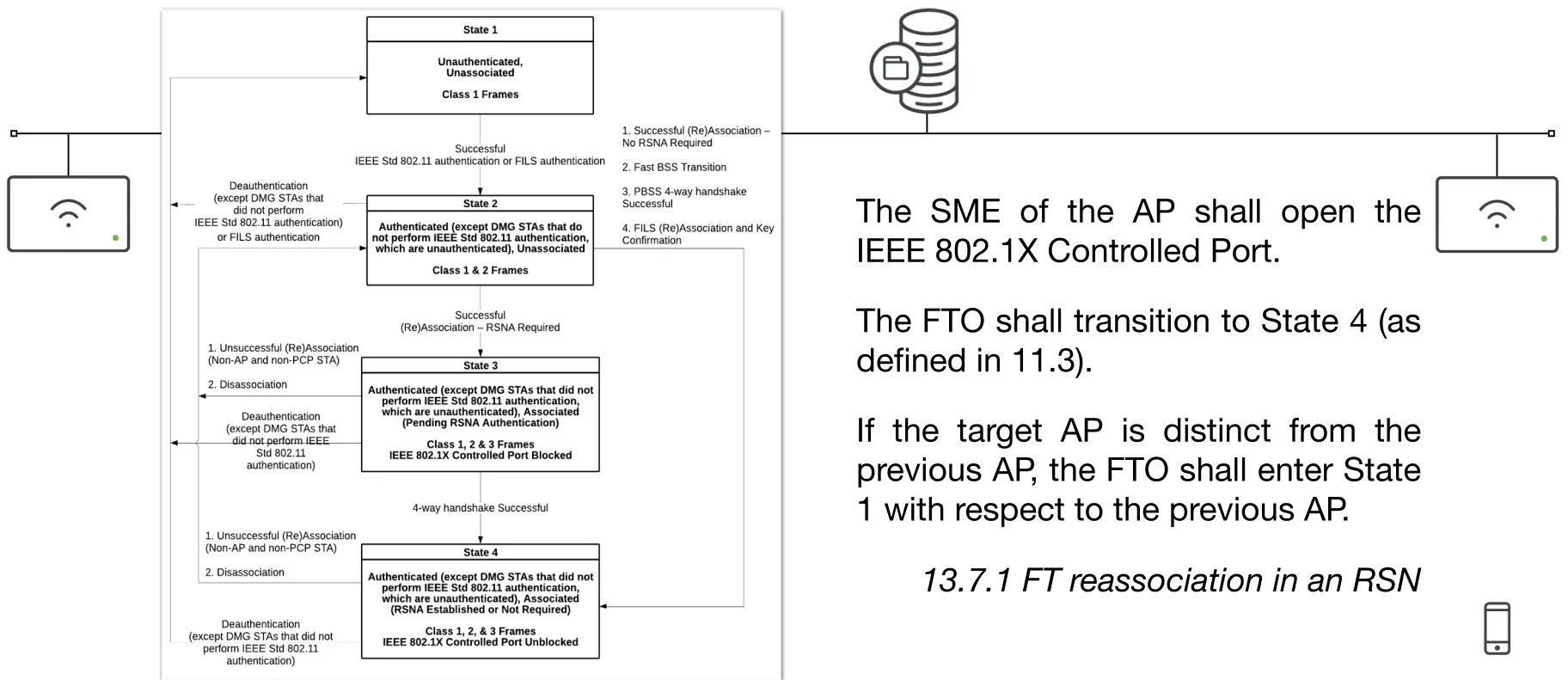
Relationship between state and services between a given pair of nonmesh STAs
Source
[1] www.thewlpc.com/presentations/analysis-of-a-fast-roam-prg-25