
Wi-Fi
Hostapd Architecture
IEEE 802.11 AP, IEEE 802.1X/WPA/WPA2/WPA3/EAP/RADIUS Authenticator
Overview
hostapd (Host Access Point Daemon) is the industry-standard user-space daemon for managing wireless Access Points (APs) and IEEE 802.11 / IEEE 802.1X / WPA / WPA2 / WPA3 authentication and key management services on Linux and UNIX-like systems.
While modern wireless drivers and the Linux kernel (via mac80211 / cfg80211) handle high-speed data path processing and real-time PHY/MAC layer frame transmission/reception, hostapd implements the upper-layer control plane, management plane, authentication state machines, and regulatory policy logic:
- AP MLME (MAC Layer Management Entity): Management frame handling (Beacons, Probe Requests/Responses, Authentication, Association, Disassociation, Deauthentication, Action frames).
- Security & Key Management: WPA-Personal / WPA-Enterprise 4-Way Handshake, Group Key Handshake, SAE (WPA3-Personal), OWE, FILS, DPP (Easy Connect), PMKSA caching, and IEEE 802.11r Fast BSS Transition (FT).
- IEEE 802.1X & RADIUS: Complete EAP authenticator, embedded RADIUS authentication & accounting client, built-in RADIUS server, and Dynamic Authorization Extensions (RADIUS DAS / RFC 5176 CoA / Disconnect-Request).
- Radio & Spectrum Management: Automatic Channel Selection (ACS), Dynamic Frequency Selection (DFS / CAC / Radar handling), Automated Frequency Coordination (AFC for 6 GHz Standard Power), Channel Switch Announcements (CSA / ECSA), and BSS Color Change Announcements (CCA).
- Advanced Multi-Generation Wi-Fi: Multi-BSSID support, 802.11n (HT), 802.11ac (VHT), 802.11ax (HE / Wi-Fi 6/6E), 802.11be (EHT / Wi-Fi 7 Multi-Link Operation - MLD/MLO), Passpoint / Hotspot 2.0 (HS2.0 / GAS / ANQP), and RRM / WNM / MBO (802.11k/v/u).
- Extensible Control & IPC: UNIX domain socket and UDP socket-based control interfaces for
hostapd_cli, orchestration daemons, and system network managers.
High-Level Architectural Diagram
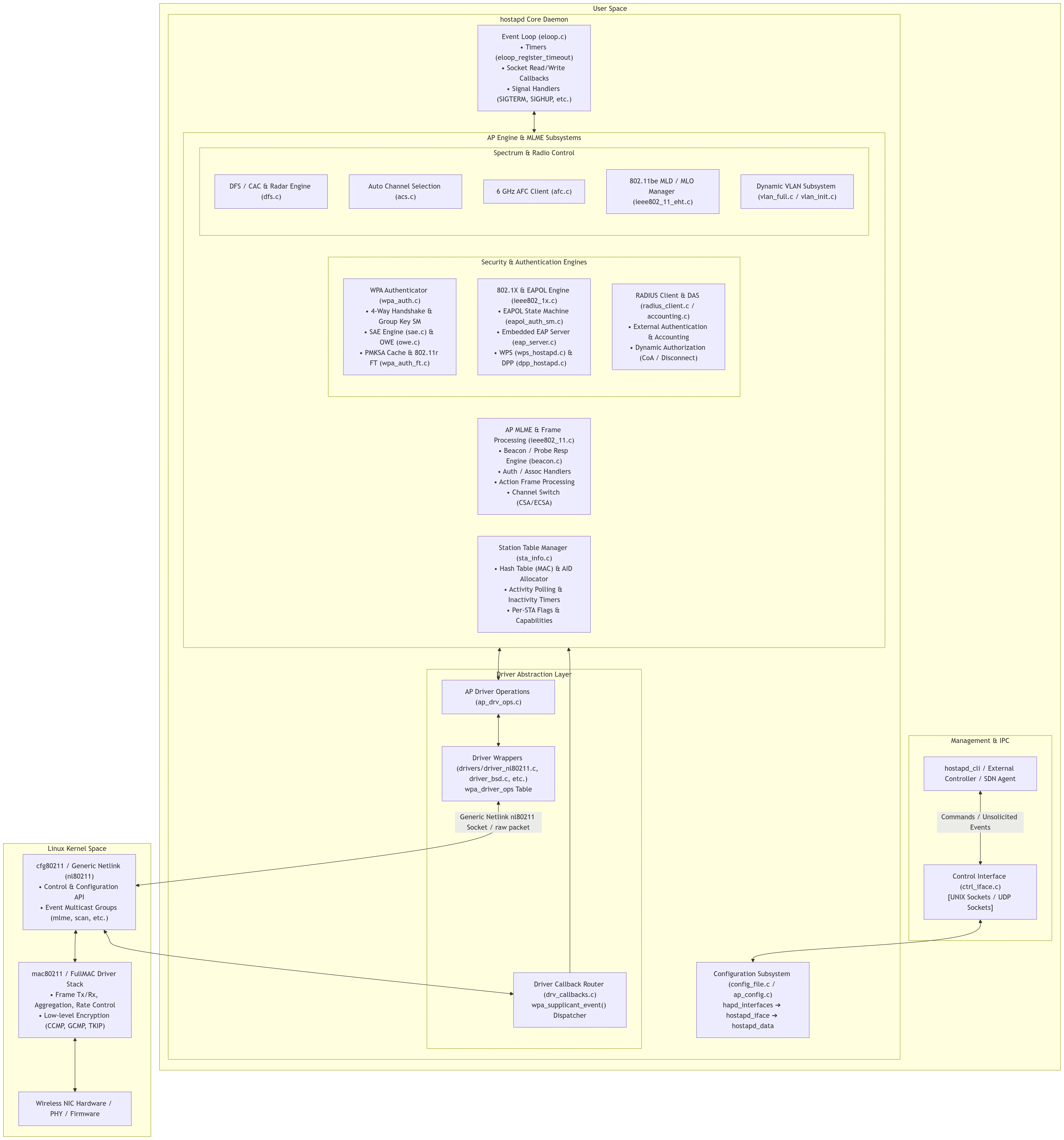
Core Data Structure Hierarchy
The in-memory object model in hostapd follows a strict hierarchical design from daemon-wide global state down to individual connected stations:
[struct hapd_interfaces] (Daemon-level global manager)
  │
  ├── [struct hostapd_iface] (Per-Physical Radio / PHY context, e.g. phy0, wlan0)
  │     ├── hw_features / current_mode (802.11a/b/g/n/ac/ax/be, channel capabilities)
  │     ├── DFS / CAC state (HAPD_IFACE_DFS, HAPD_IFACE_ACS, HAPD_IFACE_ENABLED)
  │     ├── struct hostapd_config *conf (PHY & radio-wide configuration)
  │     │
  │     └── [struct hostapd_data **bss] (Array of Virtual BSS / SSIDs on this Radio)
  │           │
  │           ├── struct hostapd_bss_config *conf (BSS-specific configuration: SSID, WPA flags)
  │           ├── const struct wpa_driver_ops *driver & void *drv_priv
  │           ├── struct wpa_authenticator *wpa_auth (WPA state machine context)
  │           ├── struct eapol_authenticator *eapol_auth (802.1X context)
  │           ├── struct radius_client_data *radius
  │           ├── struct wps_context *wps / struct dpp_authentication *dpp_auth
  │           │
  │           └── [struct sta_info *sta_list] & [struct sta_info *sta_hash[256]]
  │                 │
  │                 ├── addr (MAC Address) & aid (Association ID: 1..2007)
  │                 ├── flags (WLAN_STA_AUTH, WLAN_STA_ASSOC, WLAN_STA_AUTHORIZED, etc.)
  │                 ├── struct wpa_state_machine *wpa_sm (Per-STA 4-way handshake state machine)
  │                 ├── struct eapol_state_machine *eapol_sm (Per-STA 802.1X state machine)
  │                 ├── struct sae_data *sae (WPA3-Personal SAE exchange state)
  │                 └── vlan_id / vlan_desc (Dynamic VLAN assigned to this station)
  │
  └── [struct hostapd_mld] (802.11be Multi-Link Device coordinator)
        ├── mld_addr (Common MLD MAC)
        └── struct dl_list links (List of affiliated hostapd_data BSS links across radios)
Key Data Structures in Source Code
-
- Holds the list of physical radio interfaces (
struct hostapd_iface **iface). - Manages the global control interface socket (
global_ctrl_sock). - Contains global MLD entries (
struct hostapd_mld **mld) for Wi-Fi 7 Multi-Link Operation. - Tracks global DPP contexts and process coordination.
- Holds the list of physical radio interfaces (
-
- Represents a physical wireless device (PHY/radio).
- Manages radio state (
HAPD_IFACE_UNINITIALIZED,HAPD_IFACE_ACS,HAPD_IFACE_HT_SCAN,HAPD_IFACE_DFS,HAPD_IFACE_ENABLED). - Contains the list of Virtual APs (
struct hostapd_data **bss) hosted on this physical PHY. - Stores hardware capabilities (
struct hostapd_hw_modes *hw_features).
-
- Represents an individual BSS (Basic Service Set / SSID).
- Holds per-BSS security engines (
wpa_auth,eapol_auth,radius,wps,dpp). - Contains the station table: linked list
sta_listand hash tablesta_hash[256]for O(1) MAC address lookups. - Manages AID (Association Identifier) bitfield bitmap
sta_aid[AID_WORDS](AIDs 1 through 2007).
-
- State container for an individual connected or connecting client station.
- Tracks IEEE 802.11 state flags (
WLAN_STA_AUTH,WLAN_STA_ASSOC,WLAN_STA_AUTHORIZED,WLAN_STA_MFP,WLAN_STA_WMM,WLAN_STA_HT,WLAN_STA_VHT,WLAN_STA_HE,WLAN_STA_EHT). - Embeds pointers to security state machines (
wpa_sm,eapol_sm,sae). - Tracks dynamic VLAN assignments, accounting session statistics, and inactivity poll timers.
Architectural Subsystem Deep Dive
Event Loop & Concurrency Model (eloop)
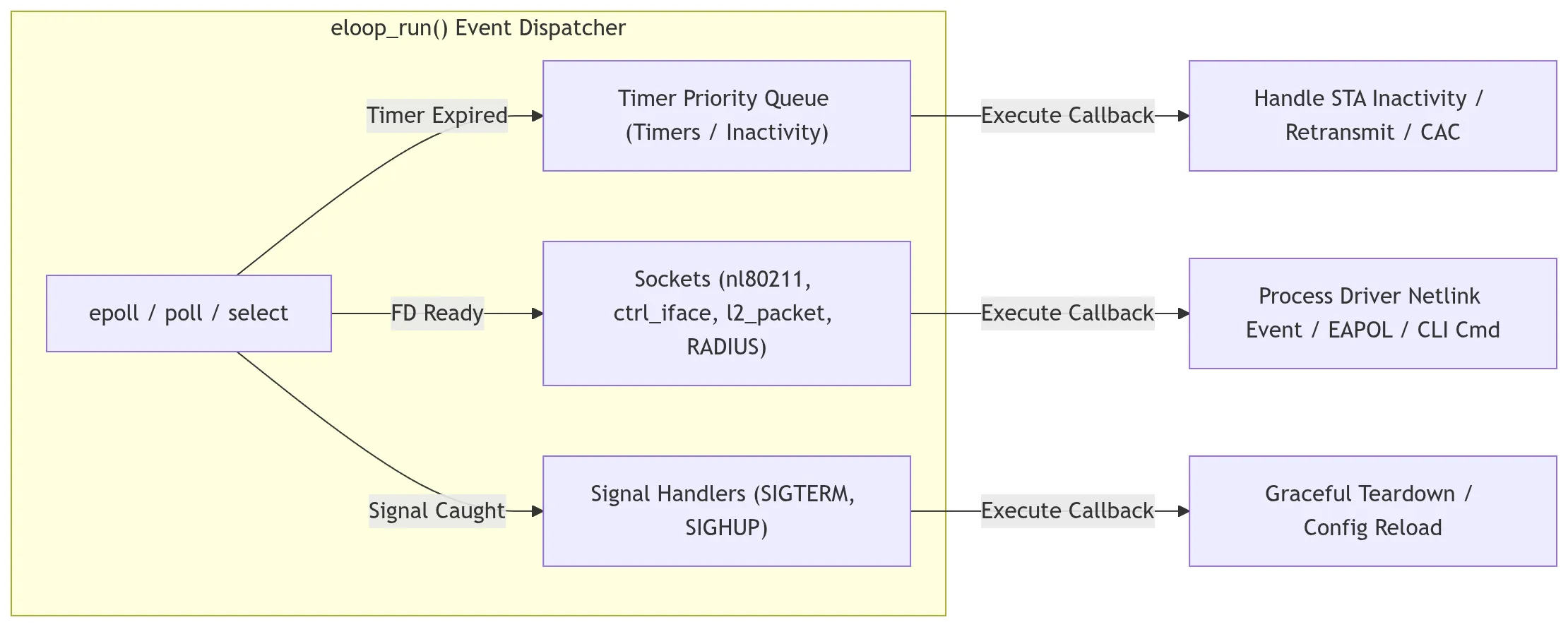
hostapd is engineered as a single-threaded, non-blocking, asynchronous event-driven daemon centered around src/utils/eloop.c.
- I/O Multiplexing: Utilizes
epoll_wait(),poll(), orselect()to monitor file descriptors for incoming network packets, Netlink socket events, and control socket connections without blocking. - Timer Management: Implements scheduled delayed callbacks via
eloop_register_timeout(secs, usecs, handler, eloop_data, user_data)andeloop_cancel_timeout(). These drive AP periodic tasks (hostapd_periodic), STA inactivity timeouts (ap_handle_timer), 4-way handshake retransmission timers, and DFS CAC timers. - Signal Dispatching: Handles asynchronous OS signals (
SIGINT,SIGTERM,SIGHUP,SIGUSR1) through signalfd or self-pipe notification routines to ensure thread-safe and interrupt-safe shutdowns and configuration reloads. - No Locking Overhead: Because the entire state machine runs on a single event-driven thread, internal data structures (
sta_info,hostapd_data) do not suffer from multi-threading mutex contention, race conditions, or deadlocks.
Configuration Subsystem
Configuration processing is handled by hostapd/config_file.c and src/ap/ap_config.c:
- Two-Level Configuration Hierarchy:
- Interface/PHY Level (
struct hostapd_config): Channel, hardware mode (hw_mode=a/b/g/n/ac/ax/be), ACS parameters, country code, regulatory domain, DFS options. - BSS Level (
struct hostapd_bss_config): SSID, BSSID, authentication suites (wpa=1/2/3), WPA key management (wpa_key_mgmt=WPA-PSK WPA-EAP SAE), encryption ciphers (rsn_pairwise=CCMP GCMP), RADIUS server IPs/secrets, VLAN configurations, and WPS settings.
- Interface/PHY Level (
- Multi-BSSID & Multi-Interface Support: A single configuration file can define multiple physical radios (
interface=wlan0,interface=wlan1) and multiple BSS definitions on each radio (bss=wlan0_0,bss=wlan0_1). - Dynamic Reloading: Supports runtime parameter updates via
SIGHUPorhostapd_cli reloadwithout restarting the daemon process.
Driver Abstraction Layer & Kernel Interfacing
hostapd is completely decoupled from driver-specific APIs via a unified Driver Abstraction Layer:
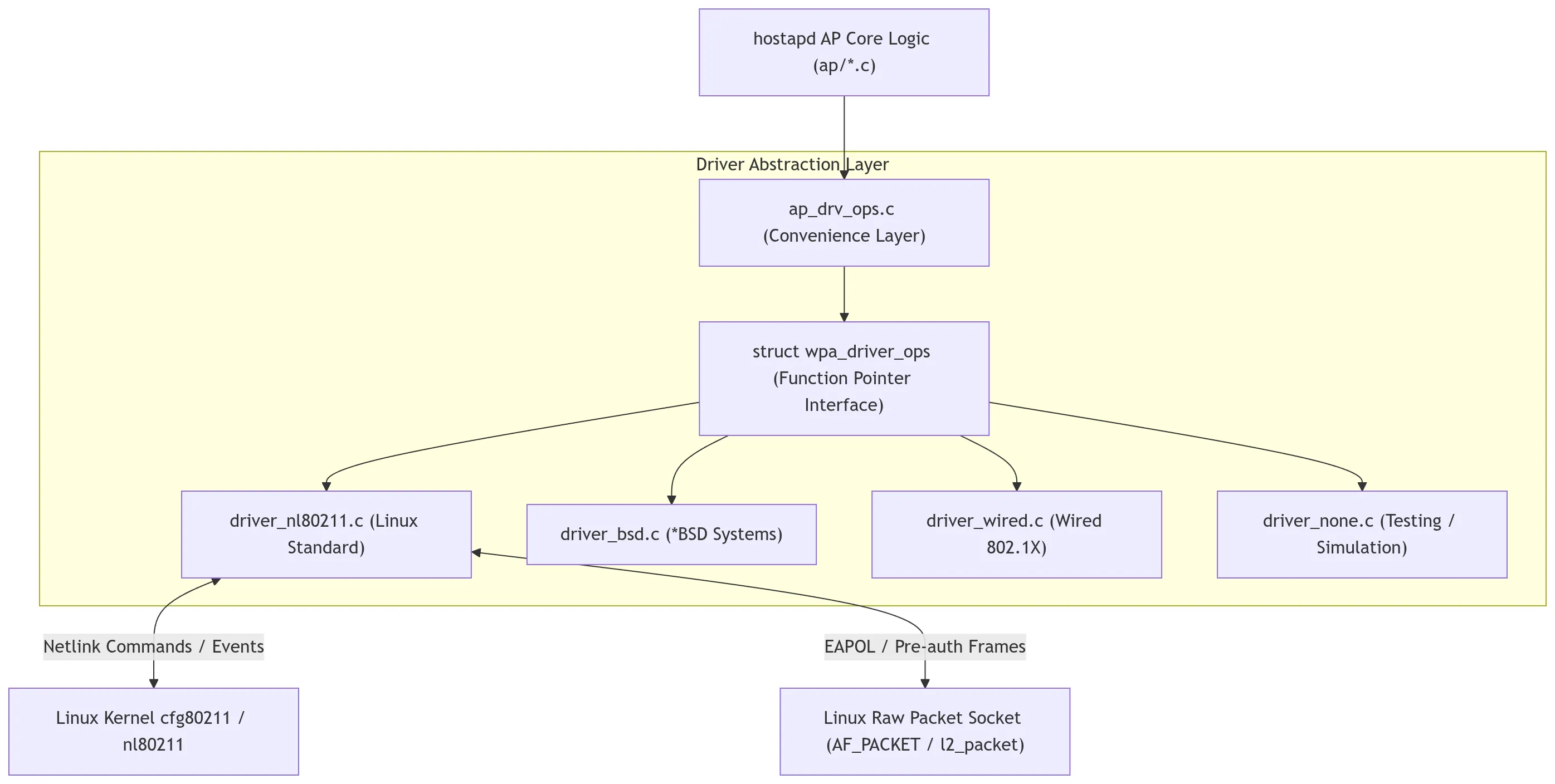
struct wpa_driver_ops: Defines over 150 standardized driver primitives (set_ap,sta_add,sta_remove,set_key,send_mlme,set_freq,send_action,set_acl,channel_switch, etc.).driver_nl80211.c:- Interacts with the Linux
cfg80211subsystem using Generic Netlink (NETLINK_GENERIC). - Registers for frame filtering (Management frames: Probe Requests, Auth, Assoc, Action frames) and receives them over Netlink.
- Subscribes to multicast Netlink groups (
nl80211events: radar detected, low ACK, STA state change, scan complete).
- Interacts with the Linux
drv_callbacks.c: Implements the central callback dispatcherwpa_supplicant_event()that translates kernel driver notifications (EVENT_RX_MGMT,EVENT_ASSOC,EVENT_EAPOL_RX,EVENT_DFS_RADAR_DETECTED,EVENT_CH_SWITCH) into internalhostapdcore events.
Station Lifecycle & AP MLME Engine
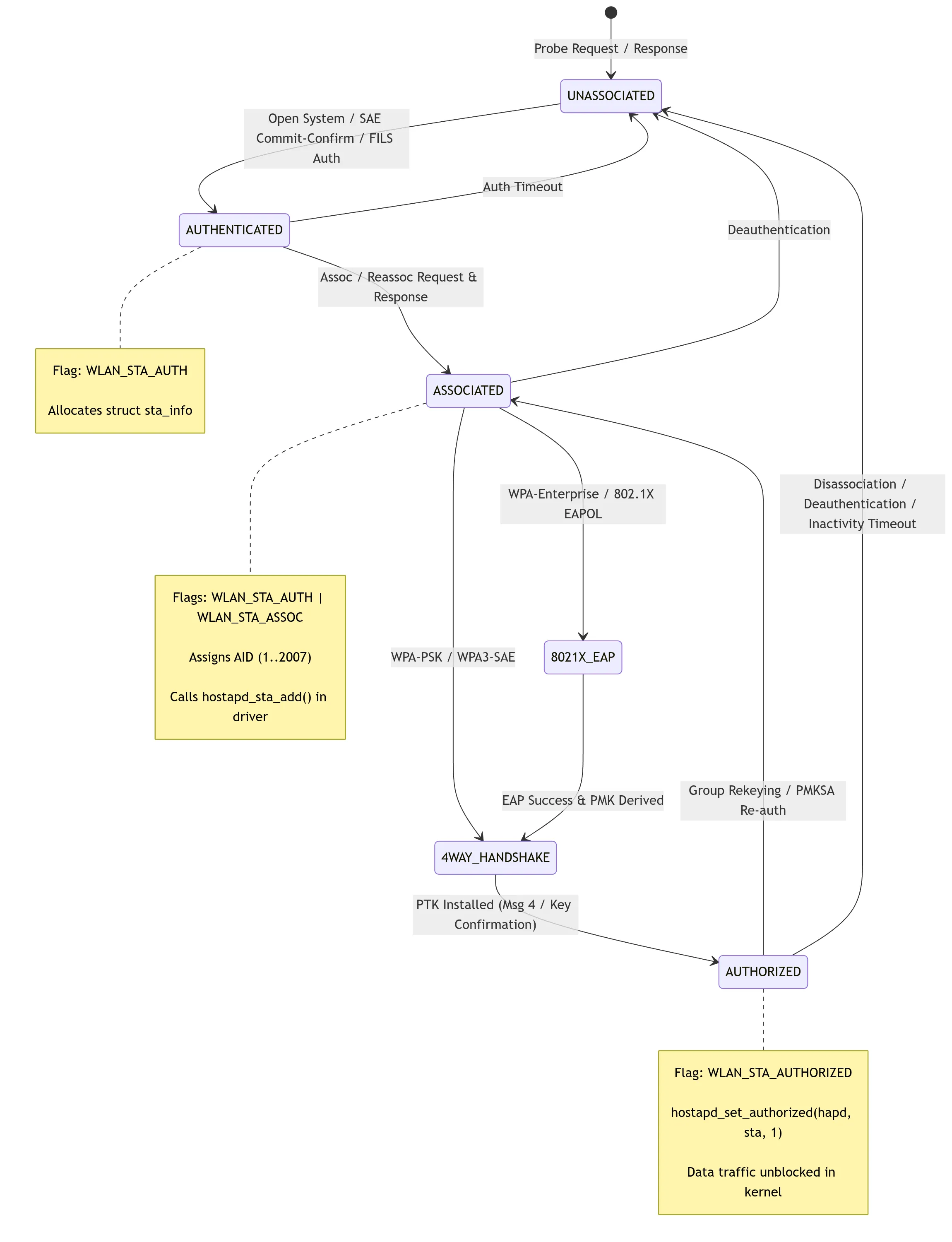
The station management state machine is governed by src/ap/ieee802_11.c and src/ap/sta_info.c:
- Management Frame Processing (
ieee802_11_mgmt): Validates frame control, BSSID/DA matching, sequence numbers, and dispatches to specific handlers:WLAN_FC_STYPE_PROBE_REQ➔handle_probe_req()WLAN_FC_STYPE_AUTH➔handle_auth()(Open, Shared, SAE, FILS)WLAN_FC_STYPE_ASSOC_REQ/REASSOC_REQ➔handle_assoc()WLAN_FC_STYPE_DISASSOC➔handle_disassoc()WLAN_FC_STYPE_DEAUTH➔handle_deauth()WLAN_FC_STYPE_ACTION➔handle_action()(WMM, Block ACK, RRM, WNM, Protected Dual, DPP, FST)
- Inactivity & Polling Engine: Uses
ap_handle_timer()to periodically poll inactive stations with data nullfunc frames. If unacknowledged, stations are transitioned to disassociated/deauthenticated states and cleaned up from driver memory.
Security, Key Management & Authentication Subsystems
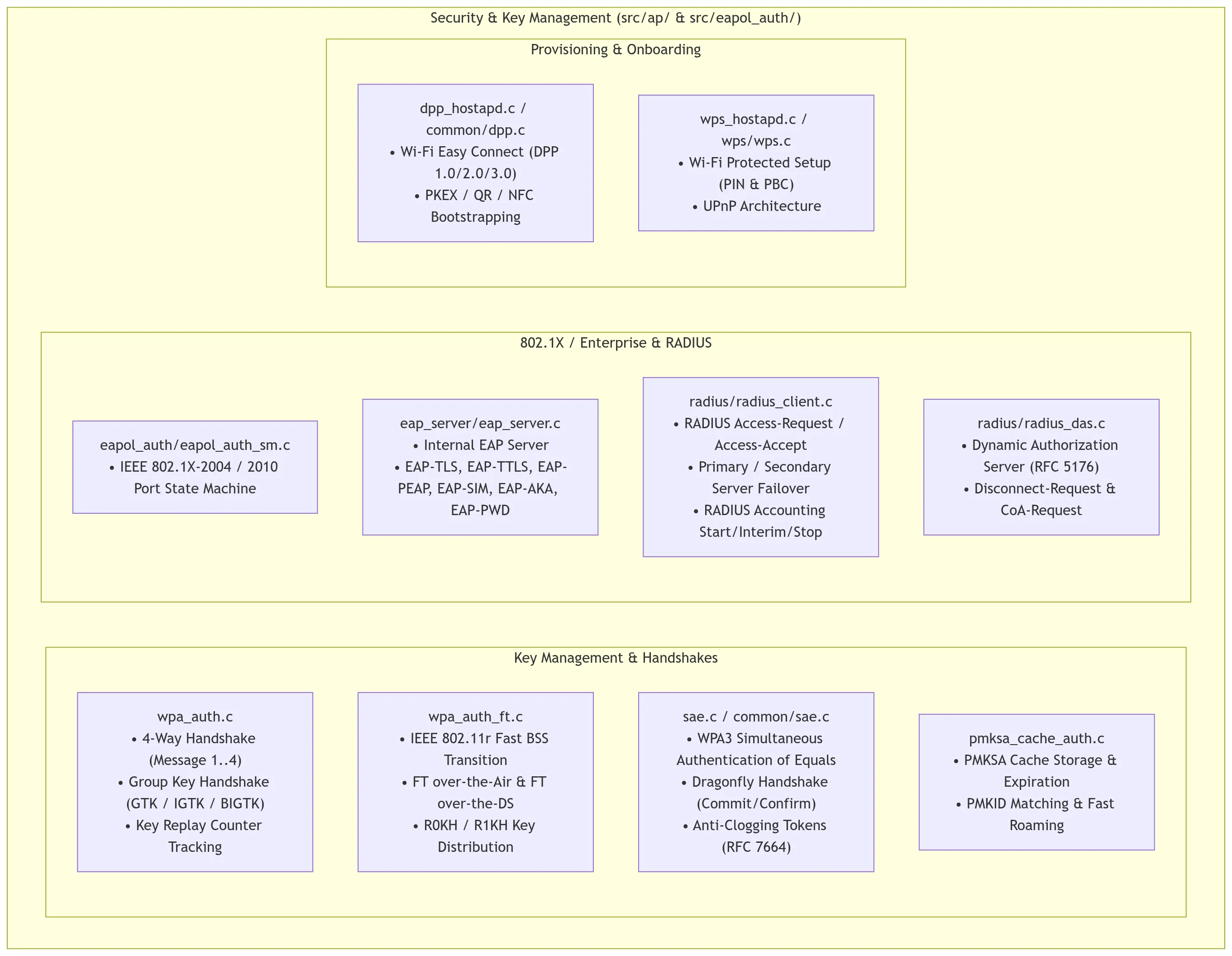
Detailed Security Flows:
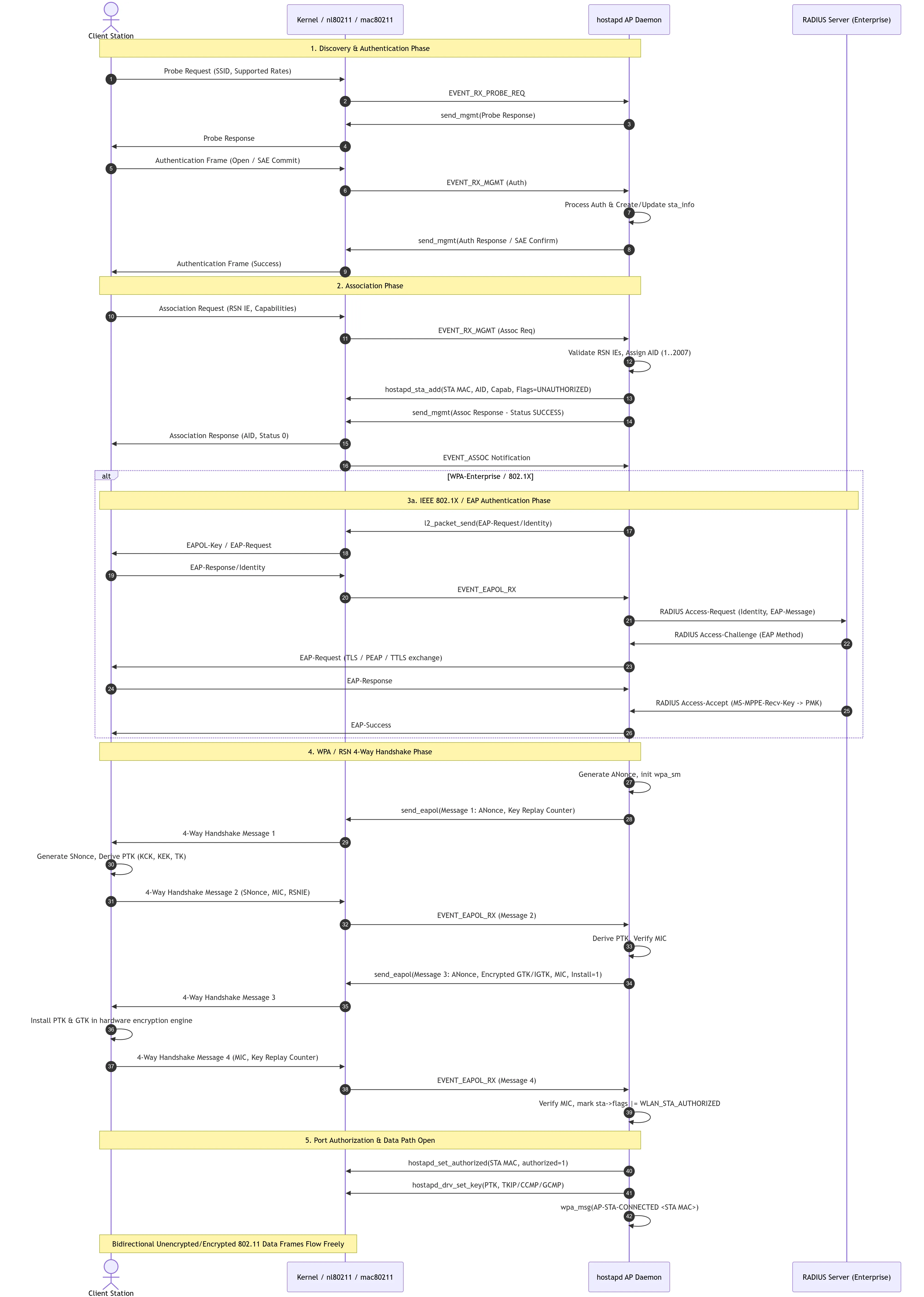
- WPA/WPA2/WPA3 4-Way Handshake:
- Msg 1 (AP ➔ STA): AP generates
ANonceand transmits to STA with Key Replay Counter. - Msg 2 (STA ➔ AP): STA generates
SNonce, calculatesPTK = PRF-X(PMK, "Pairwise key expansion", Min(AA,SPA) || Max(AA,SPA) || Min(ANonce,SNonce) || Max(ANonce,SNonce)), and sendsSNonce+ MIC + RSN IE. - Msg 3 (AP ➔ STA): AP verifies MIC, derives identical
PTK, generatesGTK/IGTK/BIGTK, sends encrypted group keys + MIC + install bit. - Msg 4 (STA ➔ AP): STA confirms key installation with MIC. AP transitions station port to authorized (
hostapd_set_authorized).
- Msg 1 (AP ➔ STA): AP generates
- SAE (WPA3-Personal Dragonfly Handshake):
- Eliminates dictionary attacks by using a password-authenticated key exchange based on zero-knowledge proofs (RFC 7664 / IEEE 802.11az/REVme).
- Implements anti-clogging tokens to defend against Denial-of-Service resource exhaustion attacks on elliptic curve math.
- 802.11r Fast Transition (FT):
- Derives a two-tier key hierarchy:
PMK-R0(held by Mobility Domain Controller) ➔PMK-R1(held by individual APs) ➔PTK. Allows sub-50ms roaming without performing a full 802.1X/EAP re-authentication.
- Derives a two-tier key hierarchy:
Radio Spectrum, DFS & Advanced PHY Features
- Automatic Channel Selection (
src/ap/acs.c):- Evaluates channel interference, noise floor, spectral survey statistics (
EVENT_GET_SURVEY), and adjacent-channel overlapping BSS (OBSS) metrics to dynamically pick optimal 2.4 GHz, 5 GHz, or 6 GHz channels.
- Evaluates channel interference, noise floor, spectral survey statistics (
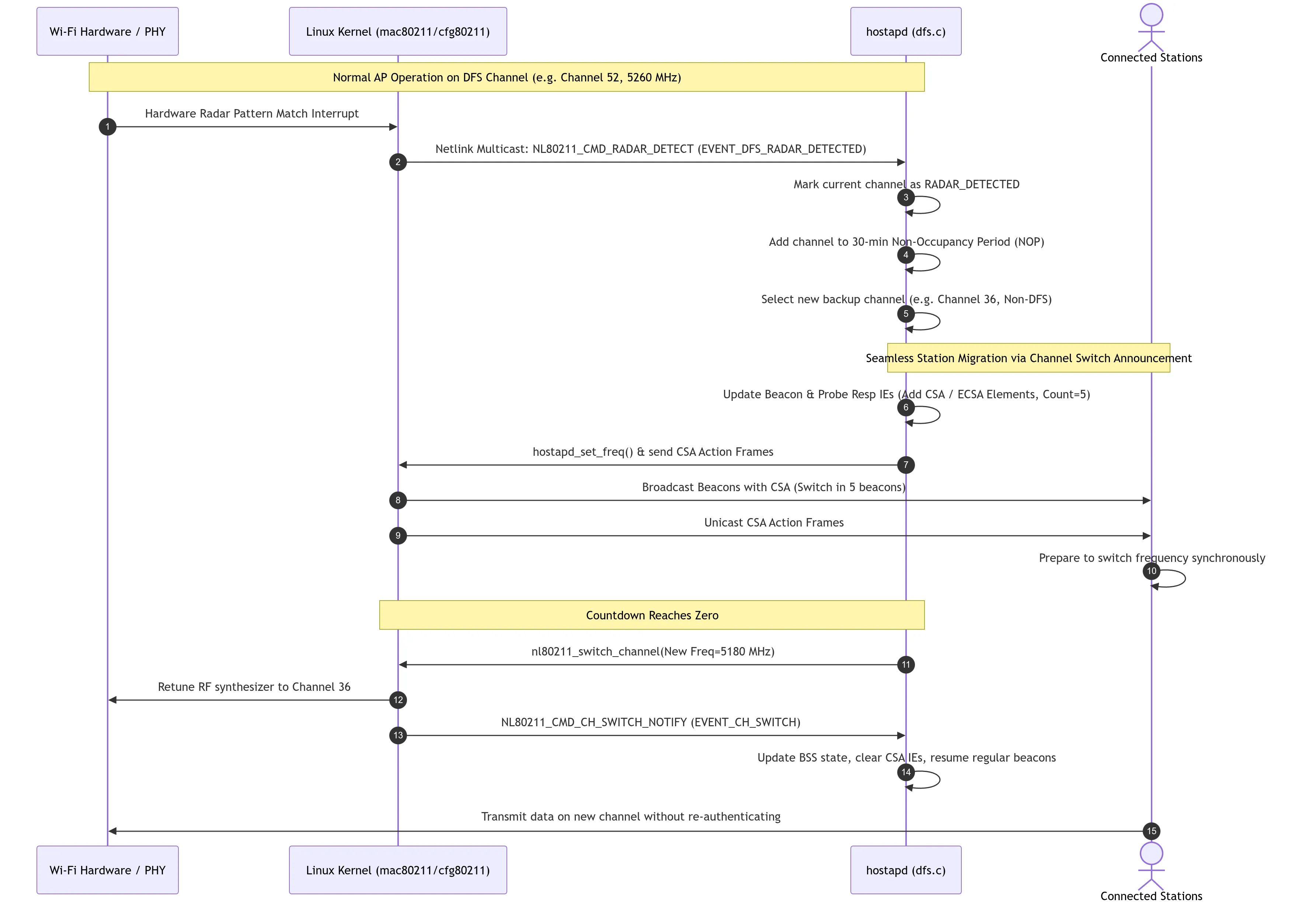
- Dynamic Frequency Selection (
src/ap/dfs.c):- Manages radar detection regulations in 5 GHz UNII-2 / UNII-2 Extended bands.
- Performs Channel Availability Check (CAC) before broadcasting beacons.
- When a radar pulse is detected (
EVENT_DFS_RADAR_DETECTED), initiates Channel Switch Announcement (CSA / ECSA) to smoothly migrate connected stations to a non-radar channel without disconnections, placing the affected channel into a 30-minute Non-Occupancy Period (NOP).
- Automated Frequency Coordination (
src/ap/afc.c):- Supports 6 GHz Standard Power APs by querying centralized AFC databases for allowed frequency ranges and Maximum Permissible EIRP powers based on geolocation.
- 802.11be Multi-Link Operation (
src/ap/ieee802_11_eht.c):- Coordinates multi-radio APs under a single Multi-Link Device (MLD) MAC address.
- Affiliates individual
hostapd_datainstances across different frequency bands (2.4 GHz + 5 GHz + 6 GHz) under a unifiedstruct hostapd_mldstate machine.
Control Interface & IPC Architecture
hostapd provides a rich remote management and IPC framework implemented in hostapd/ctrl_iface.c and src/ap/ctrl_iface_ap.c:
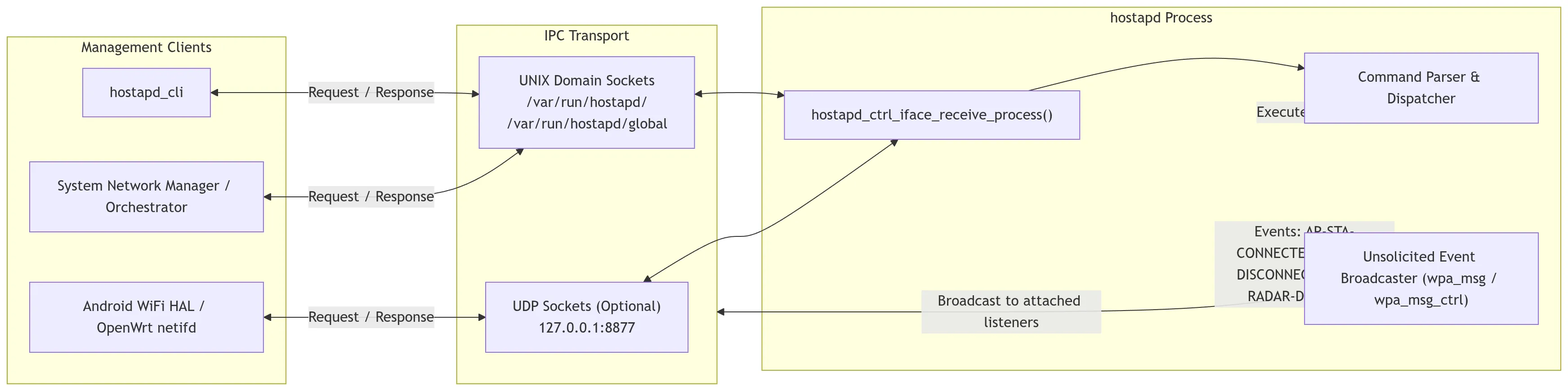
- Control Interface Sockets:
- Per-Interface Sockets (
/var/run/hostapd/wlan0): Targets operations for a specific BSS (e.g.STA,STATUS,DISASSOCIATE,GET_CONFIG). - Global Socket (
/var/run/hostapd/global): Daemon-wide operations (e.g.INTERFACE_ADD,INTERFACE_REMOVE,RELOAD). - MLD Socket (
/var/run/hostapd/mld0): Wi-Fi 7 multi-link device coordination commands.
- Per-Interface Sockets (
- Event Notification Bus: Clients send
ATTACHto register for asynchronous event notifications (AP-STA-CONNECTED,AP-STA-DISCONNECTED,WPS-PBC-ACTIVE,DFS-RADAR-DETECTED,EAP-SUCCESS).
End-to-End Operational Sequences
Station Association & WPA2/WPA3 4-Way Handshake Flow
DFS Radar Detection & Channel Switch Announcement (CSA) Flow
Source Tree Organization Reference Table
| Directory / File | Key Architectural Role | Primary Components & APIs |
|---|---|---|
hostapd/main.c | Main Daemon Entry Point | main(), argument parsing, daemonization, hostapd_global_init(), hostapd_global_run(). |
hostapd/config_file.c | Configuration File Parser | Parses hostapd.conf, multi-BSS blocks, security modes, and rates. |
hostapd/ctrl_iface.c | Daemon IPC Server | UNIX domain socket & UDP request handling, hostapd_cli command execution. |
src/ap/hostapd.c | AP Lifecycle Management | hostapd_setup_interface(), hostapd_enable_iface(), hostapd_reload_config(). |
src/ap/ieee802_11.c | AP MLME & Frame Processing | ieee802_11_mgmt(), handle_auth(), handle_assoc(), handle_action(). |
src/ap/sta_info.c | Station Table Manager | ap_get_sta(), ap_sta_add(), ap_sta_hash_add(), AID allocation, inactivity timers. |
src/ap/wpa_auth.c | WPA/RSN Authenticator | 4-Way Handshake, Group Key Handshake, PTK/GTK/IGTK derivation. |
src/ap/wpa_auth_ft.c | 802.11r Fast Transition | FT over-the-air, FT over-the-DS, R0KH / R1KH key exchange. |
src/ap/beacon.c | Beacon Generator | Information Elements (IE) construction, TIM bitmap, CSA/ECSA injection. |
src/ap/dfs.c | Dynamic Frequency Selection | Radar detection handling, CAC timers, Non-Occupancy Period (NOP) enforcement. |
src/ap/acs.c | Auto Channel Selection | Spectrum scanning, survey data analysis, channel scoring algorithm. |
src/ap/afc.c | 6 GHz Standard Power AFC | Automated Frequency Coordination client for 6 GHz regulatory authorization. |
src/ap/ieee802_11_eht.c | Wi-Fi 7 / 802.11be MLO | Multi-Link Device (MLD) link management, EHT capabilities, partner link sync. |
src/ap/vlan_init.c | Dynamic VLAN Subsystem | 802.1Q tagging, bridge interfaces, per-user dynamic VLAN assignment. |
src/ap/drv_callbacks.c | Kernel Event Dispatcher | wpa_supplicant_event() event router from driver to hostapd core. |
src/ap/ap_drv_ops.c | AP Driver Operation Wrappers | Common wrapper routing high-level AP requests to driver function pointers. |
src/drivers/driver_nl80211.c | Linux nl80211 Driver Wrapper | Generic Netlink (nl80211) communications, socket management, raw packet Tx/Rx. |
src/radius/ | RADIUS Client & Server | RADIUS authentication, accounting, and Dynamic Authorization (DAS / CoA). |
src/eapol_auth/ | 802.1X Authenticator | IEEE 802.1X Port Access Entity (PAE) state machine implementation. |
src/eap_server/ | Integrated EAP Server | EAP-TLS, EAP-TTLS, EAP-PEAP, EAP-SIM, EAP-AKA, EAP-PWD, EAP-FAST. |
src/utils/eloop.c | Asynchronous Event Loop | epoll/poll/select I/O multiplexing, timeouts, signal handling. |
src/utils/wpabuf.c | Resizable Buffer Library | Safe dynamic byte buffer manipulation for frame creation and parsing. |
Summary & Architectural Strengths
- Clean Separation of Concerns: High-frequency data plane encryption and transmission reside inside the kernel (
mac80211/firmware), while complex management state machines and policy decisions reside in user space (hostapd). - Deterministic Concurrency: The asynchronous, single-threaded
eloopdesign completely eliminates concurrency deadlocks and multi-threading race conditions while handling thousands of simultaneous stations. - Pluggable & Portable Architecture: Abstract driver interfaces (
wpa_driver_ops) allow identical AP management logic to operate across Linux (nl80211), BSD, Windows, wired MACsec switches, or software simulation testbeds. - Comprehensive Standards Compliance: Implements the complete lifecycle of IEEE 802.11 standards from legacy 802.11a/b/g up to modern 802.11ax (Wi-Fi 6/6E) and 802.11be (Wi-Fi 7 Multi-Link Operation).