Wi-Fi
Wi-Fi Protected Access 3 (WPA3)
WPA3
In June 2018, the Wi-Fi Alliance officially announced WPA3 (Wi-Fi Protected Access 3), the most significant overhaul of wireless security in over a decade. The announcement came not a moment too soon by that point, WPA2, which had been the industry standard since 2004, was showing serious cracks.
The most devastating blow to WPA2’s reputation came in October 2017 with the disclosure of KRACK (Key Reinstallation Attack), a vulnerability that allowed attackers to manipulate and potentially decrypt WPA2-protected traffic by exploiting weaknesses in the four-way handshake protocol. Around the same time, research demonstrated that offline dictionary attacks against WPA2-PSK (Pre-Shared Key) networks were remarkably practical, especially as GPU-accelerated cracking tools became widely available.
Note: By 2018, WPA2-PSK networks were vulnerable to offline brute-force attacks that could be executed on commodity hardware at billions of password guesses per second a sobering reality for anyone relying on a short Wi-Fi passphrase.
WPA3 was designed from the ground up to address these vulnerabilities, modernize cryptographic standards, and make Wi-Fi security robust enough for the next generation of connected devices from smartphones and laptops to IoT sensors and smart-city infrastructure.
History of Wi-Fi Security
Understanding WPA3 requires appreciating the lineage it evolved from. Wi-Fi security did not begin strong it began as almost an afterthought.
WEP (1997–2003)
Wired Equivalent Privacy (WEP) was introduced alongside the original 802.11 standard. It used the RC4 stream cipher with a 40-bit (later 104-bit) key and a 24-bit Initialization Vector (IV). By 2001, researchers had demonstrated that WEP could be cracked in minutes by passively collecting enough packets. The IV space was too small, key management was static, and the protocol lacked integrity protection. WEP was formally deprecated in 2004.
WPA (2003–2004)
Wi-Fi Protected Access (WPA) was a transitional standard designed to run on existing WEP hardware. It introduced TKIP (Temporal Key Integrity Protocol), which dynamically generated per-packet keys using a 128-bit key and a per-packet mixing function. While far better than WEP, TKIP was a patch over a fundamentally weak cipher (RC4) and was eventually found to be vulnerable to certain theoretical attacks.
WPA2 (2004–2018)
WPA2 introduced mandatory support for AES-CCMP (Advanced Encryption Standard in Counter Mode with CBC-MAC), a vastly stronger encryption scheme. WPA2 became the gold standard for over 14 years. However, its four-way handshake remained susceptible to offline dictionary attacks, and the KRACK vulnerability of 2017 exposed deeper flaws in its key reinstallation logic.
WPA3 Definition and Architecture
WPA3 (Wi-Fi Protected Access 3) is the security standard succeeding WPA2, split into two main branches:
-
WPA3-Personal: for home/personal networks, authenticated with a password via SAE (Simultaneous Authentication of Equals), replacing WPA2’s PSK.
-
WPA3-Enterprise: for enterprise networks, authenticated via 802.1X/EAP (certificates, username/password, SIM, etc.), with an additional 192-bit mode for high-security environments (government, defense).
Each device (AP or STA) is configured to operate in one of several “modes” — combinations of allowed AKMs (Authentication and Key Management), cipher suites, and PMF (Protected Management Frames) requirements.

Types of “Security Association” (WPA2 vs WPA3)
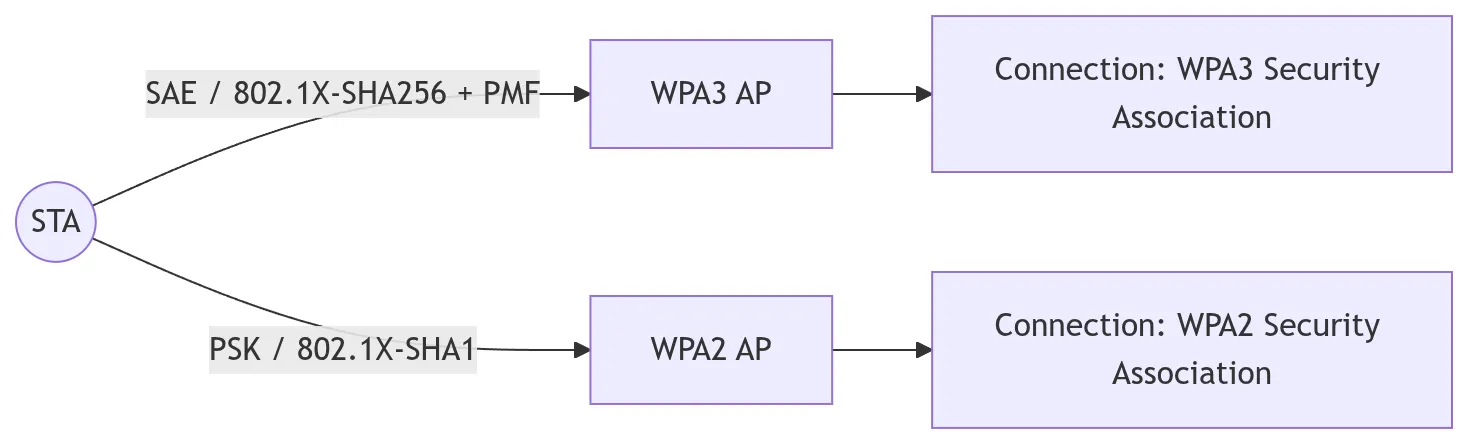
When an AP and STA successfully connect, the result can be a WPA3 security association or a WPA2 security association, depending on the negotiated AKM and PMF.
| Condition | Result |
|---|---|
| AKM ∈ {SAE, FT-SAE, 802.1X-SHA256, FT-802.1X, 802.1X 192-bit, FT-802.1X-SHA384} and PMF enabled | WPA3 |
| AKM ∈ {PSK, FT-PSK, 802.1X-SHA1, FT-802.1X} | WPA2 |
| WPA3 STA connects to a WPA2-only AP (or vice versa) | WPA2 (downgraded) |
WPA3-Personal
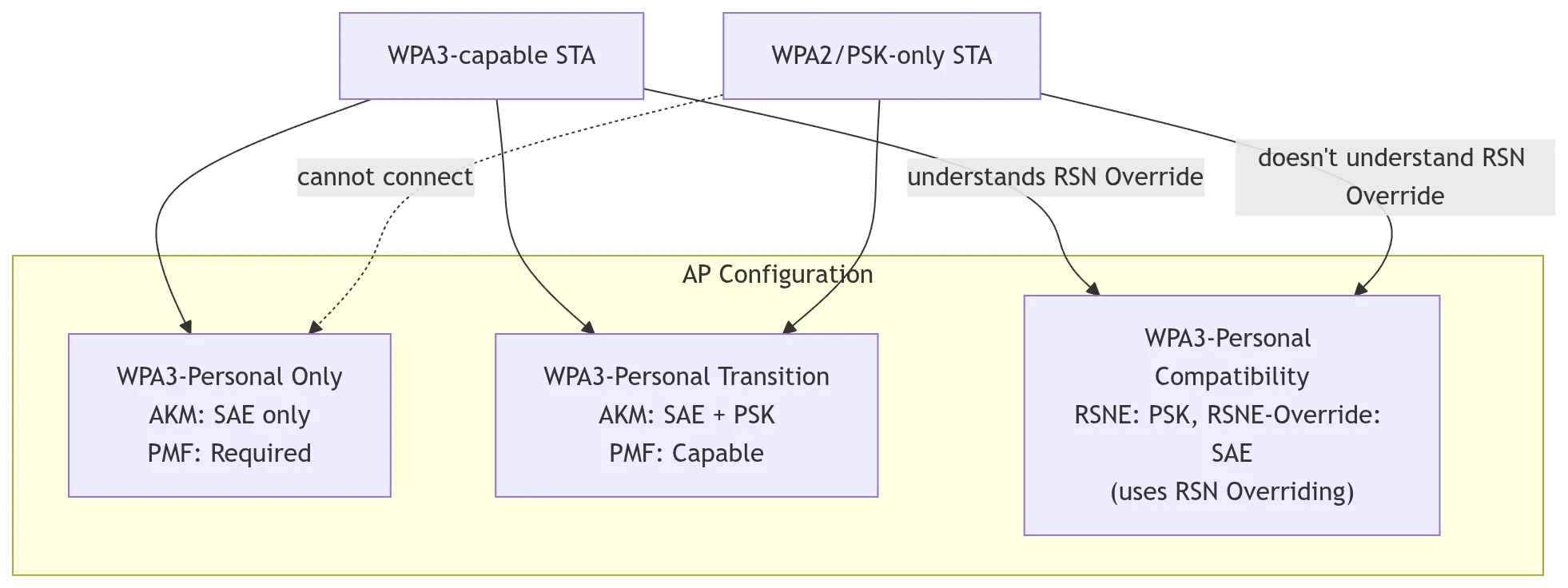
WPA3-Personal Only Mode
-
Only enables the SAE AKM (00-0F-AC:8) and/or SAE group-dependent hash (00-0F-AC:24).
-
Prohibits any PSK-type AKM.
-
PMF Required (MFPC=1, MFPR=1).
-
⇒ Legacy devices that only support PSK will not be able to connect.
WPA3-Personal Transition Mode
-
Enables both SAE and PSK simultaneously for backward compatibility with WPA2 devices.
-
PMF is Capable (MFPC=1, MFPR=0) — not mandatory, but if the STA selects SAE, PMF must still be negotiated.
-
WPA3-capable STAs will automatically pick SAE (more secure); legacy STAs use PSK.
-
Not used in the 6 GHz or Sub-1GHz bands (these bands require SAE only).
WPA3-Personal Compatibility Mode
-
A newer mechanism (since v3.4) that uses RSN Overriding so the AP can advertise PSK (in the regular RSNE) and SAE (in the RSNE Override) at the same time — allowing modern WPA3 STAs to see SAE without breaking compatibility with legacy WPA2 STAs (some older STAs fail when the RSNE advertises multiple AKMs at once).
-
There is no separate STA mode — a STA that understands RSN Override will upgrade to WPA3; a STA that doesn’t will fall back to WPA2.
WPA3-Personal SAE-PK Only/Transition Mode
See details in section 6 (SAE-PK).
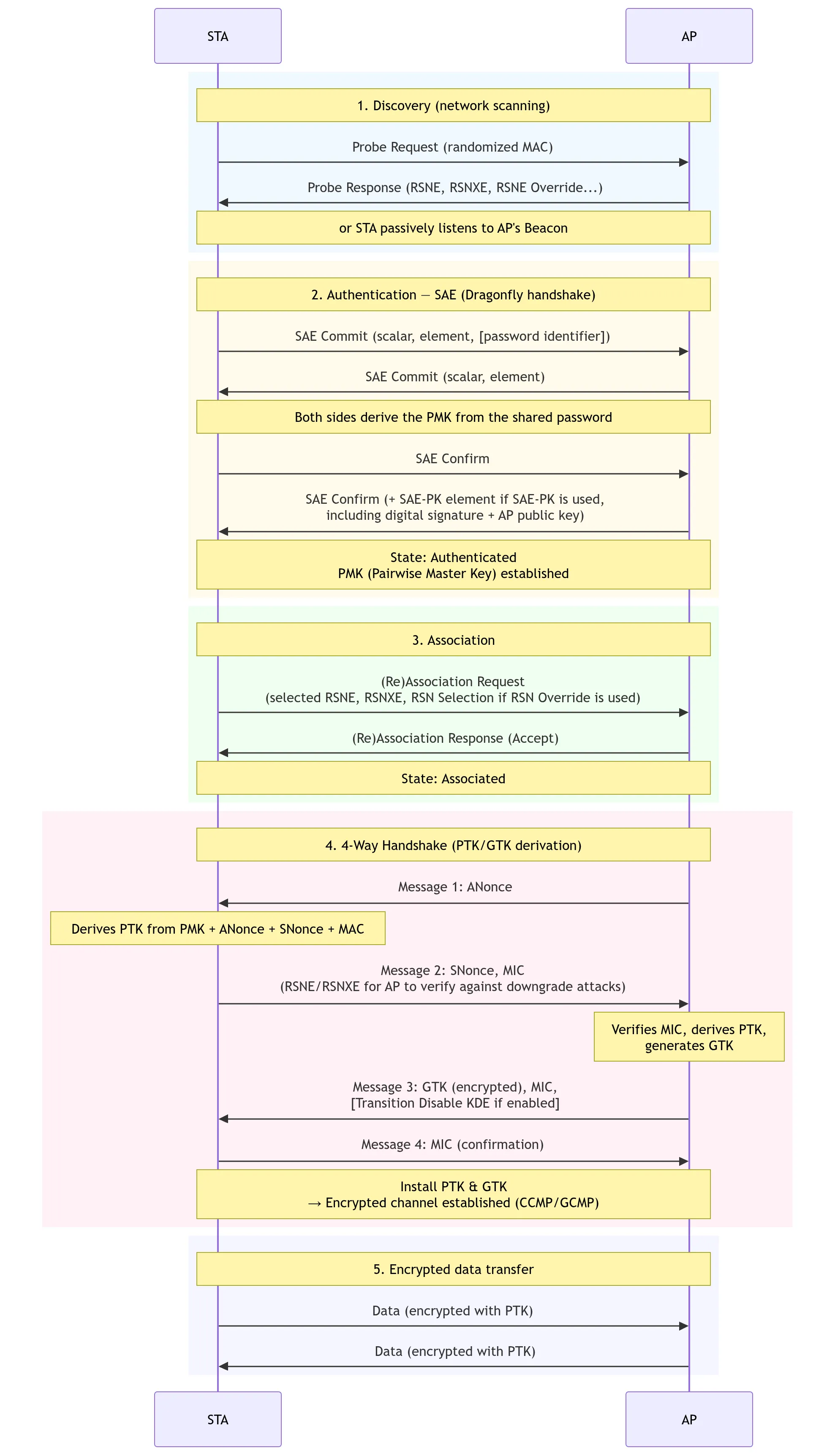
WPA3-Personal (SAE) Connection Message Flow
WPA3-Enterprise
| Mode | Required/Allowed AKM | PMF | Notes |
|---|---|---|---|
| Only Mode | 802.1X-SHA256 (00-0F-AC:5) | Required | SHA1 prohibited |
| Transition Mode | SHA1 (00-0F-AC:1) + SHA256 (00-0F-AC:5) | Capable | Backward compatibility |
| 192-bit Mode | Suite-B 192-bit (00-0F-AC:12) | Required | GCMP-256 + BIP-GMAC-256; strong EAP certificates required |
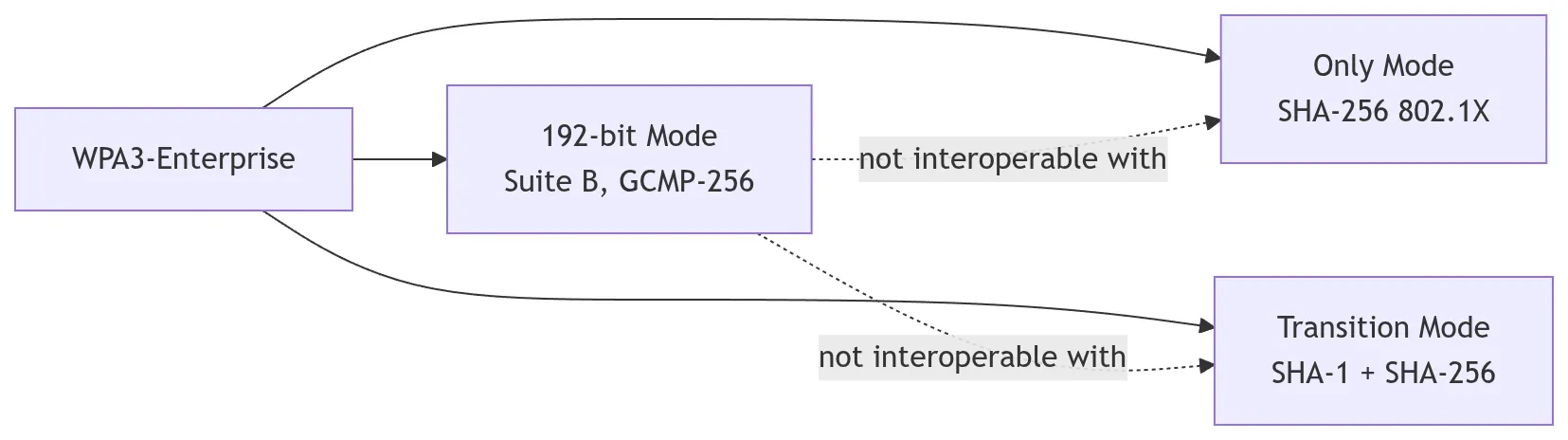
WPA3-Enterprise Connection Message Flow
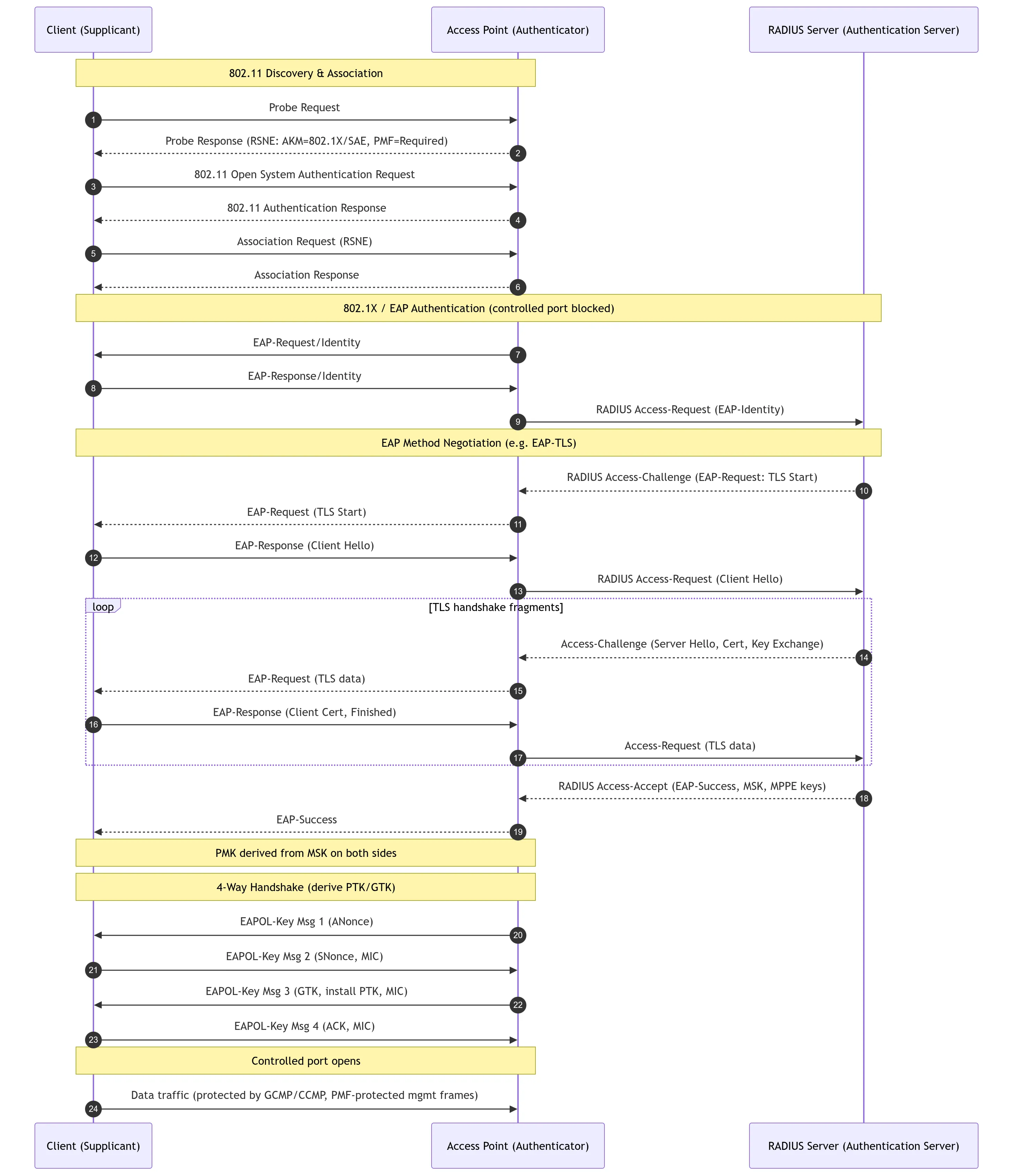
AKM-based Classification
AKM Summary Table
| AKM Selector | Name | Type | Security Association |
|---|---|---|---|
| 00-0F-AC:2 | PSK | Personal | WPA2 |
| 00-0F-AC:4 | FT over PSK | Personal | WPA2 |
| 00-0F-AC:6 | PSK SHA-256 | Personal | WPA2 |
| 00-0F-AC:8 | SAE | Personal | WPA3 |
| 00-0F-AC:9 | FT over SAE | Personal | WPA3 |
| 00-0F-AC:24 | SAE (group-dependent hash) | Personal | WPA3 |
| 00-0F-AC:25 | FT over SAE (group-dependent hash) | Personal | WPA3 |
| 00-0F-AC:1 | 802.1X SHA-1 | Enterprise | WPA2 |
| 00-0F-AC:5 | 802.1X SHA-256 | Enterprise | WPA3 |
| 00-0F-AC:3 | FT over 802.1X | Enterprise | WPA3 (if PMF enabled) |
| 00-0F-AC:12 | 802.1X SHA-384 (Suite B 192-bit) | Enterprise | WPA3 192-bit |
STA AKM Selection Preference Order
When an AP advertises multiple AKMs, a WPA3 STA must select according to this descending preference order:
Personal: FT-SAE(H2E) → SAE(H2E) → FT-SAE → SAE → FT-PSK → PSK-SHA256 → PSK
Enterprise: FT-802.1X-SHA256 → 802.1X-SHA256 → 802.1X-SHA1
SAE-PK (SAE Public Key)
The Problem
With regular SAE/PSK, the password is a symmetric secret — anyone who knows the password (including an attacker) can impersonate the AP (“evil twin”) to launch a man-in-the-middle attack.
The SAE-PK Solution
The AP additionally holds an ECDSA public/private key pair. The SAE-PK password is generated so that it represents a fingerprint of the AP’s public key → it serves both as the access password and as a way for the STA to authenticate the AP’s identity.
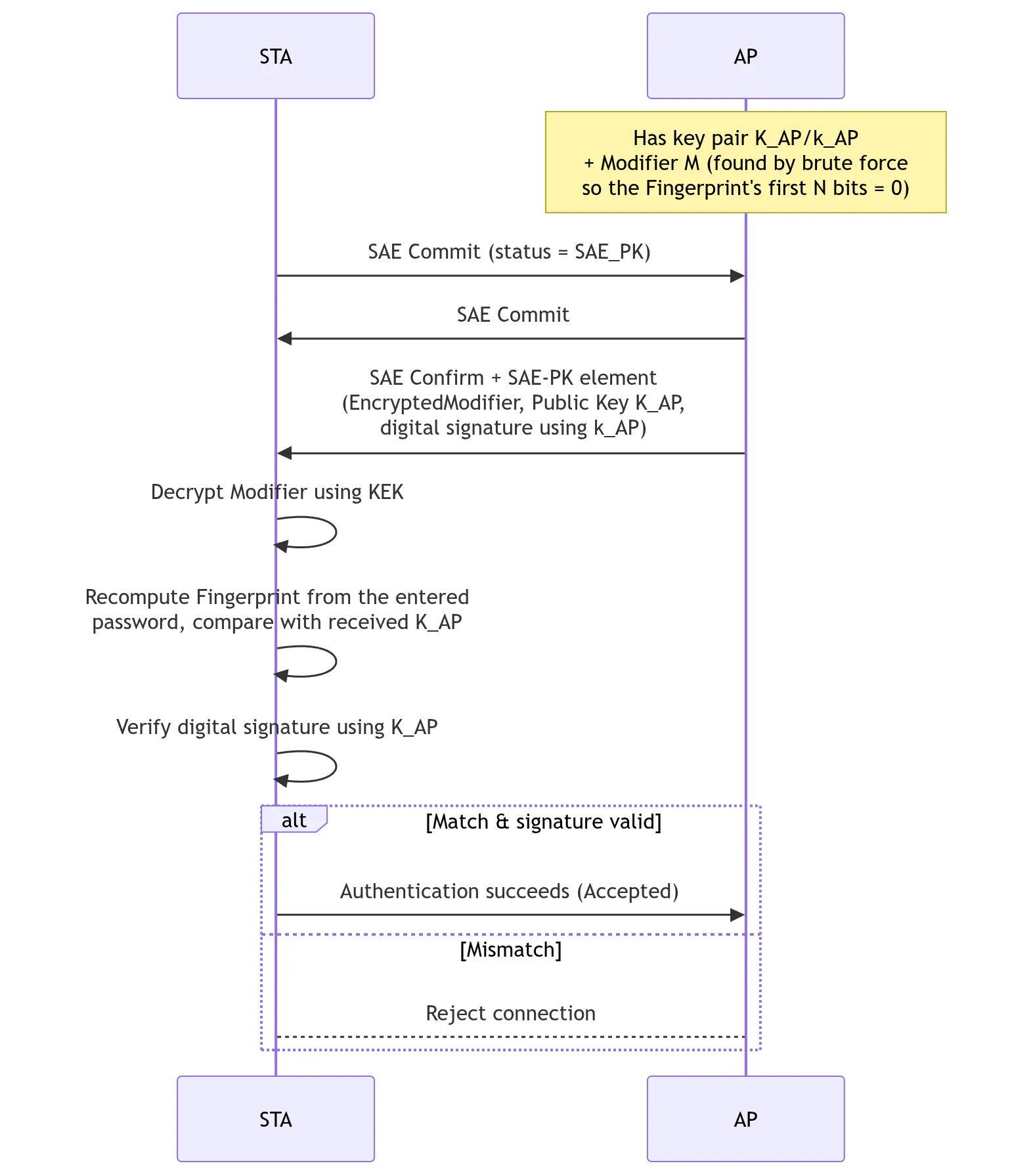
SAE-PK Password Format
Example (λ=12): a2bc-de3f-ghi4
-
Base32-encoded (lowercase), with a hyphen inserted every 4 characters.
-
A final checksum character (Verhoeff algorithm) to detect typos.
-
The
Secparameter (3 or 5 octets) determines the strength against second-preimage attacks.
| λ (character count) | Sec | Strength S (bits) | Average brute-force time (50 TH/s) |
|---|---|---|---|
| 12 | 3 | 76 | 48 years |
| 12 | 5 | 92 | 3.1 million years |
| 16 | 3 | 95 | 25.1 million years |
| 16 | 5 | 111 | 1.6 trillion years |
WIFI URI / QR Code
WPA3 defines a WIFI:...;; syntax for embedding network information into a QR code, enabling quick device provisioning.
WIFI:T:WPA;R:3;S:MyNet;P:a2bc-de3f-ghi4;K:<base64 public key>;;| Field | Meaning |
|---|---|
T | Security type (WPA = password-based; absent = open network/Enhanced Open) |
R | Transition Disable bitmap (hex form) |
S | SSID |
H | Hidden SSID (true/false) |
I | SAE Password Identifier |
P | Password |
K | AP public key (only present when SAE-PK is supported) |
Transition Disable
The Problem: A STA configured in “Transition Mode” (accepting both WPA2 & WPA3) can still be tricked into connecting to a fake AP that only supports weaker algorithms (PSK, SHA-1, etc.).
The Solution: After successfully connecting using the strongest algorithm, the AP sends the STA a Transition Disable KDE (in the 4-way handshake, encrypted) — instructing the STA to lock down its Network Profile so it no longer allows weaker algorithms on subsequent connections.
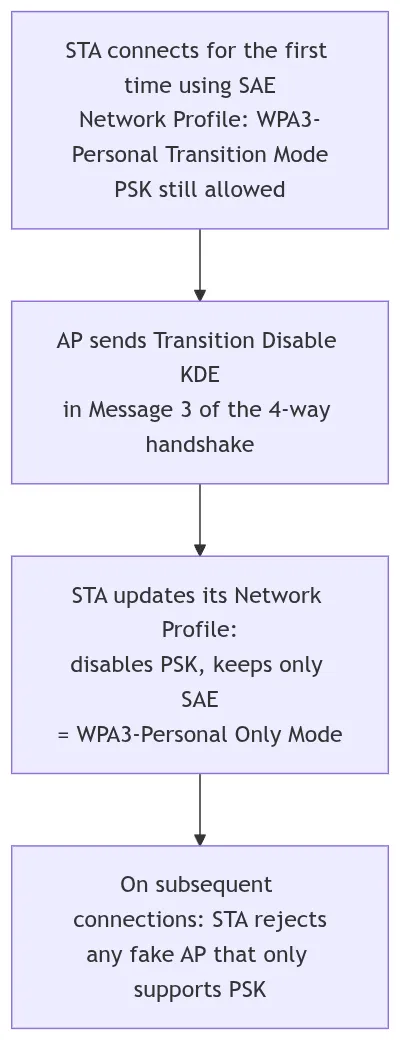
Transition Disable Bitmap Bits
| Bit | Name | Strongest algorithm | Algorithms disabled |
|---|---|---|---|
| 0 | WPA3-Personal Only | SAE / SAE(H2E) | All PSK / FT-PSK |
| 1 | SAE-PK Only | SAE-PK | SAE without SAE-PK, PSK |
| 2 | WPA3-Enterprise | 802.1X SHA-256 | 802.1X SHA-1 |
| 3 | Wi-Fi Enhanced Open | OWE | Open without encryption |
Server Certificate Validation & UOSC (WPA3-Enterprise)
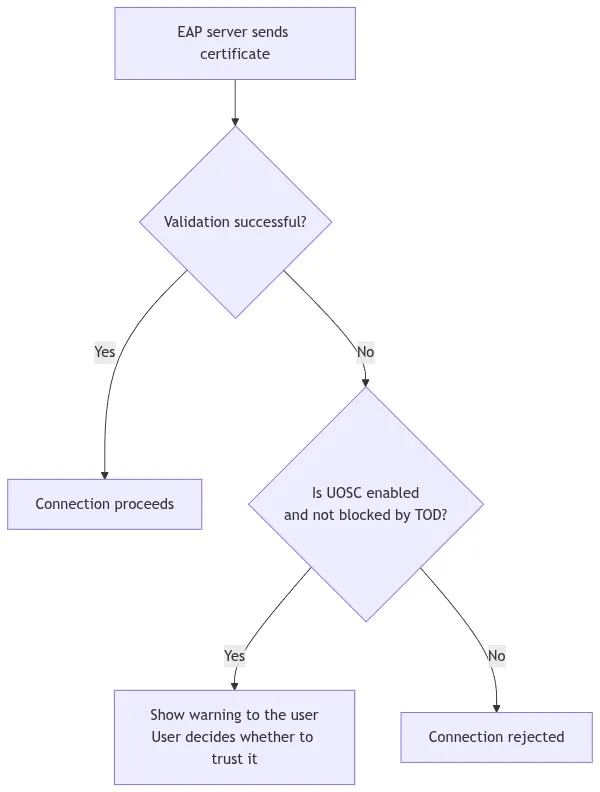
When using EAP-TLS/TTLS/PEAP, the STA is required to validate the server’s certificate. If validation fails, the STA may (optionally) allow the user to perform UOSC – User Override of Server Certificate (manual acceptance) — unless prohibited by a TOD (Trust Override Disable) policy embedded in the certificate:
-
TOD-STRICT: Prohibits UOSC entirely (even on the very first connection).
-
TOD-TOFU: Allows UOSC on the first connection (Trust-On-First-Use), but prohibits it on subsequent connections once a certificate has been stored.
RSN Overriding — Solving Compatibility Issues When Extending the Standard
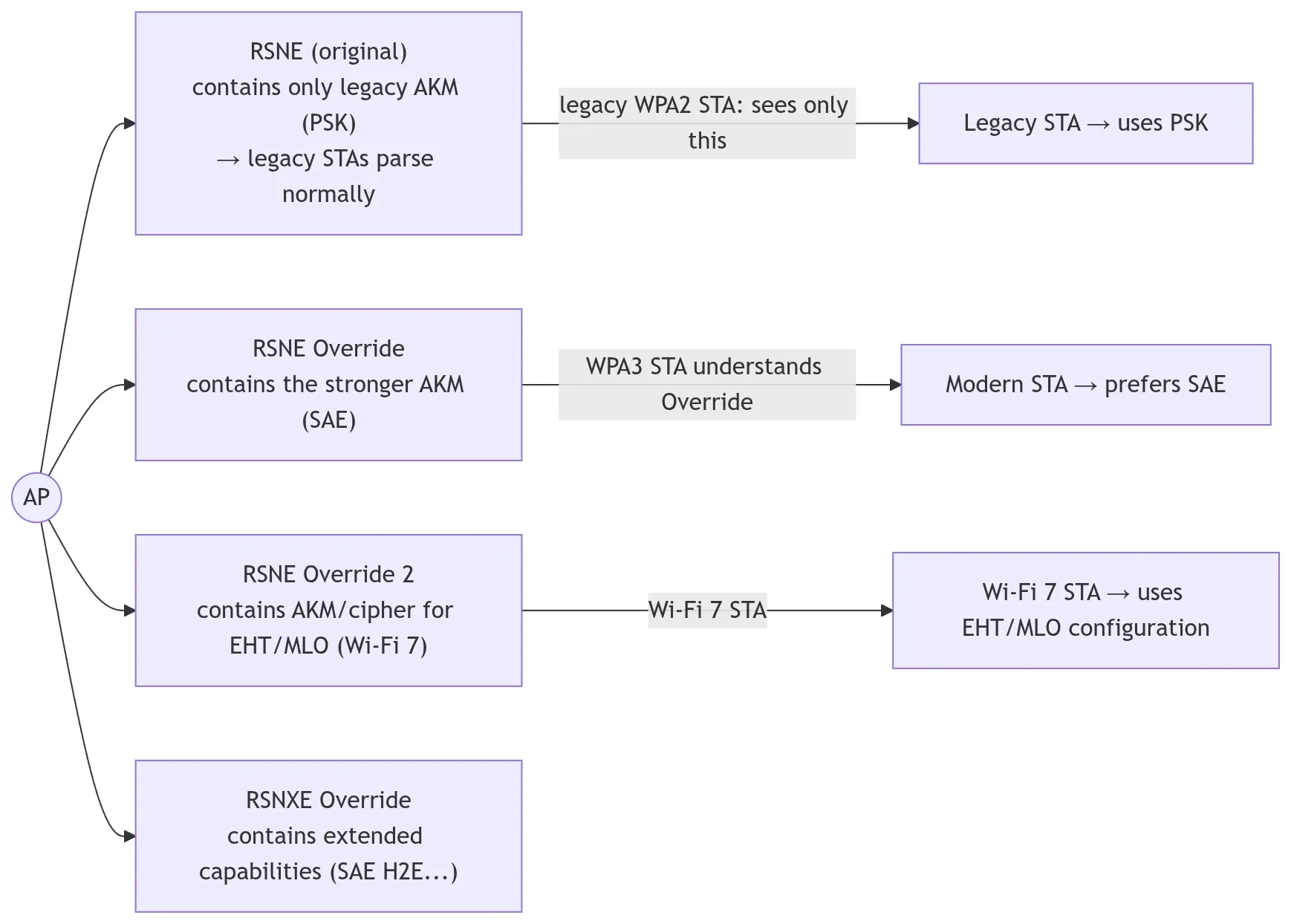
The Problem: Some legacy STAs fail/crash when parsing an RSNE that lists too many AKMs/ciphers at once (e.g., when an AP adds SAE alongside PSK).
The Solution: Instead of stuffing everything into one RSNE, the AP splits the information into multiple separate elements:
-
A STA that supports RSN Overriding signals this capability by setting the last six octets of its SNonce to a fixed value
50:6F:9A:00:00:29(SNonce cookie) during the 4-way handshake — the AP recognizes this and returns all RSNE/RSNXE variants in Message 3 so the STA can verify it isn’t being subjected to a downgrade attack (ensuring the AP isn’t hiding stronger security options). -
This mechanism is the foundation of WPA3-Personal Compatibility Mode (section 3.3).
Constraints by Frequency Band / Wi-Fi Generation
| Band / Standard | Key constraints |
|---|---|
| 6 GHz | PMF Required is mandatory; TKIP, PSK, 802.1X-SHA1 prohibited; WPA3-Personal/Enterprise Transition Mode prohibited; SAE Hunting-and-Pecking prohibited (Hash-to-Element only) |
| Sub-1GHz | Similar to 6 GHz (Transition Mode prohibited, PMF mandatory) |
| EHT / MLO (Wi-Fi 7) | PSK and 802.1X-SHA1 prohibited in associations using EHT/MLO; AKM 00-0F-AC:24 (SAE-H2E) & GCMP-256 mandatory; unencrypted Open prohibited |
Data Packet Handling Protections
The specification lists numerous real-world vulnerabilities that have been exploited (fragmentation/cache attacks, plaintext injection, etc.) and requires devices to:
-
Never reassemble fragments encrypted with different keys.
-
Discard incomplete fragments upon a new association/reassociation (to prevent cache attacks).
-
Verify that the Packet Number (PN) of consecutive fragments increments by exactly 1.
-
Reject plaintext fragments when the MSDU/MMPDU is expected to be encrypted.
-
Never accept fragmented broadcast/multicast frames.
-
Check each A-MSDU subframe individually, preventing abuse of a fake EAPOL header.
-
APs must not forward EAPOL frames (to prevent DoS).
-
Verify TKIP MIC at the full MSDU level.
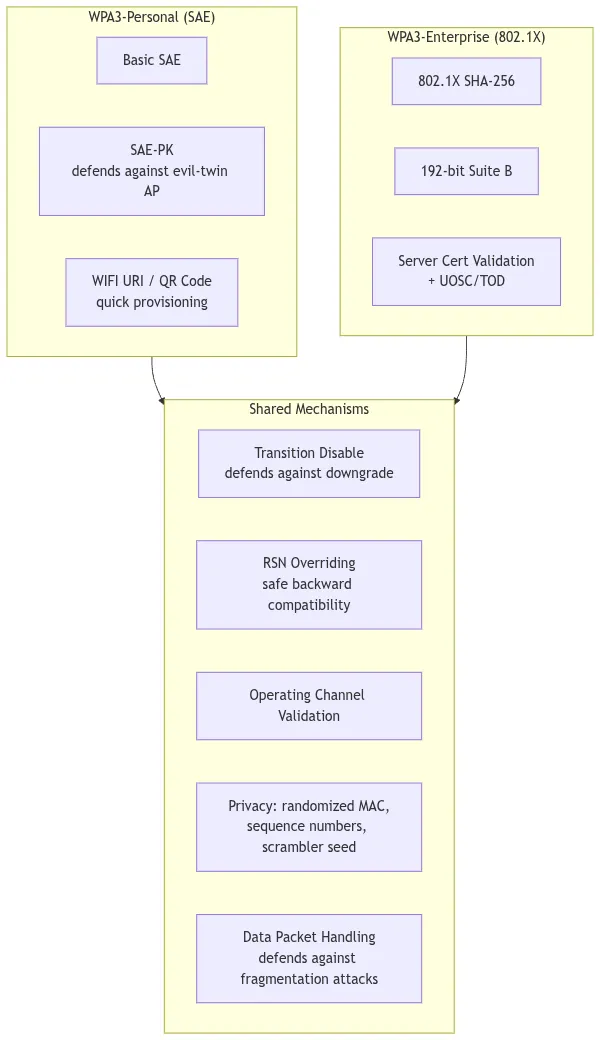
Summary
Source
Original document: WPA3™ Specification Version 3.5, Wi-Fi Alliance, © 2025 (copyright owned by Wi-Fi Alliance, used under the terms stated in the original document).