Linux Netfilter and Traffic Control
Linux Netfilter and Traffic Control
Overview
Netfilter is a framework inside the Linux kernel which offers flexibility for various networking-related operations to be implemented in form of customized handlers. Netfilter offers various options for packet filtering, network address translation, and port translation. Its components:
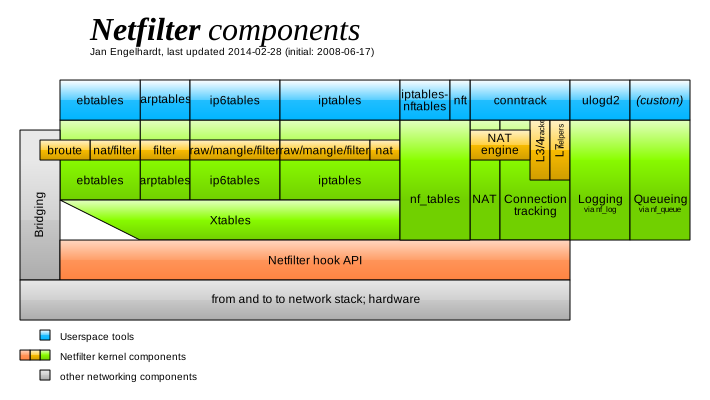
And the flow of network packets through the Netfilter:
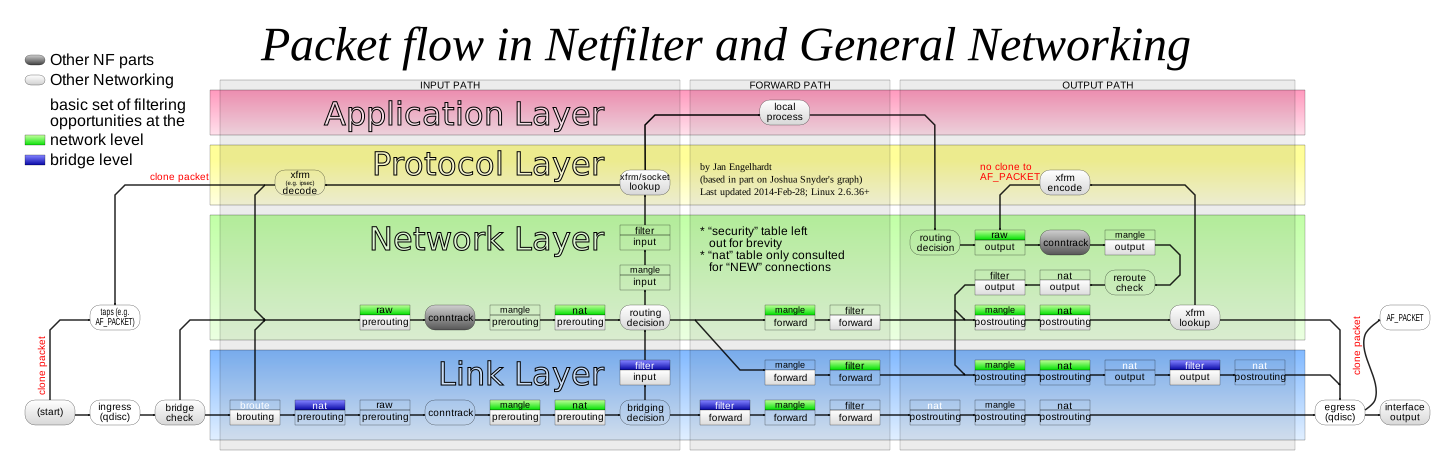
Netfilter Hooks in the Linux Kernel
Netfilter places
As can be seen from the network packet sending and receiving flow diagram above, the hook function of Nefilter can be registered in many different places. It is defined as follows:
1
2
3
4
5
6
7
8
enum nf_inet_hooks {
        NF_INET_PRE_ROUTING,
        NF_INET_LOCAL_IN,
        NF_INET_FORWARD,
        NF_INET_LOCAL_OUT,
        NF_INET_POST_ROUTING,
        NF_INET_NUMHOOKS
};
- NF_INET_PRE_ROUTING: incoming packets pass this hook in the ip_rcv() (linux/net/ipv4/ip_input.c) function before they are processed by the routing code.
- NF_INET_LOCAL_IN: all incoming packets addressed to the local computer pass this hook in the function ip_local_deliver().
- NF_INET_FORWARD: incoming packets are passed this hook in the function ip_forwared().
- NF_INET_LOCAL_OUT: all outgoing packets created in the local computer pass this hook in the function ip_build_and_send_pkt().
- NF_INET_POST_ROUTING: this hook in the ipfinishoutput() function before they leave the computer.
Register the hooks
The kernel provides the following functions to register and unregister functions.
1
2
3
4
int nf_register_hook(struct nf_hook_ops *reg);
void nf_unregister_hook(struct nf_hook_ops *reg);
int nf_register_hooks(struct nf_hook_ops *reg, unsigned int n);
void nf_unregister_hooks(struct nf_hook_ops *reg, unsigned int n);
Among them, nf_hook_ops is structured as follows:
1
2
3
4
5
6
7
8
9
10
11
12
struct nf_hook_ops
{
        struct list_head list;

        /* User fills in from here down. */
        nf_hookfn *hook;
        struct module *owner;
        u_int8_t pf;
        unsigned int hooknum;
        /* Hooks are ordered in ascending priority. */
        int priority;
};
hook functions
The hook function is specified by nf_hookfn *hook and its function declaration is as follows:
1
2
3
4
5
typedef unsigned int nf_hookfn(unsigned int hooknum,
                               struct sk_buff *skb,
                               const struct net_device *in,
                               const struct net_device *out,
                               int (*okfn)(struct sk_buff *));
It returns one of the following results:
1
2
3
4
5
6
7
8
// <linux/netfilter.h>
#define NF_DROP 0
#define NF_ACCEPT 1
#define NF_STOLEN 2
#define NF_QUEUE 3
#define NF_REPEAT 4
#define NF_STOP 5
#define NF_MAX_VERDICT NF_STOP
pf
pf (protocol family) is the identifier of the protocol family.
1
2
3
4
5
6
7
8
9
enum {
        NFPROTO_UNSPEC =  0,
        NFPROTO_IPV4   =  2,
        NFPROTO_ARP    =  3,
        NFPROTO_BRIDGE =  7,
        NFPROTO_IPV6   = 10,
        NFPROTO_DECNET = 12,
        NFPROTO_NUMPROTO,
};
hooknum
This is the hook identifier. All valid identifiers for each protocol family are defined in a header file, for example <linux/netfilter_ipv4.h>:
1
2
3
4
5
6
7
8
9
10
11
12
/* IP Hooks */
/* After promisc drops, checksum checks. */
#define NF_IP_PRE_ROUTING       0
/* If the packet is destined for this box. */
#define NF_IP_LOCAL_IN          1
/* If the packet is destined for another interface. */
#define NF_IP_FORWARD           2
/* Packets coming from a local process. */
#define NF_IP_LOCAL_OUT         3
/* Packets about to hit the wire. */
#define NF_IP_POST_ROUTING      4
#define NF_IP_NUMHOOKS          5
priority
This is the priority of the hook. All valid identifiers for each protocol family are defined in a header file, for example <linux/netfilter_ipv4.h>
1
2
3
4
5
6
7
8
9
10
11
12
13
14
15
16
17
18
19
20
21
22
23
24
25
26
enum nf_ip_hook_priorities {
        NF_IP_PRI_FIRST = INT_MIN,
        NF_IP_PRI_CONNTRACK_DEFRAG = -400,
        NF_IP_PRI_RAW = -300,
        NF_IP_PRI_SELINUX_FIRST = -225,
        NF_IP_PRI_CONNTRACK = -200,
        NF_IP_PRI_MANGLE = -150,
        NF_IP_PRI_NAT_DST = -100,
        NF_IP_PRI_FILTER = 0,
        NF_IP_PRI_SECURITY = 50,
        NF_IP_PRI_NAT_SRC = 100,
        NF_IP_PRI_SELINUX_LAST = 225,
        NF_IP_PRI_CONNTRACK_CONFIRM = INT_MAX,
        NF_IP_PRI_LAST = INT_MAX,
};

enum {
        NFPROTO_UNSPEC =  0,
        NFPROTO_IPV4   =  2,
        NFPROTO_ARP    =  3,
        NFPROTO_BRIDGE =  7,
        NFPROTO_IPV6   = 10,
        NFPROTO_DECNET = 12,
        NFPROTO_NUMPROTO,
};
Netfilter hooks example
Register a hook function at NF_INET_LOCAL_IN to print the source MAC address, destination and IP address of the packet. Download the source packet.
1
2
3
4
5
6
7
8
9
10
11
12
13
14
15
16
17
18
19
20
21
22
23
24
25
26
27
28
29
30
31
32
33
34
35
36
37
38
39
40
41
42
43
44
45
46
47
48
49
50
51
52
53
54
55
56
57
58
59
60
61
62
63
64
65
66
67
68
69
70
71
72
73
74
75
#include <linux/module.h>
#include <linux/kernel.h>
#include <linux/types.h>
#include <linux/skbuff.h>
#include <linux/ip.h>
#include <linux/udp.h>
#include <linux/tcp.h>
#include <linux/netfilter.h>
#include <linux/netfilter_ipv4.h>


MODULE_LICENSE("GPLv3");
MODULE_AUTHOR("You");
MODULE_DESCRIPTION("Netfliter test");

static unsigned int
nf_test_in_hook(unsigned int hook, struct sk_buff *skb, const struct net_device *in,
                const struct net_device *out, int (*okfn)(struct sk_buff*));

static struct nf_hook_ops nf_test_ops[] __read_mostly = {
  {
    .hook = nf_test_in_hook,
    .owner = THIS_MODULE,
    .pf = NFPROTO_IPV4,
    .hooknum = NF_INET_LOCAL_IN,
    .priority = NF_IP_PRI_FIRST,
  },
};

void hdr_dump(struct ethhdr *ehdr) {
    printk("[MAC_DES:%x,%x,%x,%x,%x,%x"
           "MAC_SRC: %x,%x,%x,%x,%x,%x Prot:%x]\n",
           ehdr->h_dest[0],ehdr->h_dest[1],ehdr->h_dest[2],ehdr->h_dest[3],
           ehdr->h_dest[4],ehdr->h_dest[5],ehdr->h_source[0],ehdr->h_source[1],
           ehdr->h_source[2],ehdr->h_source[3],ehdr->h_source[4],
           ehdr->h_source[5],ehdr->h_proto);
}

#define NIPQUAD(addr) \
        ((unsigned char *)&addr)[0], \
        ((unsigned char *)&addr)[1], \
        ((unsigned char *)&addr)[2], \
        ((unsigned char *)&addr)[3]
#define NIPQUAD_FMT "%u.%u.%u.%u"

static unsigned int
nf_test_in_hook(unsigned int hook, struct sk_buff *skb, const struct net_device *in,
                const struct net_device *out, int (*okfn)(struct sk_buff*)) {
  struct ethhdr *eth_header;
  struct iphdr *ip_header;
  eth_header = (struct ethhdr *)(skb_mac_header(skb));
  ip_header = (struct iphdr *)(skb_network_header(skb));
  hdr_dump(eth_header);
  printk("src IP:'"NIPQUAD_FMT"', dst IP:'"NIPQUAD_FMT"' \n",
         NIPQUAD(ip_header->saddr), NIPQUAD(ip_header->daddr));
  return NF_ACCEPT;
}

static int __init init_nf_test(void) {
  int ret;
  ret = nf_register_hooks(nf_test_ops, ARRAY_SIZE(nf_test_ops));
  if (ret < 0) {
    printk("register nf hook fail\n");
    return ret;
  }
  printk(KERN_NOTICE "register nf test hook\n");
  return 0;
}

static void __exit exit_nf_test(void) {
  nf_unregister_hooks(nf_test_ops, ARRAY_SIZE(nf_test_ops));
}

module_init(init_nf_test);
module_exit(exit_nf_test);
References
- https://wiki.dreamrunner.org/public_html/Linux/Networks/netfilter.html
This post is licensed under CC BY 4.0 by the author.