
Software Architecture
Software Architecture and Technology of Large Scale Systems
A software leader's guide to large scale systems: how to move from developer to architect, how to evaluate an architecture, the core techniques for scalability, reliability, performance, data and security, and a layered router platform as a worked example.
Developer To Architect
A developer is paid to make one component correct. An architect is paid to make a whole system keep working while it grows: more users, more devices, more engineers, more features, and more things that can fail. The difference is not seniority, it is the question you ask.
| A developer asks | An architect asks |
|---|---|
| Does this function work? | What happens to this function when the load is 100 times higher? |
| Which library is best? | What does it cost to replace this library in three years? |
| How do I fix this bug? | What class of bugs does this design make impossible, and which does it make likely? |
| How do I finish my task? | How do five teams finish theirs without blocking each other? |
Habits that I have seen separate the two:
- Think in trade-offs, not in best practices. Every real decision gives something up. Write down what you give up.
- Own the quality attributes. Features are visible. Latency, availability, security and operability are invisible until they fail, so someone must own them explicitly.
- Optimise for change. A system is judged by how cheaply it can change, not by how elegant it was on day one.
- Make decisions explicit. A short written record of why a choice was made is worth more than the diagram of what was chosen.
- Stay close to the code. An architect who stops reading code, traces and incident reports ends up designing systems that do not exist.
What Makes a System “Large Scale”?
Large scale does not only mean many users. A system is large in several independent dimensions, and each one breaks a different assumption:
| Dimension | Example | What breaks |
|---|---|---|
| Load | Millions of requests per second | A single machine, a single database, a lock |
| Data | Petabytes of state | Backups, migrations, queries that scan |
| Geography | Users on every continent | The speed of light: latency can only be hidden, never removed |
| Fleet | Millions of deployed devices (routers, phones, sensors) | Manual operations, version diversity, flaky connectivity |
| Organisation | Hundreds of engineers in dozens of teams | Shared ownership, release coordination, one big codebase |
| Time | Ten years of accumulated decisions | Understanding, upgrade paths, data formats |
Two consequences follow, and they are the core of this post:
- At scale, rare events become routine. A disk that fails once in five years fails every day in a fleet of two thousand disks. Design for failure as the normal case.
- At scale, coordination is the real cost. Anything that needs every node, every team or every request to agree is the first thing that stops scaling.
Evaluating an Architecture
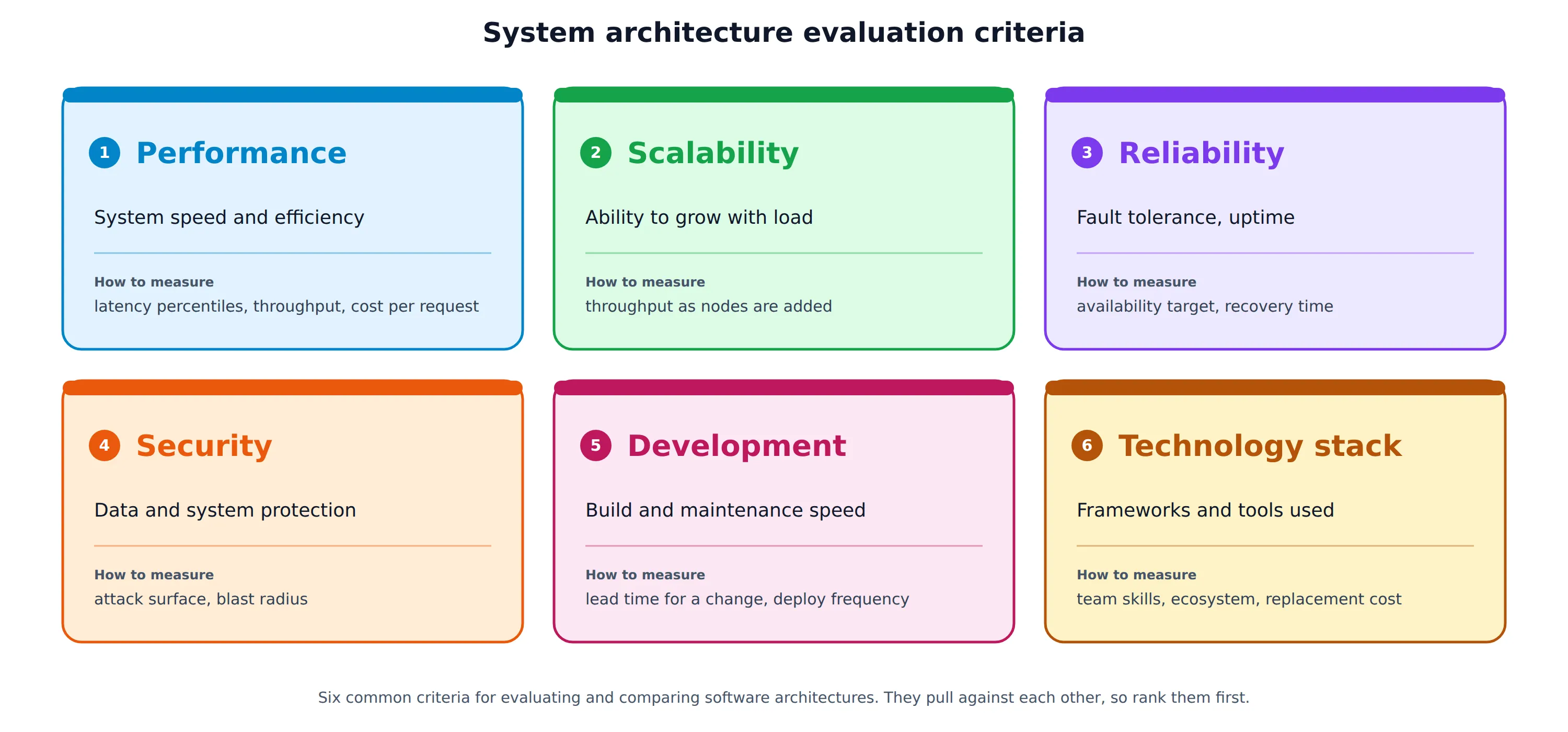
There is no “good architecture” in the abstract, only an architecture that fits a set of priorities. Six criteria cover most reviews:
| Criterion | The question to ask | A measurable form |
|---|---|---|
| Performance | How fast and how efficient is it? | p50 / p99 latency, throughput, CPU and memory per request |
| Scalability | Can it grow with load by adding resources? | Throughput as a function of nodes, cost per extra unit of load |
| Reliability | Does it keep working when parts fail? | Availability (SLO), MTTR, error budget |
| Security | Are the data and the system protected? | Attack surface, blast radius of a compromised component |
| Development | How fast can we build and maintain it? | Lead time for a change, deploy frequency, onboarding time |
| Technology stack | Are the frameworks and tools the right ones? | Team skills, ecosystem, licence and support, replacement cost |
These criteria pull against each other. More replicas raise reliability and cost. Stronger consistency hurts latency. Strict security slows development. A useful review ranks the criteria for this product first, for example “reliability and security first, development speed second”, and only then judges the design.
Quality attribute scenarios
Vague goals such as “must be fast” cannot be tested. Write each requirement as a scenario:
Source:       a user in Europe
Stimulus:     opens the dashboard
Environment:  normal load, one availability zone degraded
Response:     the page renders
Measure:      p99 under 800 ms, 99.95% of requests succeed over 30 days
A scenario like this can be load-tested, monitored and argued about.
Scalability
Vertical and horizontal scaling
| Vertical (scale up) | Horizontal (scale out) | |
|---|---|---|
| How | A bigger machine | More machines |
| Limits | The biggest machine you can buy, and it is a single point of failure | Coordination between machines |
| Complexity | Low | High: partitioning, consistency, load balancing |
| Use it | First. It is cheap in engineering time | When one machine is no longer enough |
Scale up as far as is sensible, then scale out. Scaling out is a one-way door that adds complexity to every later decision.
The rules that make scale-out possible
- Stateless services. Keep no per-user state in the process. State lives in a database, cache or token, so any instance can serve any request and instances can be added or killed freely.
- Partition the data (sharding). Split data by a key so that each node owns a subset. Choose a key with an even spread and one that most queries can use. Moving a hot shard later is painful.
- Remove shared bottlenecks. A global lock, a single sequence generator or one leader for every write caps the whole system at the speed of one machine.
- Prefer asynchronous work. A queue turns a spike into a longer backlog instead of an outage.
Laws worth remembering
Amdahl’s law. If a fraction of the work can run in parallel on workers, the best speed-up is
With the limit is 20 times, however many nodes you add. The serial part, such as a lock or a coordinator, sets the ceiling.
Little’s law. In a stable system the average number of requests in flight equals the arrival rate times the average time each spends in the system :
If a service takes 200 ms per request and must handle 5,000 requests per second, it needs requests in flight, so thread pools, connections and queues must be sized for about that number. When grows, grows with it, which is how a slow dependency fills every thread.
Reliability and Availability
Availability is a budget
| Availability | Downtime per year | Downtime per month |
|---|---|---|
| 99% | 3.65 days | 7.3 hours |
| 99.9% | 8.76 hours | 43.8 minutes |
| 99.99% | 52.6 minutes | 4.4 minutes |
| 99.999% | 5.26 minutes | 26 seconds |
Each extra nine costs roughly ten times more. Pick the number from the business impact of downtime, not from pride. The error budget is the allowed unreliability (for example 0.1% for a 99.9% target). While budget remains, ship features. When it is spent, work on reliability.
Composition rules
If components are required in series, availabilities multiply. If they are redundant, failures multiply:
Five dependencies at 99.9% each, all required, give only . Two independent replicas at 99.9% give , but only if their failures really are independent. Two replicas in the same rack, on the same power feed or running the same buggy release fail together.
Techniques
- Remove single points of failure, and look for the hidden ones: a shared DNS, a shared certificate, a shared configuration service.
- Failure domains. Spread replicas across hosts, racks and zones so one fault cannot take out all copies. Bound the blast radius with cells or shards, so a bad change hurts 5% of users instead of 100%.
- Timeouts, retries and backoff. Every remote call needs a timeout. Retry with exponential backoff and jitter, and only for idempotent operations, or retries become a self-inflicted overload.
- Circuit breakers and bulkheads. Stop calling a failing dependency and isolate resource pools, so one slow service cannot consume every thread.
- Graceful degradation. Decide what the product does without each dependency: serve stale data, hide a widget, queue the action.
- Idempotency. Make operations safe to repeat, with request IDs, so retries and at-least-once delivery do not double-charge or double-apply.
- Backpressure and load shedding. Reject early and cheaply instead of failing slowly under overload.
Performance
Understand and measure first
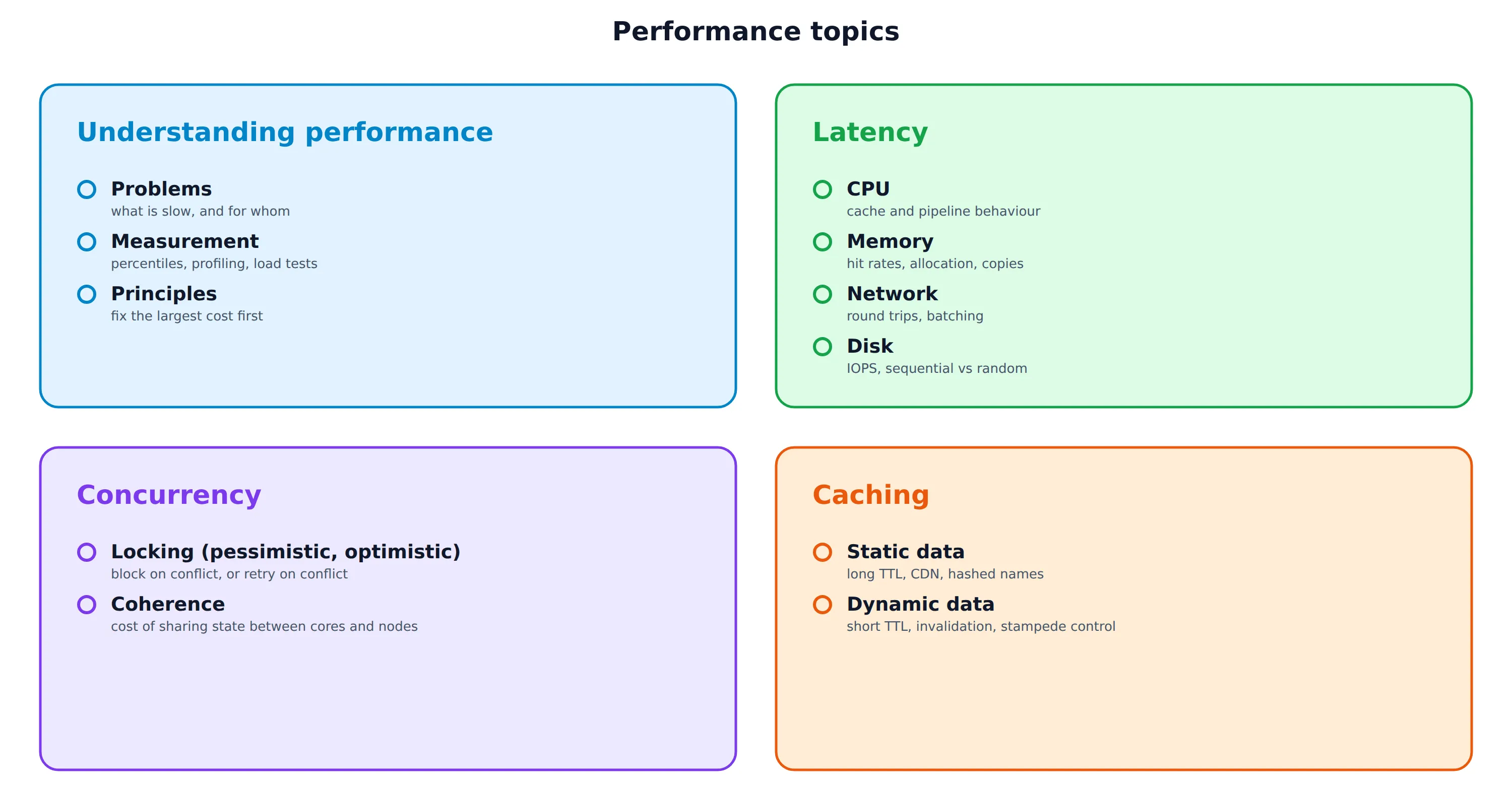
Optimise nothing until you can measure it. Track percentiles, not averages: the p99 of a service is what a user sees once they make a few dozen calls, and a fan-out that waits for 100 backends is dominated by the slowest of them. Profile in production-like conditions and fix the largest cost first.
Latency has a hierarchy
Orders of magnitude, on typical current hardware:
| Operation | Rough time |
|---|---|
| CPU cache hit | about 1 ns |
| Main memory access | about 100 ns |
| SSD random read | about 100 microseconds |
| Round trip inside a data centre | about 0.5 ms |
| Round trip between continents | about 100 to 150 ms |
| Spinning disk seek | about 10 ms |
Each layer is roughly 10 to 1000 times slower than the one above it. Most performance work is about avoiding a trip down the hierarchy: keep hot data in memory, batch network calls, avoid chatty protocols, and move data closer to users.
Concurrency
- Locking. Pessimistic locks assume conflict and block others, which is simple and safe under heavy contention. Optimistic concurrency assumes conflicts are rare, works without locks and retries on a version mismatch, which scales better when contention is low.
- Coherence cost. Sharing mutable state between cores or nodes costs cache-line bouncing or network round trips. Share less: partition the data, give each worker its own, and merge results.
- Event loops versus threads. Event-driven designs handle many idle connections cheaply but must never block. Thread-per-request designs are simpler but cost memory per connection.
Caching
A cache trades freshness for speed. Decide per data type:
| Data | Strategy | Watch out for |
|---|---|---|
| Static (assets, reference data) | Long TTL, CDN, content-hashed names | Invalidation on deploy |
| Dynamic (user data, query results) | Short TTL, write-through or explicit invalidation, per-key versions | Stale reads, thundering herd on expiry, cache stampede |
“There are only two hard things in computer science: cache invalidation and naming things.” Cache only what you can afford to see stale, and always have a plan for the cache being empty.
Data at Scale
Data decisions are the hardest to reverse, so make them with the most care.
Replication and consistency
Replication gives availability and read scale, and it forces a choice about consistency. In a network partition a system must choose between staying consistent (refusing some requests) and staying available (possibly returning stale data). This is the CAP trade-off. Even without a partition there is a latency-versus-consistency trade-off (PACELC).
| Model | What you get | Typical use |
|---|---|---|
| Strong (linearizable) | Every read sees the latest write | Money, inventory, locks |
| Eventual | Replicas converge if writes stop | Feeds, counters, caches |
| Causal / read-your-writes | Related operations are seen in order | User-facing sessions |
Choosing a store
| Need | Fits | Trade-off |
|---|---|---|
| Transactions, relations, ad-hoc queries | Relational database | Scaling writes beyond one node is hard |
| Huge key-value workloads with simple access | Key-value / wide-column store | Limited query model |
| Documents with flexible schema | Document store | Joins and cross-document transactions are weak |
| Full-text and analytics search | Search engine | Not a system of record |
| Time series (metrics, telemetry) | Time-series database | Specialised queries |
| Events as the source of truth | Append-only log | Rebuilding state means replaying |
Use one database that you understand well until it genuinely cannot cope. A polyglot system multiplies the operational burden.
Patterns
- CQRS and event sourcing: separate the write model from the read models, and store changes as events. Powerful, but a large step in complexity. Use it where history and audit really matter.
- Sagas: replace distributed transactions with a sequence of local transactions and compensating actions.
- Outbox pattern: write the data change and the outgoing event in the same local transaction, then publish from the outbox, so no event is lost.
- Schema evolution: make every change backward and forward compatible (add fields, never repurpose them) so old and new versions can run side by side.
Communication Between Components
| Style | Examples | Good for | Cost |
|---|---|---|---|
| Synchronous request / response | REST, gRPC | Queries, simple flows | Caller is coupled to the callee’s speed and availability |
| Asynchronous messaging | Queues, pub/sub | Spikes, retries, loose coupling | Eventual consistency, ordering, duplicates |
| Event streaming | Log-based brokers | Many consumers, replay, audit | Operating the platform, schema discipline |
| Local IPC | Unix sockets, message queues, shared memory | Processes on one machine | Limited to a single host (see IPC) |
Rules that prevent most integration pain:
- Define contracts first (an API schema or protocol definition) and version them.
- Assume at-least-once delivery and make consumers idempotent.
- Avoid distributed monoliths: services that must deploy together, or that call each other in long synchronous chains, have all the costs of microservices and none of the benefits.
Architecture Styles
| Style | Strength | Weakness | Choose it when |
|---|---|---|---|
| Layered monolith | Simple to build, test and deploy | Grows into a ball of mud without discipline | Small team, new product |
| Modular monolith | One deployable, but strict module boundaries | Needs enforced boundaries | Most teams, most of the time |
| Microservices | Independent deploy and scale per team | Distributed-system costs on every call | Many teams and clear domain boundaries |
| Event-driven | Loose coupling, easy fan-out | Harder to follow and debug | Many independent reactions to a change |
| Plug-in / hexagonal | The core is isolated from I/O and vendors | Extra indirection | Long-lived products with changing integrations |
Teams split into microservices too early more often than too late. Start with a modular monolith, draw boundaries along business domains (bounded contexts), and split a module out only when it needs its own scale, its own release cadence or its own team. Conway’s law is real: the system’s structure copies the organisation’s communication structure, so design both together.
Security by Design
- Least privilege for every service, user and key.
- Defence in depth: assume any single control will fail.
- Zero trust inside the network: authenticate and authorise every call, even between internal services.
- Secrets out of code: a secret store with rotation, never a repository or an image.
- Limit the blast radius: per-tenant isolation, scoped tokens, network segmentation.
- Secure the supply chain: pinned and scanned dependencies, signed builds.
- Threat-model early: list assets, trust boundaries and attackers, and rank the risks before the design is frozen.
Operability and Observability
A system you cannot see is a system you cannot run. Build observability in from the start:
- Metrics show the trend (rate, errors, duration for services; utilisation, saturation, errors for resources).
- Logs show the detail. Make them structured, and include a request ID.
- Traces show where the time went across services.
- Alerts page a human only for symptoms users feel, with a runbook attached. Alerting on every cause creates fatigue.
Deployments are part of the architecture:
- CI/CD with automated tests and a fast, boring release process.
- Progressive delivery: canary releases, feature flags and fast rollback limit the cost of a bad change.
- Infrastructure as code keeps environments reproducible.
- Chaos and game days prove that the failure handling you designed really works.
Choosing a Technology Stack
Technology choices outlive the people who made them. Ask:
| Question | Why it matters |
|---|---|
| Does the team already know it? | Skill is a bigger factor than benchmark numbers |
| How mature is the ecosystem and the community? | Libraries, hiring, answers at 3 a.m. |
| What is the operational cost? | Running it costs more than writing it |
| What are the licence and vendor risks? | Lock-in and support terms |
| How hard is it to replace? | Put the unstable choice behind an interface |
| Does it fit the failure model? | Memory safety, concurrency model, deployment size |
A good rule is to spend “innovation tokens” sparingly: pick boring, proven technology for the parts that are not your differentiator, and take risks only where the new technology gives a real advantage.
Record decisions
Keep a short Architecture Decision Record for each significant choice:
Title:        Use PostgreSQL as the system of record
Status:       Accepted
Context:      We need transactions, relations and ad-hoc reporting; load is under 5k writes/s.
Decision:     PostgreSQL with one primary and two read replicas.
Consequences: Strong consistency and simple queries; writes cannot scale past one node,
              so we will shard by tenant if we pass 20k writes/s.
Alternatives: A wide-column store (rejected: weak query model).
The point is the context and the consequences. A year later nobody remembers why, and the record answers it.
Case Study: A Layered Router Platform
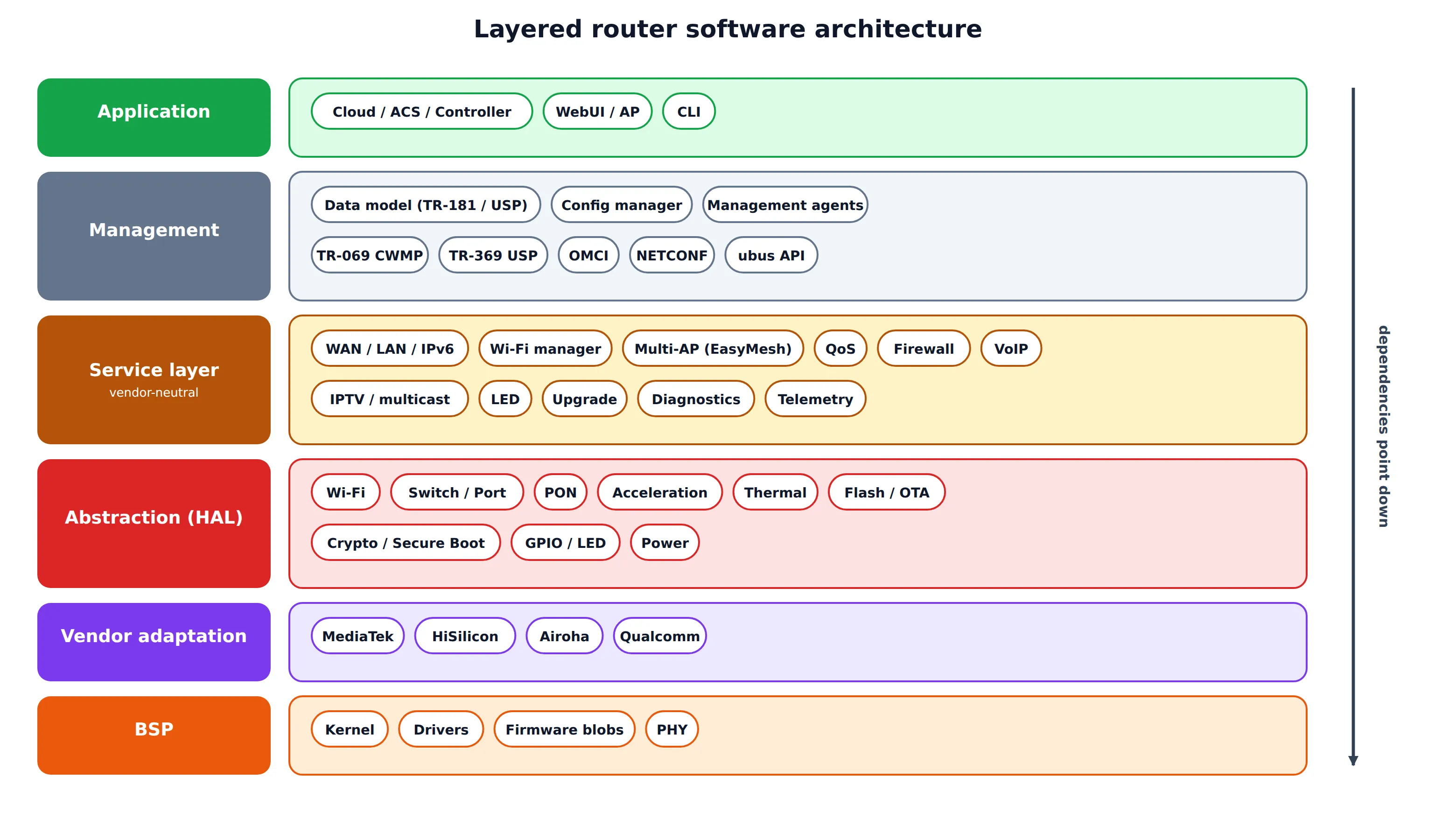
Not every large scale system lives in a data centre. A home or carrier gateway is a fleet problem: millions of devices, several chip vendors, years of firmware versions, and a cloud that must manage all of them. The architecture below is the layered model I use for router software:
| Layer | Responsibility | Why it exists |
|---|---|---|
| BSP | Kernel, drivers, firmware blobs, PHY | Everything tied to one chipset |
| Vendor adaptation | One adapter per SoC vendor (for example MediaTek, HiSilicon, Airoha, Qualcomm) | Confine vendor differences to one place |
| Abstraction (HAL) | Uniform interfaces for Wi-Fi, switch, PON, acceleration, thermal, flash/OTA, crypto and secure boot, GPIO/LED, power | Let upper layers ignore the chip |
| Service layer (vendor-neutral) | WAN/LAN and IPv6, Wi-Fi manager, Multi-AP (EasyMesh), QoS, firewall, VoIP, IPTV and multicast, LED, upgrade, diagnostics, telemetry | The product logic, written once and reused on every platform |
| Management | Data model (TR-181 / USP), configuration manager, management agents (TR-069 CWMP, TR-369 USP, OMCI, NETCONF, ubus API) | One way to configure and observe the device, whatever the protocol |
| Application | Cloud / ACS / controller, web UI, CLI | What operators and users touch |
The same principles from the rest of this post show up in a small form:
- Dependency direction. Dependencies point downwards, and only through interfaces. The service layer never calls a vendor SDK directly. This is the hexagonal idea: the business logic is isolated from I/O and vendors.
- A porting seam. Adding a new SoC means writing a vendor adapter and a HAL implementation. The service layer, the data model and the cloud do not change. That is what makes ten products on four chipsets possible with one team.
- One data model. A single TR-181 data model above the services lets TR-069, TR-369 and the web UI all drive the same configuration, so a fix in one place is a fix everywhere.
- Fleet operability. Remote upgrade (OTA) with rollback, staged rollout, telemetry and diagnostics are first-class services, because you cannot send an engineer to a million homes.
- Resource limits are real. A device with a few hundred megabytes of RAM and flash needs budgets for memory, CPU and storage, and it must keep forwarding traffic even when management is unhealthy. Separate the data plane (must never stop) from the control and management plane (can restart).
For concrete examples of the same layering, see how the Multi-AP stack is split into processes in prplMesh and how a Wi-Fi AP separates control from the data path in hostapd.
Common Anti-Patterns
| Anti-pattern | Symptom | Better |
|---|---|---|
| Premature microservices | Ten services, one team, constant cross-service bugs | A modular monolith |
| Distributed monolith | Services deployed in lock step | Fewer, larger services with stable contracts |
| Resume-driven design | The newest tool for a plain problem | Boring technology |
| Big-bang rewrite | Two systems, neither finished | Strangler pattern: replace piece by piece |
| Golden hammer | One database or framework for every job | Match the tool to the access pattern |
| No observability | Incidents debugged by guessing | Metrics, logs and traces from day one |
| Ignoring failure | Works in the demo, falls over in production | Timeouts, retries, degradation, game days |
| Architecture by committee | Nothing decided, or decided to please everyone | One accountable owner, written decisions |
A Practical Checklist
Before you approve a design, can you answer these?
- What are the top three quality attributes, in order, and what are their measurable targets?
- What is the expected load now and in two years, and what is the first bottleneck?
- What fails, and what does the user see? Walk through each dependency.
- What is the blast radius of a bad deploy and how fast can we roll it back?
- Where is the state, who owns it, and how is it backed up and restored?
- How do we change the data format without a flag day?
- How do we know it is healthy, and who gets paged when it is not?
- What is the cost to run it at the target scale?
- Which decision is hardest to reverse, and have we recorded why we made it?
Summary
- Architecture is trade-offs under constraints. Rank the criteria first: performance, scalability, reliability, security, development speed and technology stack. Then judge the design.
- Scale changes what is normal. Failures become routine and coordination becomes the cost, so design for failure and remove shared bottlenecks.
- Make the system stateless and partitioned, and use asynchronous work to absorb spikes.
- Treat availability as a budget, and use redundancy, failure domains, timeouts and graceful degradation to spend it wisely.
- Measure before you optimise, watch percentiles, and remember the latency hierarchy.
- Be most careful with data decisions. They are the hardest to reverse.
- Start simple: a modular monolith, boring technology, and written decisions. Split and specialise only for a measured reason.
- The same ideas work at every size, from a cloud service with millions of requests to a router platform with millions of devices.